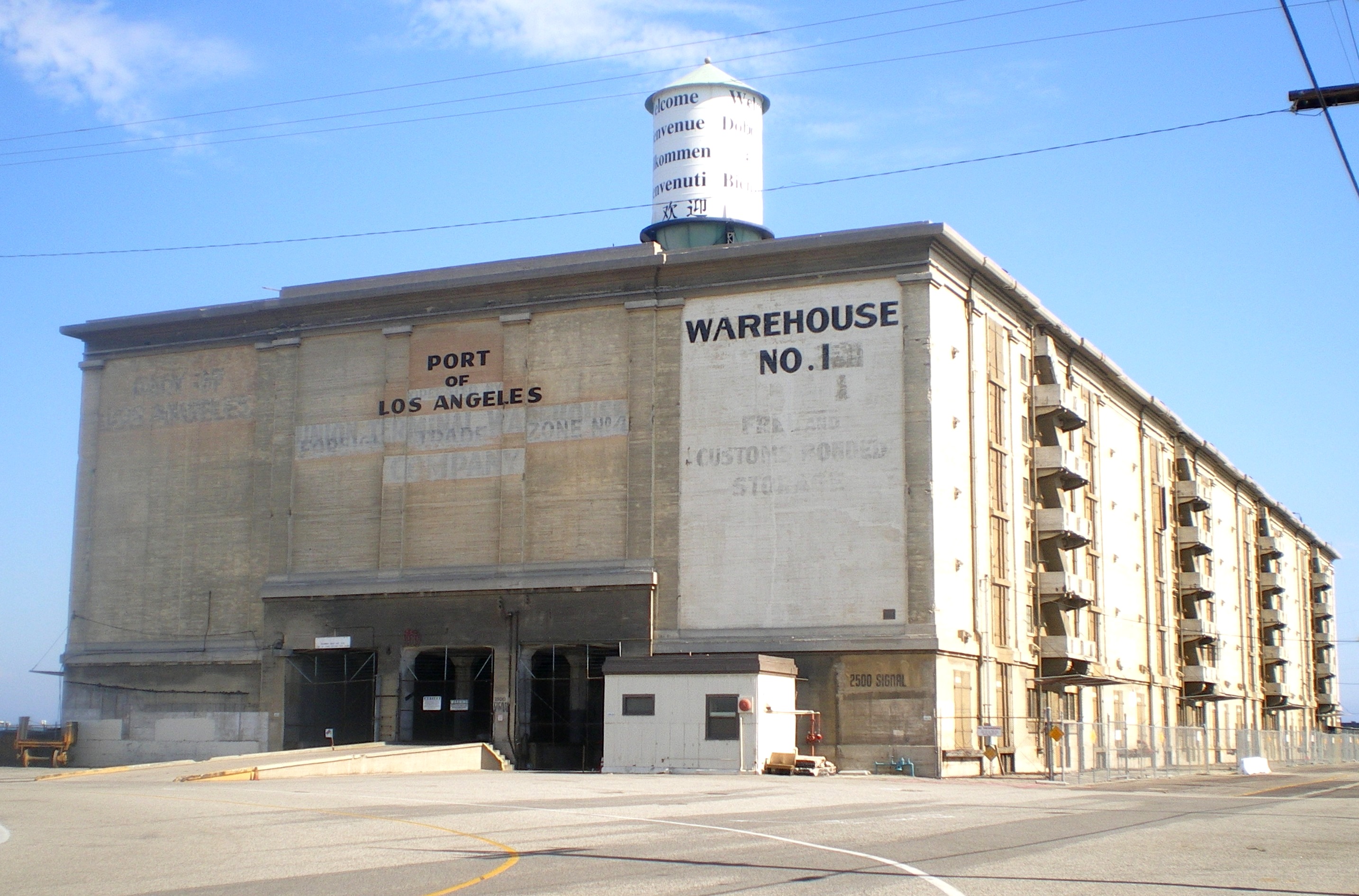
Municipal Warehouse No. 1
Three men worked in eight-hour shifts, climbing seven flights of stairs to reach the lookout station atop Municipal Warehouse No. 1. In a room with windows commanding every approach from the sea, they sat at a telescope on wheels that could be pointed in any direction with the touch of a finger. From 1928 onward, the Marine Exchange operated this perch above the harbor, tracking every vessel that entered or left the Port of Los Angeles. The warehouse beneath them - six stories of reinforced concrete built on more than 3,000 wooden piles - represented Los Angeles's audacious bet that the Panama Canal would transform it into a Pacific trade powerhouse.
Sea Caravans and Ambition
The Panama Canal opened in August 1914, and Los Angeles business leaders saw destiny arriving. If modern port facilities could be built, they believed, the world's commercial fleet would descend on their harbor. World War I postponed these plans, but ambition remained undimmed. By late 1914, foundation tests were underway for what Chief Harbor Engineer S.A. Jubb called the 'mammoth new warehouse.' The Los Angeles Times noted that while the structure's massiveness precluded architectural beauty, considerable study had been given to cornice and wall panels to achieve 'as pleasing and symmetrical an effect as is consistent with the purposes and proportions of the building.'
The Largest West of Chicago
When completed in April 1917, Municipal Warehouse No. 1 stood as the largest structure of its kind west of Chicago. Its nearly twelve acres of floor space could accommodate the goods of countless merchants and manufacturers. Sixteen electric hoists conveyed freight to the various lofts. Railroad tracks ran directly into the basement, where elevators brought goods down to loading platforms for shipment across the nation. The building was designed for efficiency at every level - quite literally, as the interior arcade had room for 24 freight cars at once. The contract went to the Merchants' Realty and Investment Company, though not without labor strife: 'unionites' immediately threatened to 'make trouble for the contractor.'
Eyes Above the Harbor
The warehouse's commanding position made its roof invaluable. The Marine Exchange began operating there in the early 1920s, providing lookout reports on ships entering and leaving port. In 1925, the Radio Corporation of America established its harbor receiving station atop the massive structure. A new four-room lookout station was built in 1928, featuring a large circular window for telescopes and a neon red beacon that cast a red glow over the building at night. The Los Angeles Times described the Exchange in 1939 as 'a world all its own up there on Warehouse No. 1.' In 1964, a new perch was constructed for the watchmen who continued their vigil over the harbor's comings and goings.
Foreign Island
World War II brought the U.S. Navy, which used the warehouse as a supply depot. After the war, Municipal Warehouse No. 1 embarked on a strange new chapter. From 1949 to 1956, it became Foreign Trade Zone 4 - in effect, a 'foreign island' or 'free city' within American borders. Goods could be imported here, manipulated, sorted, graded, inspected, and re-exported without paying duties unless they entered the United States for domestic distribution. Following the success of similar zones in New York, New Orleans, and San Francisco, Los Angeles had created its own duty-free enclave at the harbor's edge.
Landmark Recognition
The decorative faces that adorn the warehouse's exterior - dozens of them, gazing out over the harbor - hint at the pride its builders took in what might otherwise have been merely a 'gigantic fireproof box.' In 2000, Municipal Warehouse No. 1 was listed on the National Register of Historic Places, recognized for its contributions to international trade and commerce along the Pacific Coast. The building still serves as a visual landmark for ships entering the port, just as it did when the first lookouts climbed to its roof a century ago, searching the horizon for the sea caravans that would make Los Angeles a crossroads of world trade.
From the Air
Located at 33.72N, 118.27W at the outermost point of land on the main channel of the Port of Los Angeles. The six-story reinforced concrete warehouse is distinctive among the port structures. Best viewed at 1,500-2,500 feet. The building sits at the seaward end of the outer harbor dock. Nearby airports include Long Beach (KLGB) and Torrance (KTOA). The Vincent Thomas Bridge and Terminal Island provide useful visual references.