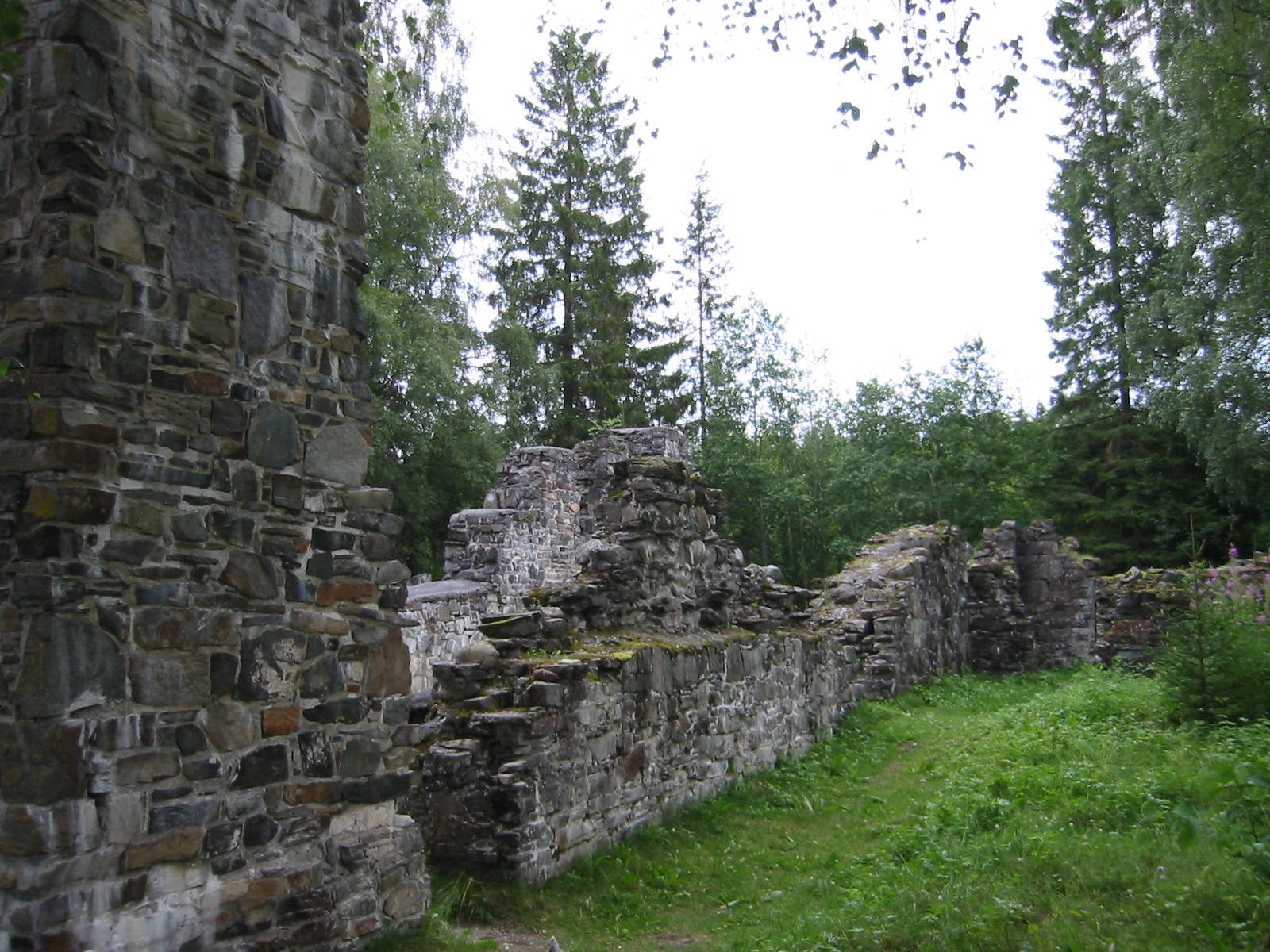
Munkeby Abbey
For centuries, the farmers around Okkenhaug in Trondelag knew that their chapel had once belonged to monks. Historians dismissed the claim -- until 1906, when a letter dated 1475 from Pope Sixtus IV turned up in the Vatican archives, requesting that the monastery at Munkeby be restored as a functioning house. The name had been telling the truth all along: Munkeby, in Norwegian, means Place of the Monks. What the archives confirmed was the existence of the most northerly Cistercian foundation ever established, a monastery planted at 63 degrees north latitude sometime between 1150 and 1180, where white-robed monks lived, prayed, and farmed in a landscape of long winters and brief, luminous summers.
Brothers at the Edge of the World
The Cistercians were not timid builders. From their mother house at Citeaux in Burgundy, they spread across medieval Europe with a discipline that prized manual labor, simplicity, and remote locations. Munkeby fit the pattern perfectly -- isolated, challenging, and far from the distractions of towns. The founding monks may have been English, as was the case with Hovedoya Abbey near Oslo and Lyse Abbey near Bergen. They built their church in stone, sturdy enough to survive centuries, while the surrounding monastic buildings were constructed of wood. For a few decades, this small community thrived at the northern frontier of European monasticism, tending their fields in the shadow of the Trondelag hills.
Absorbed and Forgotten
In 1207, a new Cistercian house was founded on the island of Tautra in the Trondheimsfjord. At some point during the 13th century, Munkeby's community and assets were transferred to Tautra, and the abbey was reduced to a grange -- a monastic farm, still owned by the order but no longer an independent house. The church, however, continued serving the local parish until 1587. An attempt in the 1470s to re-establish Munkeby as a full monastery failed -- the very effort that Pope Sixtus IV's letter addressed. When Norway officially adopted Lutheranism in 1537, all Catholic religious houses became Crown property, and Munkeby's monastic identity was formally extinguished. The wooden buildings succumbed to fire in 1567. Only the stone walls of the church remained, slowly weathering into the landscape.
Ruins Reclaimed
The Society for the Preservation of Ancient Norwegian Monuments acquired the site in 1967, but no full archaeological excavation has ever been carried out. Partial digs, including test excavations in 2000, have failed to locate significant remains of the monastic buildings, though their position south of the church is not in doubt. What survives is the stone skeleton of the simple church itself, its walls still standing despite centuries of use as a quarry. The ruins sit in quiet farmland, largely unvisited, a place where the scale of medieval ambition is measured in rough-cut stone and the silence of an empty nave.
The Monks Return
In 2007, the Trappist Abbey of Citeaux in France -- the spiritual descendant of the very order that founded Munkeby -- decided to establish a new monastery near the medieval ruins. Four monks took up residence in 2009 at Munkeby Mariakloster, built about 1.5 kilometers from the original site. The Trappists are a reformed branch of the Cistercians, and their return to Munkeby closes a circle that stretches across 800 years. They now form a companion community to Trappistine nuns who have resettled the site of the former Tautra Abbey on its island in the fjord. Where the medieval monks once farmed and prayed at the edge of the known world, their modern successors do the same -- rising before dawn, keeping silence, producing cheese and bread. The Place of the Monks has earned its name once more.
From the Air
Located at 63.73N, 11.39E near Okkenhaug in Levanger Municipality, Trondelag, Norway. The ruins and modern monastery sit in open farmland about 5 km east of the town of Levanger. Nearest major airport is Trondheim Airport, Varnes (ENVA), approximately 65 km to the south. At 1,500-3,000 feet AGL, the stone ruins of the medieval church are distinguishable in the pastoral landscape. The modern Munkeby Mariakloster is visible as a newer building complex roughly 1.5 km from the ruins.