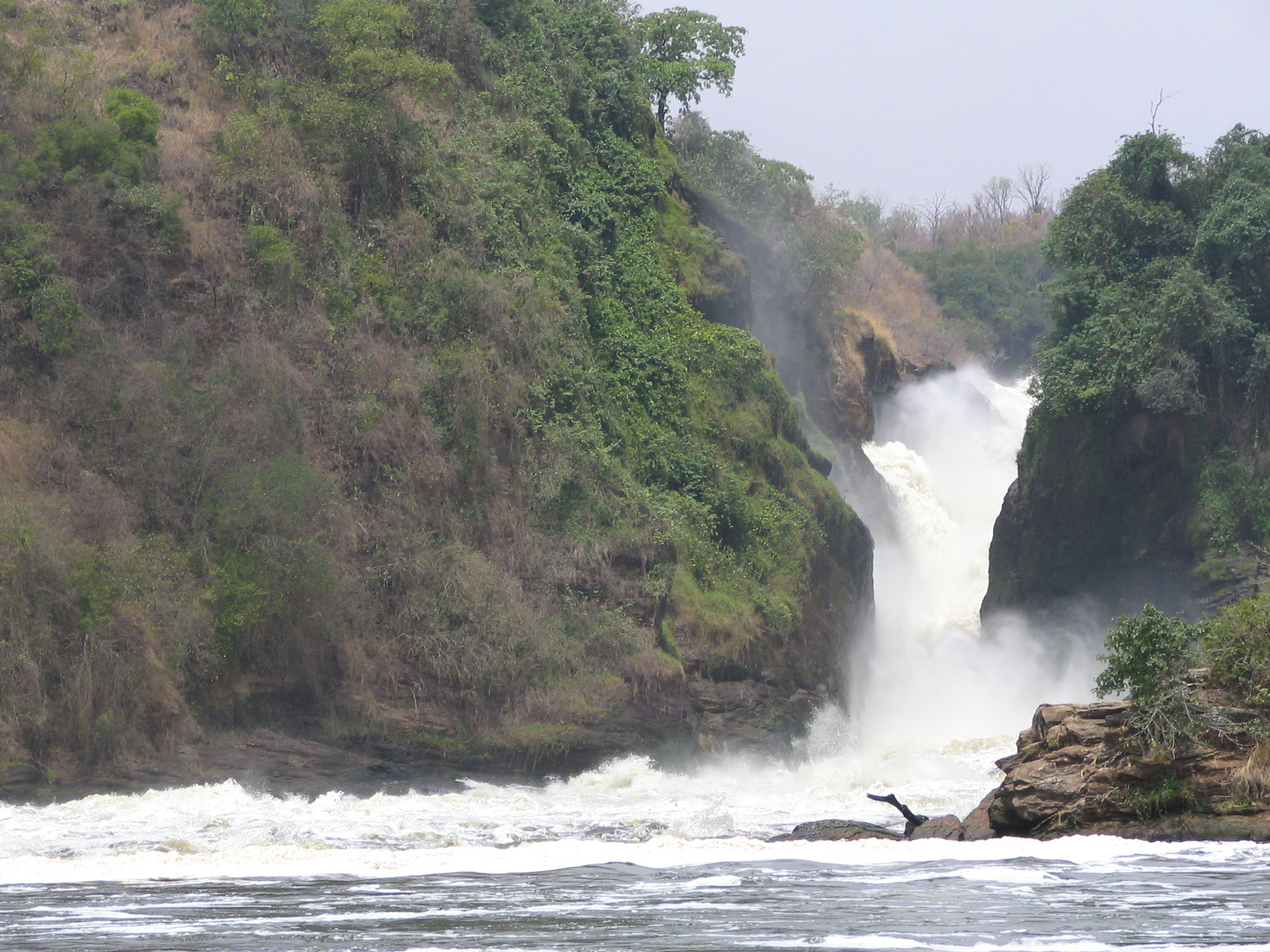
Murchison Falls National Park
The entire Nile River -- every cubic meter of it that has traveled from Lake Victoria across Uganda -- forces itself through a crack in the rock seven meters wide. Then it falls. The explosion of water at Murchison Falls is not the tallest waterfall in Africa, not by a long way. The drop is only 43 meters. But what the falls lack in height, they compensate for with sheer, compressed violence: up to 300 cubic meters per second detonating through a gap barely wider than a living room. The mist that rises from the base hangs permanently in the air, feeding rainbows and drenching the riverbanks where hundreds of hippos wallow and Nile crocodiles slide into the current. Samuel Baker, the explorer who named these falls in 1864 after Roderick Murchison, president of the Royal Geographical Society, called the sight one of the greatest spectacles he had ever witnessed.
Where the Nile Breaks Through
Murchison Falls National Park sprawls across 3,840 square kilometers of northern Uganda, part of the Albertine Rift system. The White Nile bisects the park from east to west before turning north to meet Lake Albert. The falls themselves sit at a point where the river narrows dramatically, channeled by the geology of the rift into that improbable seven-meter cleft. Adjacent to the main falls, Uhuru Falls -- "uhuru" meaning freedom in Swahili -- broke through the rock in 1962, the year Uganda gained independence, as though the landscape itself had something to say about the occasion. A boat cruise from the downstream landing stage to the base of the falls is the park's signature experience: two to three hours of gliding past elephants drinking at the water's edge, pods of hippos surfacing and snorting, and crocodiles basking on sandbanks, the roar of the falls growing louder with every bend in the river.
The Prehistoric Bird in the Papyrus
At the opposite end of the park from the falls, where the Victoria Nile spreads into the delta at the northern tip of Lake Albert, a different kind of spectacle awaits. The delta is a maze of papyrus-fringed channels and floating islands, and somewhere among them stands the shoebill stork. There is no bird on Earth that looks more like a dinosaur forgot to go extinct. Standing over a meter tall, grey-blue and motionless, the shoebill hunts by waiting -- sometimes for hours -- then striking with a bill shaped like a Dutch clog to seize lungfish and frogs from the murky water. Spotting one requires a dedicated delta cruise in the opposite direction from the falls. The park's broader bird count exceeds 450 species, making it one of the richest birding sites in East Africa, but the shoebill is the one that draws people to the delta and keeps them scanning the papyrus edges with binoculars long after their arms ache.
Rothschild's Last Stand
The savanna north of the river hosts game drives along the Buligi circuit, where the wildlife roster reads like a field guide to the East African plains: lion, leopard, elephant, buffalo, and Uganda kob graze and hunt across open grassland and woodland. But Murchison Falls holds particular significance for one species. The Rothschild's giraffe, distinguished from other giraffe subspecies by its cream-colored legs and the absence of markings below the knee, is endangered across its range. Murchison Falls is one of the last strongholds where these animals can be seen in meaningful numbers. Jackson's hartebeest, Defassa waterbuck, and the small, elegant oribi round out the antelope population. The park endured heavy poaching during Uganda's civil conflicts in the 1970s and 1980s, when Idi Amin's soldiers and subsequent militias decimated wildlife populations. Recovery has been slow but visible, and the fact that these animals are here at all is a testament to decades of conservation work.
Chimpanzees in the Southern Forest
South of the Nile, the landscape shifts from savanna to dense tropical forest. Budongo Forest Reserve, which merges into the park's southeastern boundary, harbors one of Uganda's largest chimpanzee populations. Guided chimp-tracking walks depart early in the morning, following habituated groups through the understorey as they forage, groom, and occasionally erupt into the screaming displays that remind visitors these are wild animals, not attractions. Black-and-white colobus monkeys and olive baboons are also common in the forest canopy. The transition from forest to savanna -- visible within a single game drive -- illustrates the ecological diversity that makes Murchison Falls unusual among African parks. It is not a single-biome destination. The forest, the river, the delta, and the open plains each offer distinct encounters, connected by the thread of the Nile flowing through it all.
Getting to the Edge
Reaching Murchison Falls requires commitment. The park lies roughly 300 kilometers northwest of Kampala, accessible via Masindi, the nearest town of any size. There is no public transport inside the park; visitors arrive by organized safari, private vehicle, or light aircraft to Pakuba or Chobe airstrips within the park boundary. The Paraa Ferry crosses the Nile inside the park, connecting the southern and northern sectors. Roads are unpaved and require four-wheel drive, especially after rain. The remoteness is part of the appeal. Uganda markets itself as off the beaten path compared to Kenya and Tanzania, and Murchison Falls is off the beaten path even by Ugandan standards. The wildlife encounters tend to be more intimate, the crowds thinner, the sense of wilderness more genuine. For those willing to make the journey, the reward is standing at the top of the falls, feeling the ground vibrate beneath their feet, watching the Nile squeeze through its impossible gap and explode into mist.
From the Air
Located at 2.37N, 31.82E in northern Uganda. The Nile River bisecting the park is clearly visible from altitude as a silver ribbon cutting through green-brown savanna. Murchison Falls itself is identifiable by the persistent mist plume at the narrow gorge. The park covers 3,840 km2. Nearest airports: Pakuba Airstrip and Chobe Airstrip within the park accommodate light aircraft. Entebbe International Airport (ENBB) is approximately 300 km southeast. Lake Albert forms the park's western boundary. Expect cumulus buildup over the rift valley most afternoons.