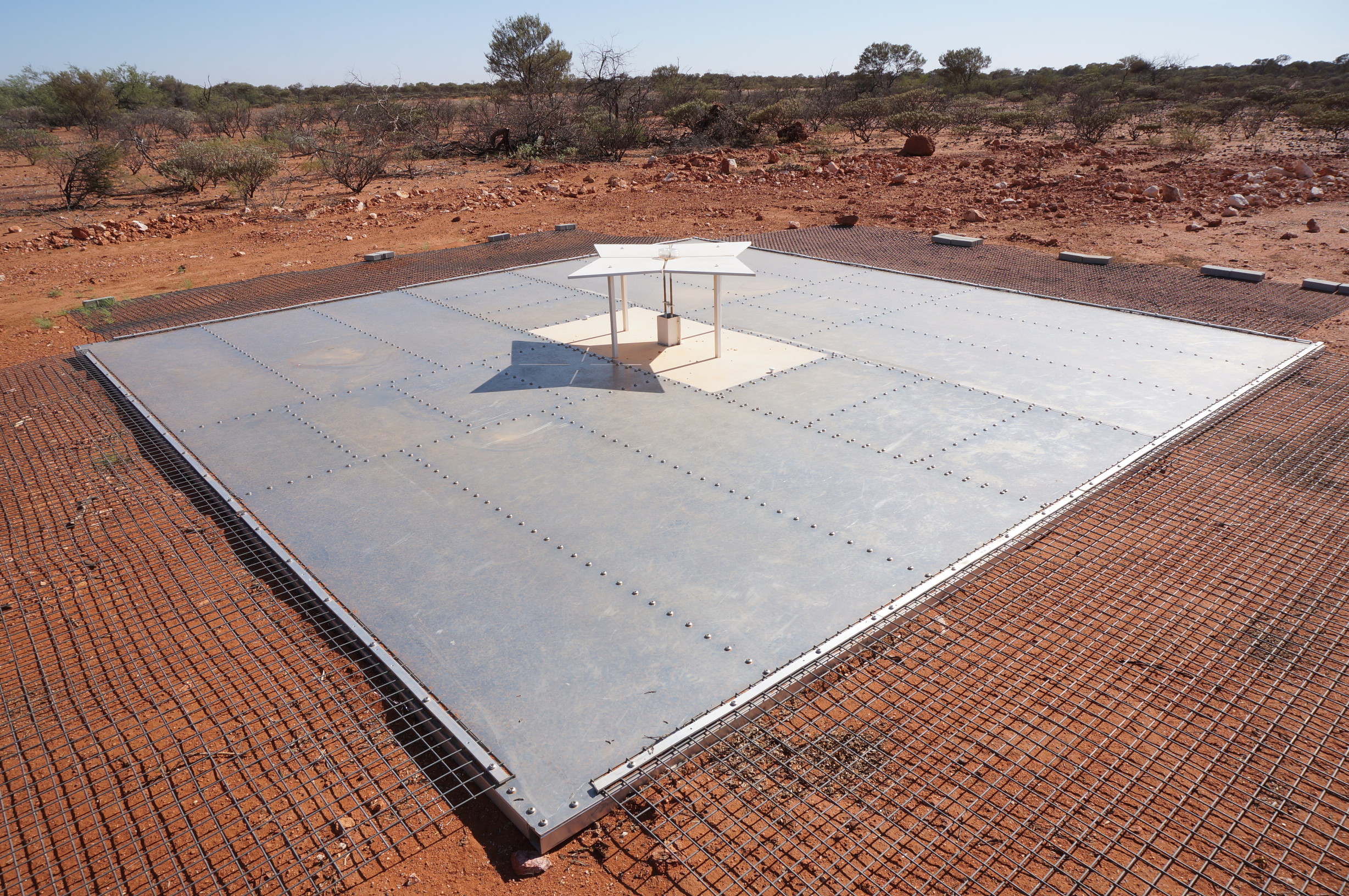
Murchison Radio-astronomy Observatory
You cannot make a phone call here. You cannot turn on a television, key a CB radio, or use a wireless router. Within a 70-kilometre radius of the Murchison Radio-astronomy Observatory, nearly every device that emits radio waves is prohibited. Within 150 kilometres, they require special approval. The coordination zone extends to 260 kilometres. This is not a security measure. It is a scientific one. The telescopes at this site are listening for signals so faint that a mobile phone on the Moon would register as one of the brightest objects in the radio sky.
Boolardy's Transformation
The observatory began its life in 2009 near Boolardy Station, a former cattle station in the Murchison Shire of Western Australia, roughly 800 kilometres north of Perth. CSIRO, Australia's national science agency, chose the site for its extraordinary radio quietness -- a product of sparse population, flat terrain, and immense distance from the electromagnetic noise of cities. The Australian Communications and Media Authority had designated it a protected radio quiet zone in April 2005. By 2012, two major instruments were operational: the Australian Square Kilometre Array Pathfinder (ASKAP), an array of 36 parabolic dishes, and the Murchison Widefield Array (MWA), a low-frequency array of hundreds of antenna tiles spread across the outback floor.
Sharing Sky and Stars
In 2022, the observatory expanded dramatically -- growing 27 times larger than its original footprint -- to accommodate the SKA-Low telescope, the Australian component of the international Square Kilometre Array project. The expanded site was formally named Inyarrimanha Ilgari Bundara, meaning 'sharing sky and stars' in the Wajarri language. The Wajarri Yamatji people are the traditional custodians of this land, and the name reflects both their deep connection to the sky and the collaborative agreement that made the expansion possible. Construction of the SKA-Low telescope began on 5 December 2022, with a ceremony marking the occasion. When complete, it will comprise 131,072 antennas spread across 74 kilometres of outback, forming one half of the most sensitive radio telescope ever built.
Listening at the Edge of Time
The instruments at the observatory pursue different questions at different wavelengths. ASKAP, with its innovative phased-array feeds, surveys the sky rapidly and has already mapped millions of galaxies. The MWA operates at lower frequencies, between 70 and 300 MHz, hunting for the faint hydrogen signal left over from the Epoch of Reionization -- the period roughly 13 billion years ago when the first stars and galaxies switched on and transformed the universe from opaque to transparent. Smaller experiments round out the site's work. The EDGES experiment, developed by MIT's Haystack Observatory and Arizona State University, measures the sky's brightness temperature to detect the global signature of Cosmic Dawn. Together, these instruments make the Murchison observatory one of the most scientifically productive radio astronomy sites on Earth.
The Cost of Quiet
Radio silence comes with consequences for the people who live nearby. The Wajarri Yamatji communities have felt the loss of seasonal cattle mustering work, reduced pest control, and fewer community activities since the observatory's establishment. CSIRO and the Australian Government have worked with the Wajarri through an Indigenous Land Use Agreement, but the transition has not been frictionless. The neighbouring Wooleen Station has developed guest facilities and is exploring tourism potential with local governments. An interpretive centre near the Murchison Settlement, 100 kilometres from the observatory, has been proposed as a way to share the site's significance with visitors. As of 2020, CSIRO and the shire council were investigating internet connectivity options -- a small mobile network or optical fibre -- to bridge the digital isolation that radio quiet enforcement imposes on surrounding communities.
A Cathedral of Emptiness
From the air, the observatory is almost invisible. The antenna dishes and tile arrays are scattered across terrain so flat and so vast that they register as specks. There are no tall buildings, no fences worth noticing, no roads that stand out against the red-brown earth. What distinguishes this place is what it lacks: the electronic hum that blankets every other inhabited corner of Australia. In that absence, the universe becomes audible. Signals from galaxies billions of light-years away arrive here without competition, their faint whispers preserved by the emptiness that most people would call nothing at all. The Wajarri knew this sky long before any telescope was built. Now the instruments are catching up.
From the Air
The Murchison Radio-astronomy Observatory is located at approximately 26.70S, 116.67E in the Murchison Shire of Western Australia, about 800 km north of Perth. From altitude, the antenna arrays appear as small clusters against flat red-brown scrubland. The site is within a protected radio quiet zone -- pilots should be aware of restrictions on radio emissions. Meekatharra Airport (ICAO: YMEK) is the nearest significant airfield, roughly 200 km to the southeast. Geraldton Airport (ICAO: YGEL) is about 370 km to the southwest. Terrain is flat with unrestricted visibility in clear conditions.