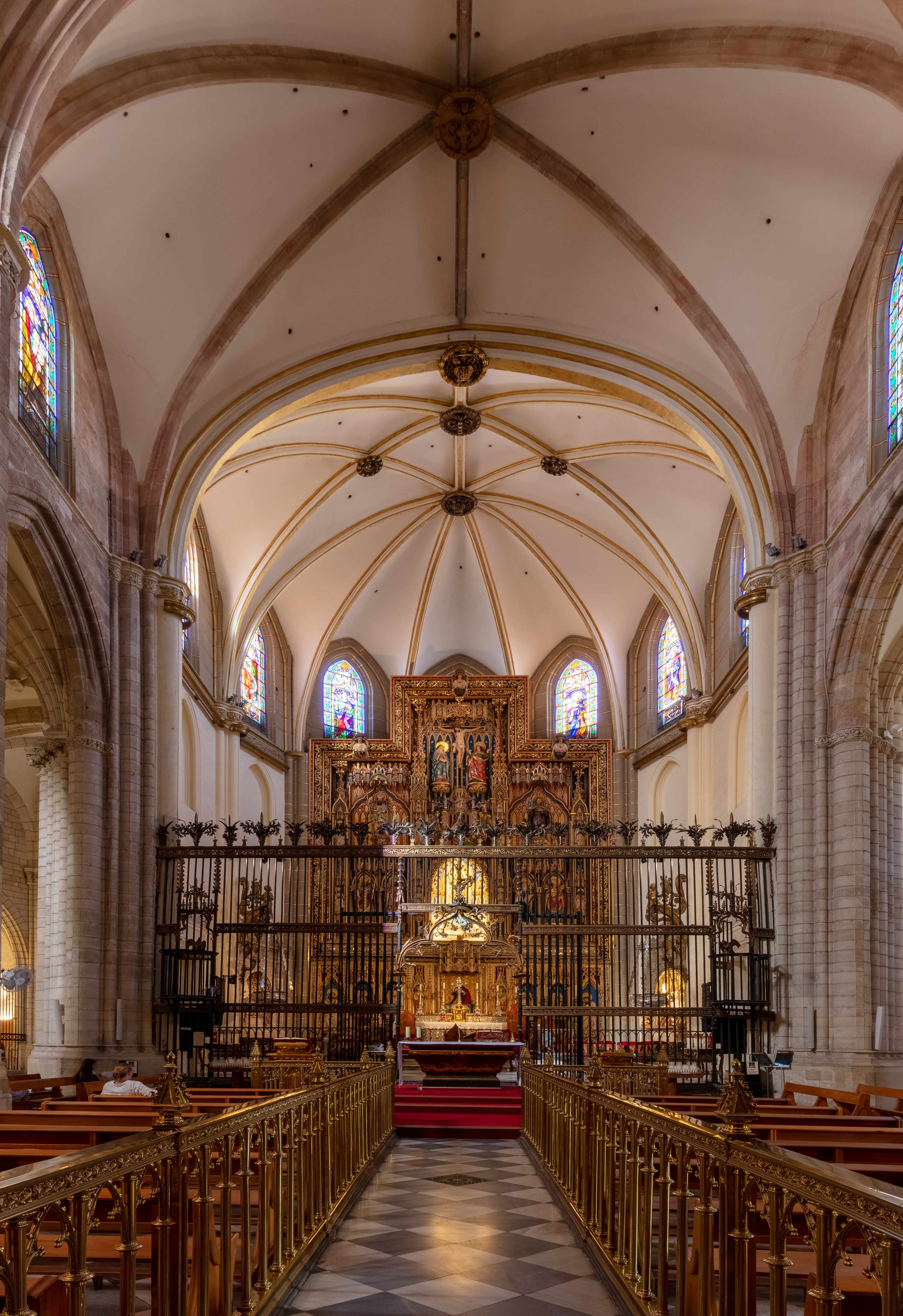
Murcia Cathedral
Beneath the main altar of Murcia Cathedral lie the heart and entrails of King Alfonso X, known as "the Wise." His body rests in Seville, his brain in a chapel in Murcia, but his heart he willed to this cathedral -- a gift, he wrote in his testament, as proof of his love for the city and in thanks for the fidelity Murcia had shown him. It is the kind of detail that captures this building's character: a place where the monumental and the intimate coexist, where a 90-meter bell tower -- among the tallest in Spain -- rises above side chapels dedicated to the patron saints of medieval labor guilds.
From Mosque to Cathedral
When King Jaime I the Conqueror took Murcia during the Mudejar revolt of 1264-66, he followed his customary practice: he seized the city's Great Mosque and consecrated it to the Virgin Mary. But the transformation from mosque to cathedral took more than a change of name. Construction of the new building did not begin until 1385, when work started on the foundations. The first stone was laid in 1388, followed by six years of delay before walls began to rise. The cathedral was completed in October 1467 -- nearly a century of construction that resulted in a primarily Gothic interior. But the building kept evolving. The Baroque main facade, designed by Valencian architect Jaume Bort i Melia, was added centuries later, creating a deliberate contrast between the restrained Gothic interior and the exuberant exterior that greeted visitors in the plaza.
The Tower That Took 270 Years
The bell tower is Murcia Cathedral's most visible feature and one of Spain's tallest campaniles, standing 90 meters high -- 95 with the weathervane. Construction began in 1521 and was not completed until 1791, a span of 270 years that produced a tower combining Renaissance, Baroque, Rococo, and Neoclassical elements across its five ascending levels. Francisco and Jacobo Florentino designed the first level in Renaissance style with Plateresque ornamentation. Jerónimo Quijano continued in a more austere Renaissance mode. The upper levels shift to Baroque, with a Rococo body and a neoclassical cupola designed by Ventura Rodriguez. At the fourth level, four conjuratories occupy the corners -- small chambers where priests conducted special ceremonies using the Lignum Crucis to ward off the storms that threatened Murcia's low-lying agricultural plain.
Twenty-Five Bells, Each With a Name
Twenty-five bells hang in the tower, all dating from the 17th and 18th centuries, each bearing its own name and history. La Campana Mora -- the Moor Bell -- is the oldest, a 14th-century survivor now preserved in the Cathedral Museum rather than the tower itself. The main bell, the Agueda-Martillo, anchors the ensemble. Others carry names that reveal their purposes and personalities: the Bell of the Spells, La Catalana, the Bell of Prayer, La Fuensanta, the Conception, La Segundilla. For centuries, these bells served as the city's communications system, warning of catastrophic floods from the Segura River, announcing wars, marking celebrations and feast days. The relationship between the bells and the river was particularly urgent in a city built on a floodplain where the Segura regularly burst its banks.
Chapels of Power and Devotion
The interior consists of three naves with an apse and twenty-three side chapels, each a miniature world of patronage and devotion. The Vélez Chapel, in the apse, is a masterpiece of Flamboyant Gothic, its cupola decorated with ten-pointed stars. The Chapel of Junterones is considered one of the finest examples of the Spanish Renaissance. The Chapel of the Immaculate offers Baroque richness. The chapels were dedicated to the patron saints of the city's labor guilds and to the bishops and nobles who funded the cathedral's construction -- a reminder that medieval cathedrals were collaborative enterprises, shaped by the intersection of sacred purpose and secular ambition. In 1854, a devastating fire destroyed the high altar and choir stalls, prompting repairs that included a new neo-Gothic altarpiece, a majestic organ by the Belgian firm Merklin-Schütze, and 16th-century Plateresque choir chairs donated by Queen Isabel II from the Monastery of Santa Maria de Valdeiglesias.
Faces in Stone
The exterior rewards careful examination. The Door of the Apostles, constructed in 1488 by Diego Sánchez de Almazán in Gothic style, frames sculptures of four apostles in its jambs and bears a shield honoring Queen Isabella the Catholic. The Chapel of the Marquess of Vélez projects outward with a polygonal plan adorned with the heraldic shields of the Chacon and Fajardo families. The Door of the Chains combines 16th- and 18th-century elements with reliefs of Saints Leandro, Isidoro, and Fulgencio. But it is Bort's main facade that dominates -- a Baroque composition of exceptional complexity and beauty, conceived as a single sculptural statement exalting the Virgin Mary. Built with the support of Cardinal Belluga, it remains one of the most photographed architectural surfaces in southeastern Spain, its carved stone figures and ornamental scrollwork catching the light differently at every hour of the day.
From the Air
Located at 37.98°N, 1.13°W in central Murcia, southeastern Spain. The cathedral's 90-meter bell tower -- Spain's tallest -- is an unmistakable landmark from the air. Nearest airport: LEMI (Region of Murcia International Airport), approximately 30 km south. Best viewed at 3,000-6,000 ft AGL, where the tower's height relative to the surrounding city is most dramatic.