Murder of Derk Wiersum
It was 7:40 in the morning on Wednesday, 18 September 2019. Derk Wiersum had two children to get to school, a law practice he had founded six months earlier, and a state witness he was representing in the biggest organized-crime trial in Dutch history. He walked from his house on the Imstenrade in Buitenveldert, a quiet residential neighborhood in the south of Amsterdam, and unlocked his car. A man in a black hoodie stepped out from the driver's side and pulled the trigger. The gun jammed. The shooter ran. Wiersum, who was 44 years old, chased him. A witness fifteen meters away heard the lawyer shouting at his attacker - phrases the witness later quoted as 'piss off' and 'goddamnit.' The shooter turned, the gun worked the second time, and Wiersum was hit ten times in the head, neck, and upper body. He died on the pavement of his own street. A white Opel Combo pulled away with the shooter inside; a second man was at the wheel.
Who He Was
Derk Wiersum was born in Amsterdam on 30 August 1975. He studied criminal law at the University of Groningen, was sworn in as a lawyer in 2003, and worked first at Van Gessel Advocaten and then at Blaauw Advocaten before opening his own firm in March 2019. He served as a deputy judge in Breda. He was the treasurer of a now-dissolved foundation that provided legal aid to people on death row abroad, and he worked with Dutch & Detained, which represents Dutch nationals imprisoned in foreign countries. Colleagues described him as someone who, in the words of one association, 'stood by the underdog.' He was married to Arjette Wiersum. They had two children. He had been representing the state witness Nabil B. in the Marengo trial since 2017.
The Trial He Was Working On
The Marengo case is the trial of sixteen men accused of multiple murders and attempted murders carried out between 2015 and 2017 by an organization Dutch media call the Mocro Maffia - a loose network of largely Moroccan-Dutch organized crime groups headquartered in and around Amsterdam. The lead defendant is Ridouan Taghi, a fugitive on Interpol's most-wanted list who was finally captured in Dubai in December 2019, three months after Wiersum's death. The witness Wiersum represented, Nabil B., had agreed to testify in exchange for a halved sentence. A week after his cooperation became public in 2018, his brother Reduan B. - who had nothing to do with the case - was shot dead. Wiersum took on Nabil B. knowing that the witness was on a death list. He did not have personal security. Defense lawyers in the Netherlands traditionally have not needed it.
The Hunt for the Killers
On 1 October 2019, two weeks after the murder, police arrested a man at Schiphol Airport as he was about to board a flight to Suriname. He was later identified as Giermo Brown, 36, from Almere, where the getaway car had been recovered. On 20 November they arrested 26-year-old Anouar Taghi, a cousin of Ridouan Taghi from Maarssen, on suspicion of organizing the murder; he had been part of an Utrecht gang that robbed ATMs with explosives. On 27 January 2020 they arrested Moreno Bieseswar, 31, from Rotterdam, on suspicion of being the shooter. Both Brown and Bieseswar were described in court documents as having intellectual disabilities. Brown was a father of six. Bieseswar had two children. The Marengo organization, prosecutors argued, had picked people on the margins of society to do the work and shielded the leaders. In October 2021, Brown and Bieseswar were each sentenced to 30 years in prison. The prosecution sought life. They appealed; so did the defense. In January 2023 the appeals court was still hearing argument.
What Came After
The killing did not stop the trial. The lawyer who succeeded Wiersum withdrew within months, citing inadequate security. Two anonymous replacements took over and then quit. By June 2020, Peter Schouten had taken over as Nabil B.'s lead lawyer; the journalist Peter R. de Vries had agreed to act as the family's confidential counselor and spokesman. In December 2020 the Dutch national counterterrorism coordinator informed Schouten and his colleague Onno de Jong that they were on a death list. They kept working. On 6 July 2021, twenty-two months after Wiersum's death, Peter R. de Vries was shot in the head as he left an Amsterdam television studio on the Lange Leidsedwarsstraat. He died on 15 July. A suspect linked to Ridouan Taghi was arrested within hours. Between 20 and 30 people connected to the Marengo case now receive state protection, from the kind of cameras-and-extra-patrols arrangement at the lower end to the Royal and Diplomatic Protection Service - the same service that guards the Dutch royal family - at the upper end. Judges and prosecutors are protected. So are some of their families.
What the Country Learned
The Netherlands had until 2019 considered itself one of the safer rule-of-law democracies in Europe. The murder of a lawyer for doing his job was, in the words of the then-Minister of Justice Ferdinand Grapperhaus, 'an attack on our rule of law' - and the words were not rhetorical. Police chief Erik Akerboom said publicly that 'a new limit has been crossed: now even people simply doing their work no longer seem safe.' Prime Minister Mark Rutte called organized crime 'a complicated fight, but one that we can win,' a sentence that read differently after de Vries was killed two years later. A widow lost a husband. Two children lost their father. A lawyer who had spent his career standing up for unpopular clients was killed at his own car on a quiet street. The trial Wiersum was working on convicted Ridouan Taghi of murder, ordering murder, and leading a criminal organization on 27 February 2024; he was sentenced to life in prison. The first hearing without Derk Wiersum in court took place the morning after his death. The state witness kept testifying.
From the Air
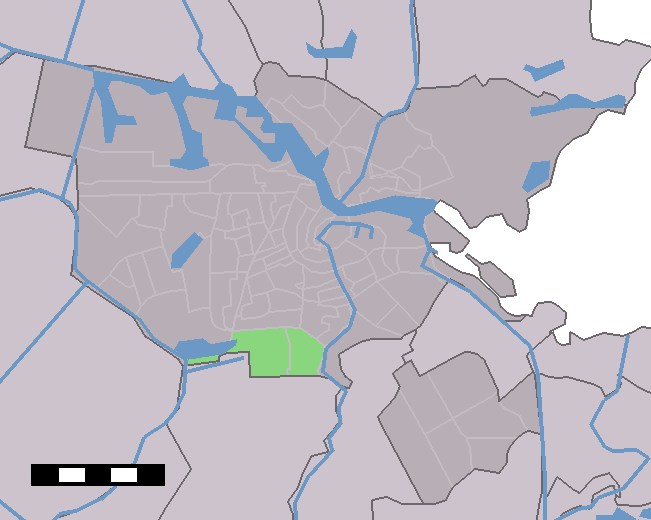
The Imstenrade is a residential street in the Buitenveldert neighborhood at the southern edge of Amsterdam, at 52.324 N, 4.875 E - between the city center and Amsterdam Schiphol Airport. Buitenveldert lies directly under the Polderbaan and Zwanenburgbaan approach paths to Schiphol. Nearest airport: Amsterdam Schiphol (EHAM), 4 nm southwest - the area sits inside the inner approach pattern. The Olympic Stadium and the Amstelpark are visible nearby; the VU University campus marks the northwest corner of the neighborhood.