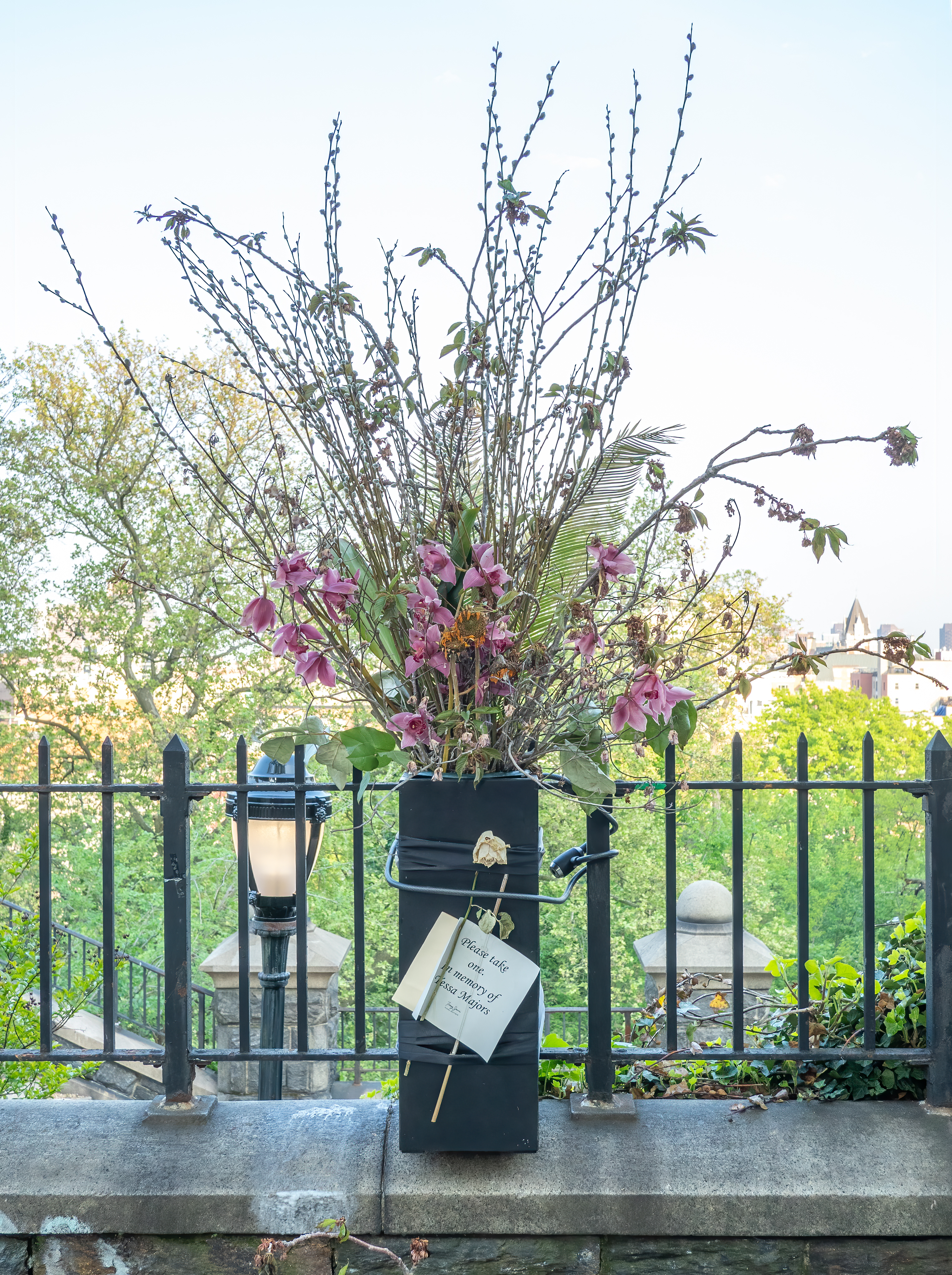
Murder of Tessa Majors
Tessa Majors had been in New York City for less than four months. An eighteen-year-old freshman at Barnard College, she had come from Charlottesville, Virginia, where she'd graduated from St. Anne's-Belfield School, led the creative writing club, run cross-country, and played in a band that had recently released an album. Her father taught English at James Madison University and had written six books. On the evening of December 11, 2019, Majors walked into Morningside Park, a slender strip of green that descends steeply from Morningside Heights toward Harlem. She was several blocks from campus. Shortly before seven o'clock, three teenagers attacked her on a staircase near 116th Street.
Seven Minutes on the Stairs
What happened on that staircase was later described by Assistant District Attorney Matthew Bogdanos as long, intentional, and premeditated. Two of the attackers grabbed Majors and put her in a chokehold while they searched her pockets for valuables. She was stabbed multiple times. After the three fled, Majors managed to stagger up the stairs to the corner of Morningside Drive and 116th Street, where she collapsed. Police responded to a 911 call and found her with multiple stab wounds. She was transported to Mount Sinai Morningside Hospital, where she was pronounced dead. The attackers were thirteen and fourteen years old.
The Shadow of Central Park
The case immediately drew comparisons to the 1989 Central Park jogger case, which had occurred nearby in the North Woods. Both involved a young female victim and alleged young male perpetrators. The New York Times called it "an eerie reprise." But the echoes cut in a painful direction: the suspects in the 1989 case -- the Central Park Five -- had ultimately been exonerated, their convictions vacated after years in prison. Manhattan Borough President Gale Brewer urged detectives to proceed carefully. Investigators, mindful of the earlier case's legacy, called in prosecutors early and video-recorded all questioning. Because the suspects were Black and the victim white, the murder surfaced what reporters described as "the longstanding racial and class tensions between Columbia University and the fast-gentrifying neighborhood of Harlem."
Three Boys, Three Outcomes
The youngest suspect, thirteen at the time of the attack, was arrested the following day. Surveillance footage showed he had not physically touched Majors during the crime, though prosecutors noted he had picked up the knife and handed it to the person who used it. In June 2020, he pleaded guilty to first-degree robbery in family court and was sentenced to eighteen months in juvenile detention. Majors's parents, in a victim impact statement read in court, criticized the deal and said the boy had shown "a complete lack of remorse." Luchiano Lewis, fourteen, pleaded guilty to second-degree murder and first-degree robbery in September 2021 and was sentenced to nine years to life. Rashaun Weaver, also fourteen, pleaded guilty to second-degree murder in December 2021, acknowledging that he had "intentionally caused the death of Tessa Majors by stabbing her with a knife." He received fourteen years to life.
The Park After Dark
Morningside Park sits on a geological fault line between two worlds: the academic enclave of Columbia University and Barnard College above, and the neighborhoods of Harlem below. The steep hillside, punctuated by staircases and dimly lit paths, had long been a source of anxiety for students and residents alike. After Majors's death, the city promised additional funding for security and lighting in the park. The NYPD committed more officers to patrol, Columbia pledged security guards, and City Council member Mark Levine sought funding for real-time police-monitored cameras. Whether these measures addressed the deeper tensions -- between a wealthy institution and a neighborhood shaped by decades of disinvestment and rapid gentrification -- remained an open question. Tessa Majors had been a journalist, a musician, a runner, and a young woman just beginning to discover what New York had to offer. The park she walked through that evening was supposed to be the seam that connected two communities. Instead, it became the place where they collided.
From the Air
Located at 40.8057°N, 73.9594°W. Morningside Park runs as a narrow north-south strip between Morningside Drive (above) and Manhattan Avenue/Morningside Avenue (below), from 110th to 123rd Streets. The Columbia University campus and Barnard College are visible just to the west atop the ridge. The Cathedral of St. John the Divine is prominent nearby. Nearest airports: KLGA (LaGuardia, 5 nm northeast), KTEB (Teterboro, 9 nm west).