Murin-an
The man who reshaped Japan's military brought water from its largest lake to build a garden where he could hear himself think. Yamagata Aritomo was born into a samurai family in 1838, traveled to Europe to study the Prussian Army, returned to reorganize Japan's entire military along Western lines, served as Minister of War, and was twice Prime Minister. He was, by every measure, one of the most powerful people in Meiji-era Japan. And what he wanted most, when the work of empire-building allowed, was a quiet place with the sound of moving water. Murin-an, his private villa and garden in Kyoto's Nanzen-ji temple district, is what that desire produced -- a landscape so perfectly composed that it became one of the most influential gardens of its era.
The Canal That Made a Garden Possible
Murin-an exists because of an engineering marvel. In 1890, the Lake Biwa Canal was completed, a waterway that channeled fresh water from Japan's largest freshwater lake through the mountains and into eastern Kyoto. The canal transformed the Nanzen-ji temple area, bringing a reliable water source to a district that had been relatively dry. Yamagata, who had a lifelong passion for garden design, recognized the opportunity immediately. He purchased land near the canal and began planning a villa and garden that would use the flowing water as its central element. The canal's aqueduct still stands today as a visible landmark in the neighborhood, its brick arches carrying water that feeds not only Murin-an but several of the great gardens nearby. Without this infrastructure project, the garden that Yamagata envisioned could not have existed -- a reminder that even the most natural-looking landscapes often depend on decidedly unnatural engineering.
A Garden Interrupted by War
Construction began in 1894, but almost immediately Yamagata was pulled away. The First Sino-Japanese War demanded the attention of the man who had rebuilt the nation's army, and the garden project halted. When the war concluded in Japan's favor, Yamagata -- then a Count, later elevated to Marquis in 1895 and Prince in 1907 -- resumed work with renewed ambition. He enlisted Ogawa Jihei, the most celebrated garden designer of the Meiji period, known professionally as Ueji. Ogawa had already designed the garden for the reconstructed Kyoto Imperial Palace, and his collaboration with Yamagata at Murin-an produced something genuinely new. The garden broke from the conventions of the Edo period, which favored enclosed, inward-looking compositions. Instead, Ogawa embraced the surrounding landscape, incorporating views of the Higashiyama Hills as an integral part of the design -- a technique called shakkei, or borrowed scenery.
Water, Light, and Borrowed Hills
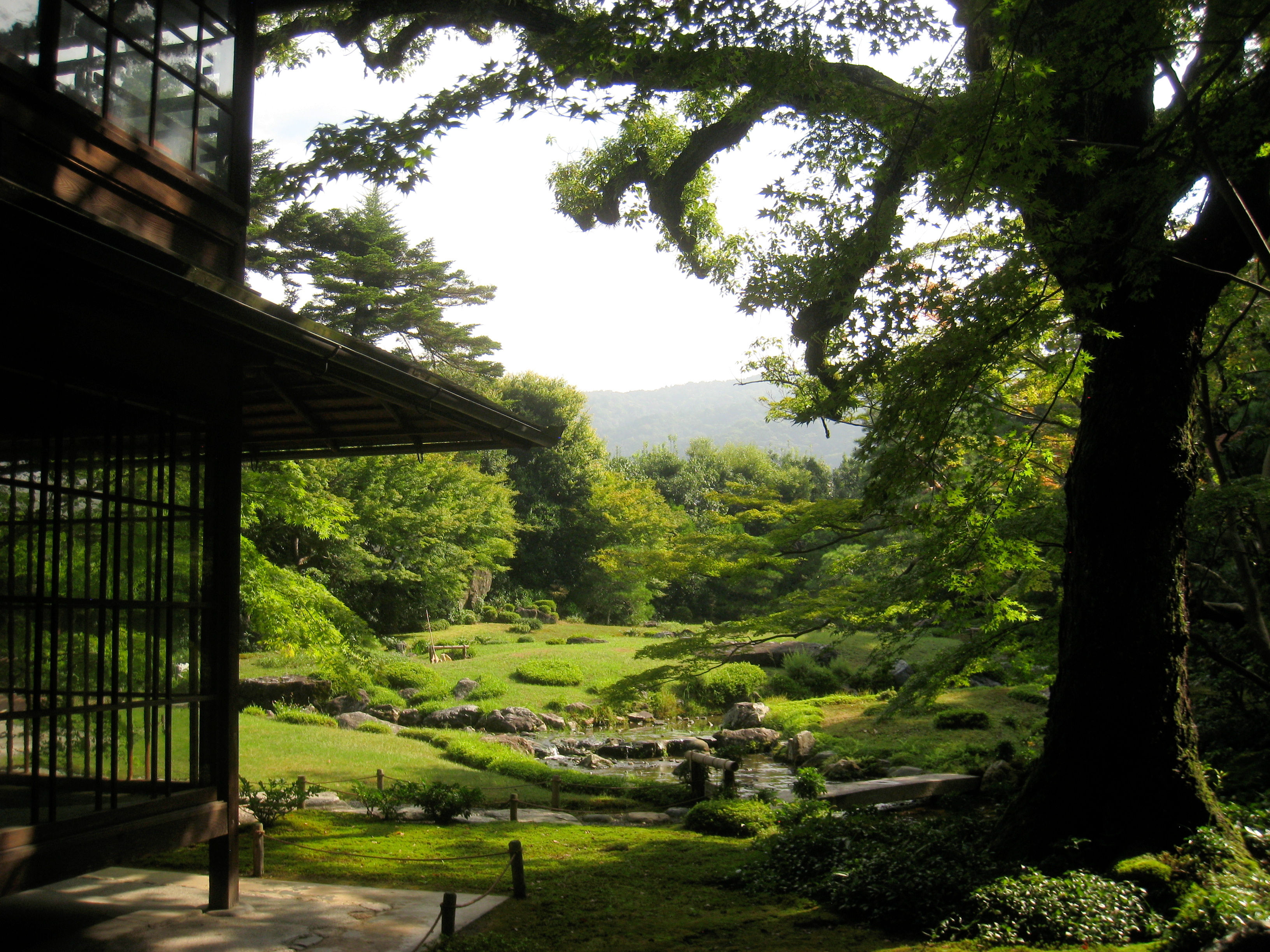
Murin-an covers 3,135 square meters, modest by the standards of aristocratic estates but designed with a density of intention that makes every meter count. Water from the Lake Biwa Canal enters the garden and flows through a shallow artificial stream punctuated by a triple waterfall -- three distinct cascades that create layered sounds as water drops over mossy stone ledges. The stream meanders through open lawns, passes beneath small stone bridges, and disappears into shaded groves of maple and pine. The garden's genius lies in its contrasts: bright, sunlit expanses of lawn give way suddenly to dark, mossy shade beneath dense canopy. The long promenade path reveals the garden in sequence, each turn offering a different composition. And always, above the treetops, the Higashiyama Hills rise as the garden's backdrop -- not a wall but an extension, making a small space feel vast. Yamagata also built a tea house, a traditional Japanese residence, and a Western-style house with an English lawn, completed in 1898.
Where Modern Japan Was Decided
Murin-an was not merely a retreat for contemplation. In April 1903, Yamagata hosted a secret meeting at the villa that shaped the course of Japanese foreign policy. The Murin-an Conference, as it became known, brought together Yamagata, Prime Minister Katsura Taro, Foreign Minister Komura Jutaro, and former Prime Minister Ito Hirobumi to discuss the escalating tensions with Russia over Manchuria and Korea. The decisions reached in this garden -- behind closed doors, far from the formal institutions of government -- set Japan on the path toward the Russo-Japanese War of 1904-1905. The Western-style reception room where these discussions took place still stands within the garden compound. Today Murin-an is owned by the city of Kyoto and open to the public, designated a Place of Scenic Beauty. Visitors walk the same paths that a prime minister paced while weighing the costs of war, listening to the same water that once masked the sound of conversations that would alter the map of East Asia.
From the Air
Located at 35.01N, 135.79E in eastern Kyoto, near the base of the Higashiyama Hills. Murin-an sits in the Nanzen-ji temple district, identifiable from the air by the cluster of traditional temple roofs and gardens along the base of the eastern hills. The brick arches of the Lake Biwa Canal aqueduct are a useful visual reference nearby. The garden itself is small and not individually visible from altitude, but the Nanzen-ji complex and surrounding forested hillside are distinctive. Nearest airports: Osaka Itami (RJOO) approximately 25nm southwest, Kansai International (RJBB) approximately 75nm south. Kyoto's grid-pattern urban layout with the eastern hills rising sharply provides excellent orientation.