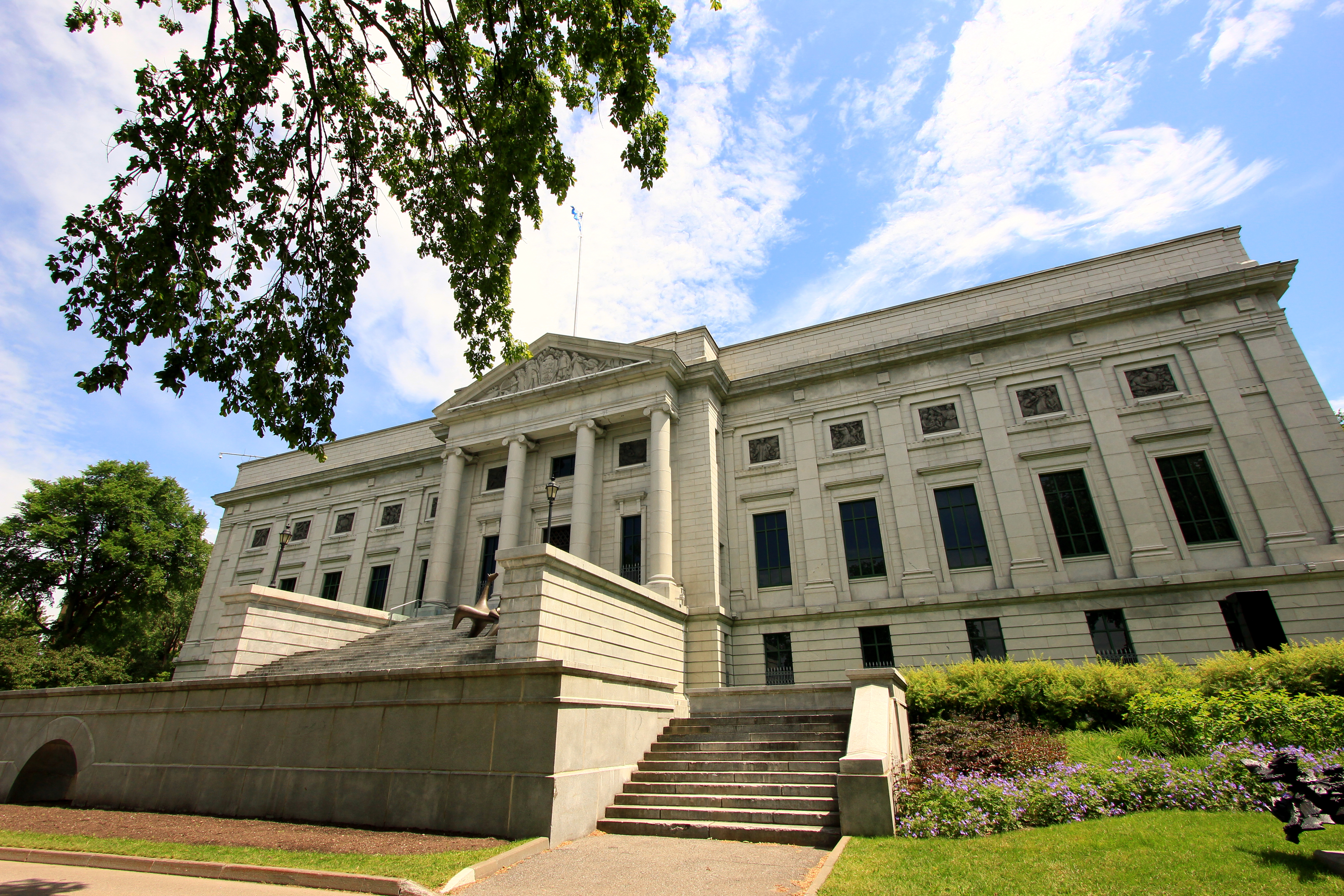
Musée national des beaux-arts du Québec
One of the four buildings in Quebec's national fine arts museum used to be a prison. Inmates once paced the corridors of the Charles Baillairge Pavilion; today, visitors walk those same passages contemplating works of modern art. That transformation -- confinement into contemplation -- captures something essential about the Musee national des beaux-arts du Quebec. Sitting within the green expanse of National Battlefields Park, on the very ground where the fate of New France was decided in 1759, the MNBAQ holds more than 40,000 works spanning from the 16th century to the present. It is not simply a museum that happens to be in Quebec City. It is the museum that set out to define what Quebec art means.
A Premier's Vision, An Artist's Lifeline
The idea was political before it was cultural. In the early 20th century, Quebec Premier Lomer Gouin proposed a provincial art collection as part of a larger program to "define the Quebec nation." His successor, Louis-Alexandre Taschereau, turned the idea into action. In March 1920, cabinet minister Athanase David announced that the province would support Quebec-based artists by purchasing their works -- a lifeline for painters and sculptors who had few institutional buyers. A five-man jury selected pieces they believed affirmed both a common rural past and "innovative art trends." The first acquisitions came from the Art Association of Montreal's 37th Spring Exhibition in 1920, though only six of those original purchases remain in the permanent collection today. Two years later, the legislature passed the Loi des musees de la province de Quebec, funding museum construction across the province. The Gerard-Morisset Pavilion broke ground in 1928, and the museum opened its doors to the public in June 1933.
Three Names, One Evolving Identity
The museum has reinvented itself with each new name. It opened as the Musee de la province de Quebec in 1933, housing art, natural history specimens, and the provincial archives under a single roof -- a cabinet of curiosities for an entire province. In 1962, the natural science collection was removed, and the institution was renamed the Musee du Quebec the following year. The archives departed in 1979, leaving the museum to focus entirely on art for the first time in its history. The final renaming came in 2002, when it became the Musee national des beaux-arts du Quebec, a title that declared both its national ambition and its dedication to fine arts. Each shedding of a collection was really an act of sharpening -- a museum discovering what it truly wanted to be.
Four Pavilions, Four Centuries
The museum complex tells its story through architecture as much as art. The Gerard-Morisset Pavilion, the original 1933 building, houses the historical art collection -- portraits of colonial Quebec, landscapes of the Saint Lawrence, paintings by Antoine Plamondon and Joseph Legare that document a world being built. The Charles Baillairge Pavilion, the converted prison, now displays modern art in spaces that once confined bodies rather than freed imaginations. And the Pierre Lassonde Pavilion, designed by the Office for Metropolitan Architecture under partners Shohei Shigematsu and Jason Long, opened in 2016 as a 100-million-dollar home for contemporary art. During its construction, the museum's tunnel system was renovated and transformed into additional viewing spaces, turning infrastructure into exhibition. In 2018, the Gerard-Morisset Pavilion underwent its own renovation, brightening viewing spaces and harmonizing the oldest building with its newer neighbors.
Collecting a Province's Soul
Walk through the galleries and you trace Quebec's self-image across four centuries. James Pattison Cockburn's painting of the ice cone at Montmorency Falls, made around 1830, hangs alongside Francois Beaucourt's 1793 portrait of Madame Trottier Desrivieres Beaubien, one of the earliest works by a Canadian-born painter. Henri Julien's La Chasse-galerie from 1906 captures Quebec folklore -- the legend of lumberjacks who make a deal with the devil to fly home in a canoe. Marc-Aurele de Foy Suzor-Cote's depiction of Jacques Cartier meeting Indigenous people at Stadacone in 1535 reimagines the founding encounter. Jean-Paul Riopelle's La Victoire et le Sphinx, completed between 1963 and 1965, represents the abstract expressionist movement that put Quebec artists on the world stage. The collection also maintains over 13,000 biographical files, along with catalogs, monographs, and audiovisual documents, all accessible through the museum's library and archives by appointment.
From the Air
The MNBAQ is located at 46.799N, 71.225W, within National Battlefields Park (the Plains of Abraham) in Quebec City. From the air, the museum complex is identifiable as a cluster of buildings on the southern edge of the park, which appears as a large green rectangle along the Saint Lawrence River bluffs southwest of the Chateau Frontenac. The Pierre Lassonde Pavilion's modern glass-and-steel structure contrasts with the older stone pavilions. Nearest airports: Quebec City Jean Lesage International (CYQB) approximately 12 nm west-southwest. Recommended viewing altitude: 3,000-5,000 feet for context within the broader Quebec City landscape.