Musashi Imperial Graveyard: Where Tokyo's Emperors Rest Beneath the Trees
On the evening of February 7, 1927, a procession four miles long wound through the winter darkness of Tokyo. Twenty thousand mourners followed a herd of sacred bulls and an ox-drawn cart bearing the coffin of Emperor Taisho, who had died on Christmas Day the previous year. Their destination was a newly prepared site in the forests of Hachioji, in western Tokyo -- a place that would become the Musashi Imperial Graveyard. Emperor Taisho was the first Japanese emperor ever buried in Tokyo, breaking a tradition that had placed monarchs in the soil of Kyoto for centuries. His father, Emperor Meiji, though he had lived and died in Tokyo, was interred on the outskirts of Kyoto near his imperial forebears. Taisho, who had lived his entire life in or near the capital, became the first true Tokyo Emperor in death as well as in life.
The First Tokyo Emperor
Emperor Taisho's decision to be buried in Tokyo -- or rather, the decision made on his behalf -- carried symbolic weight far beyond the choice of a burial plot. For generations, the imperial house had maintained its connection to Kyoto through the placement of tombs, even after the capital moved to Tokyo in 1868. Emperor Meiji was born and raised in Kyoto, and though he spent his reign in the new capital, his mausoleum sits on the outskirts of the old one. But Emperor Taisho had no such connection. Born in Tokyo in 1879, he was the first emperor to spend his entire life in the metropolitan region. His burial at Hachioji in the western suburbs of Tokyo acknowledged what geography and history had already made plain: the center of imperial life had permanently shifted east.
A Forest of Zelkova and Cryptomeria
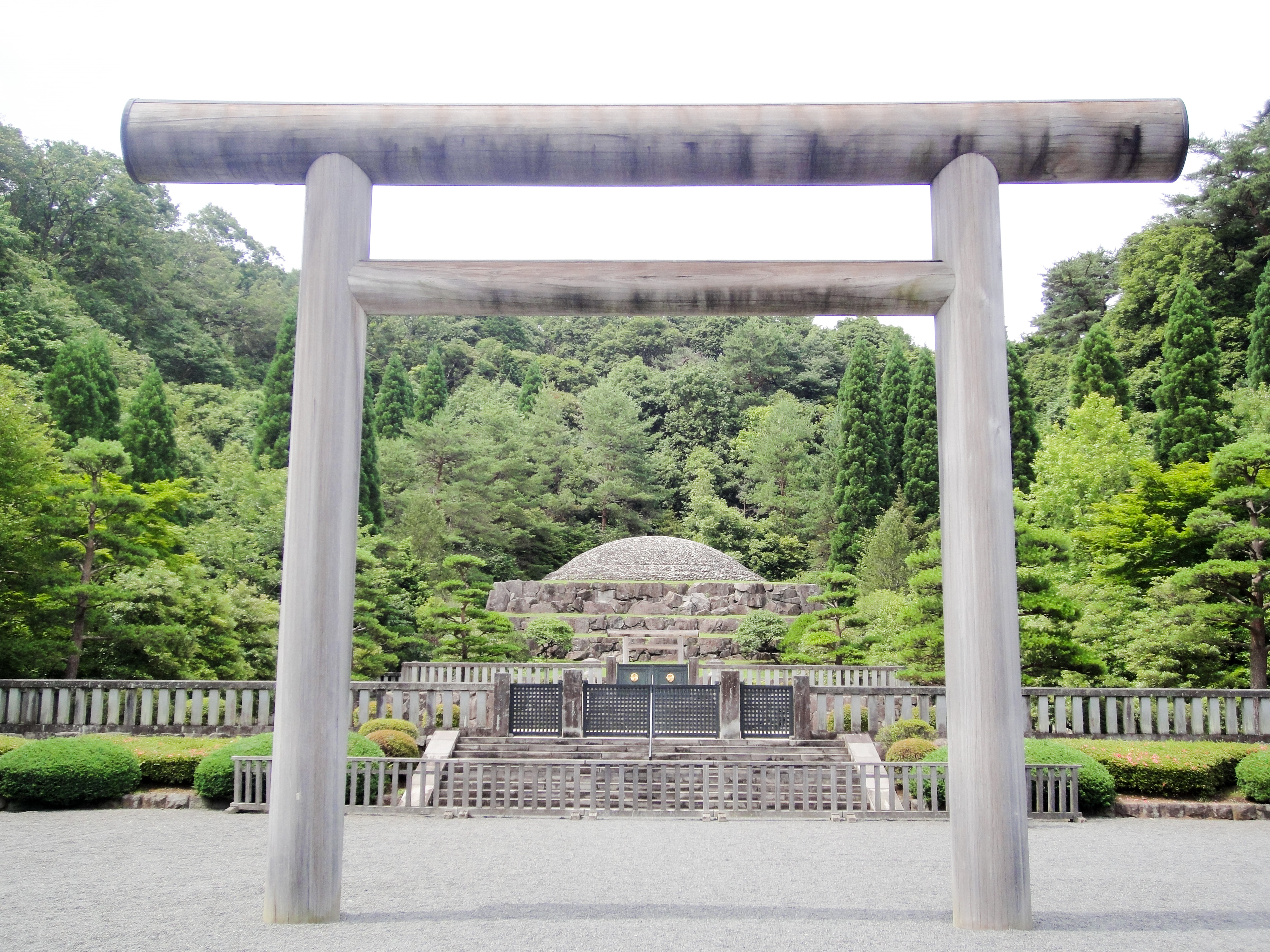
The graveyard occupies a designed landscape that blurs the line between garden and forest. The approach from the Koshu Kaido, one of the ancient highways that radiated from Edo, is lined with zelkova trees. The mausolea themselves stand within groves of cryptomeria, the Japanese cedar whose tall, straight trunks create a cathedral-like stillness. Stone-topped mounds mark the burial sites, and torii gates frame the approach paths. Smaller monuments and religious structures are scattered throughout the grounds, which are administered by the Imperial Household Agency's Archives and Mausolea Department. The design is semi-natural -- woodland, rocks, and trees arranged to suggest a sacred grove rather than a formal cemetery. Visitors walk along gravel paths through deep shade, and the surrounding forest muffles the sounds of the city that has grown up around it.
Two Emperors, Two Empresses
Four members of the imperial family rest at Musashi. Emperor Taisho was interred first, following his death on December 25, 1926. His wife, Empress Teimei, joined him in 1951. Their son, Emperor Showa -- known to much of the world as Hirohito -- died on January 7, 1989, after a reign that spanned the rise and fall of imperial Japan, the devastation of the Second World War, and the nation's postwar transformation into an economic superpower. His state funeral on February 24, 1989, drew representatives from 163 countries. The coffin was brought to Hachioji by motor hearse, and burial took place at nightfall, honoring the ancient tradition of interring emperors after dark. Empress Kojun, Hirohito's wife, was the last to be interred, in 2000. Together, the four mausolea span a century of Japanese history.
A Break with Three Centuries of Tradition
In 2012 and 2013, the Imperial Household Agency confirmed that Emperor Akihito and Empress Michiko planned to break with tradition in a different way. Rather than the in-ground burial that had been the norm for Japanese monarchs for some 350 years, they chose cremation. Their ashes will be placed in individual mausoleums, built side by side on the west side of Emperor Taisho's tomb, covering approximately 3,500 square meters -- about eighty percent of the 4,300 square meters occupied by Emperor Showa and Empress Kojun's tombs. Cremation facilities will be added to the graveyard for this purpose. The decision reflects a modernizing impulse within the imperial house, even as the choice to remain at Musashi affirms the site's role as the permanent resting place of Tokyo's emperors.
From the Air
Located at 35.650°N, 139.280°E in the Hachioji area of western Tokyo, near the base of Mount Takao. The graveyard's dense forest canopy is visible as a dark green patch amid surrounding suburban development. Yokota Air Base (RJTY) lies approximately 5 nautical miles to the north. The site is close to Takao Station on the JR Chuo Line. Best viewed at 2,000-4,000 feet AGL; the contrast between the forested imperial grounds and surrounding urban grid is striking from the air. Mount Takao (599 meters) rises to the southwest.