Musasir
Its name in Akkadian means "Exit of the Serpent." In Urartian, they called it Ardini. Somewhere in the folds of the Zagros Mountains, south of Lake Urmia, this holy city of the kingdom of Urartu once stood as one of the most sacred places in the ancient Near East. Musasir housed the great temple of Haldi, the supreme deity of the Urartian pantheon, and for more than a century it drew pilgrims, kings, and eventually conquerors to its gates. Today, despite decades of searching, no one can say with certainty where exactly it stood.
A Kingdom's Sacred Heart
Musasir entered the historical record through Assyrian cuneiform texts of the 9th and 8th centuries BC. Around 800 BC, the Urartian king Ishpuini incorporated the city into his expanding realm, an event commemorated on the Kelashin Stele, a bilingual inscription in Assyrian and Urartian carved into rock near a mountain pass. The city's importance was not military or commercial but spiritual. The temple of Haldi, built in 825 BC, made Musasir the religious center of Urartu, a kingdom that at its height stretched from the Caucasus to the northern Zagros. Urartologist Paul Zimansky has speculated that the Urartians themselves, or at least their ruling dynasty, may have emigrated northwest into the Lake Van region from Musasir, suggesting the city was not merely a provincial shrine but possibly the birthplace of Urartian civilization itself.
The Sack That Echoed Through Centuries
In 714 BC, Assyrian king Sargon II marched against "the seven kings of Urartu" and reached Musasir. During the reign of Urartian king Rusa I, the city was governed by a vassal named Urzana. Sargon's forces overwhelmed the holy city, and the plunder was spectacular enough that the Assyrians immortalized it in stone. A bas-relief adorning Sargon's palace at Khorsabad depicted the temple of Musasir in remarkable detail, showing a columned facade with shields mounted on its walls. This image, one of the earliest architectural representations in Near Eastern art, is now our primary visual record of the temple. The original relief was lost when Arab raiders attacked a convoy of antiquities being shipped down the Tigris River in the 1850s. It likely lies buried in the river's silt to this day. What survives is a drawing made by French artist Eugene Flandin, who copied it on site before the disaster.
The Search for Serpent's Gate
The location of Musasir remains one of the great unsolved puzzles of Near Eastern archaeology. All proposed sites cluster in the same general region, the Zagros Mountains south of Lake Urmia, but none has been confirmed. French Assyriologist Francois Thureau-Dangin placed it tentatively at Mudjesir, about 10 kilometers west of Topzawa. The 19th-century traveler H. F. B. Lynch argued for a location near the modern town of Rawandiz in Iraqi Kurdistan. More recently, Iranian archaeologist Reza Heidari has proposed Rabat city near Sardasht in Iran's West Azerbaijan Province. Excavations at a site called Rabat Tepe on the southwestern shore of Lake Urmia have yielded Urartian-period remains that some researchers identify with Musasir, though the identification is not universally accepted.
Fragments Across the World
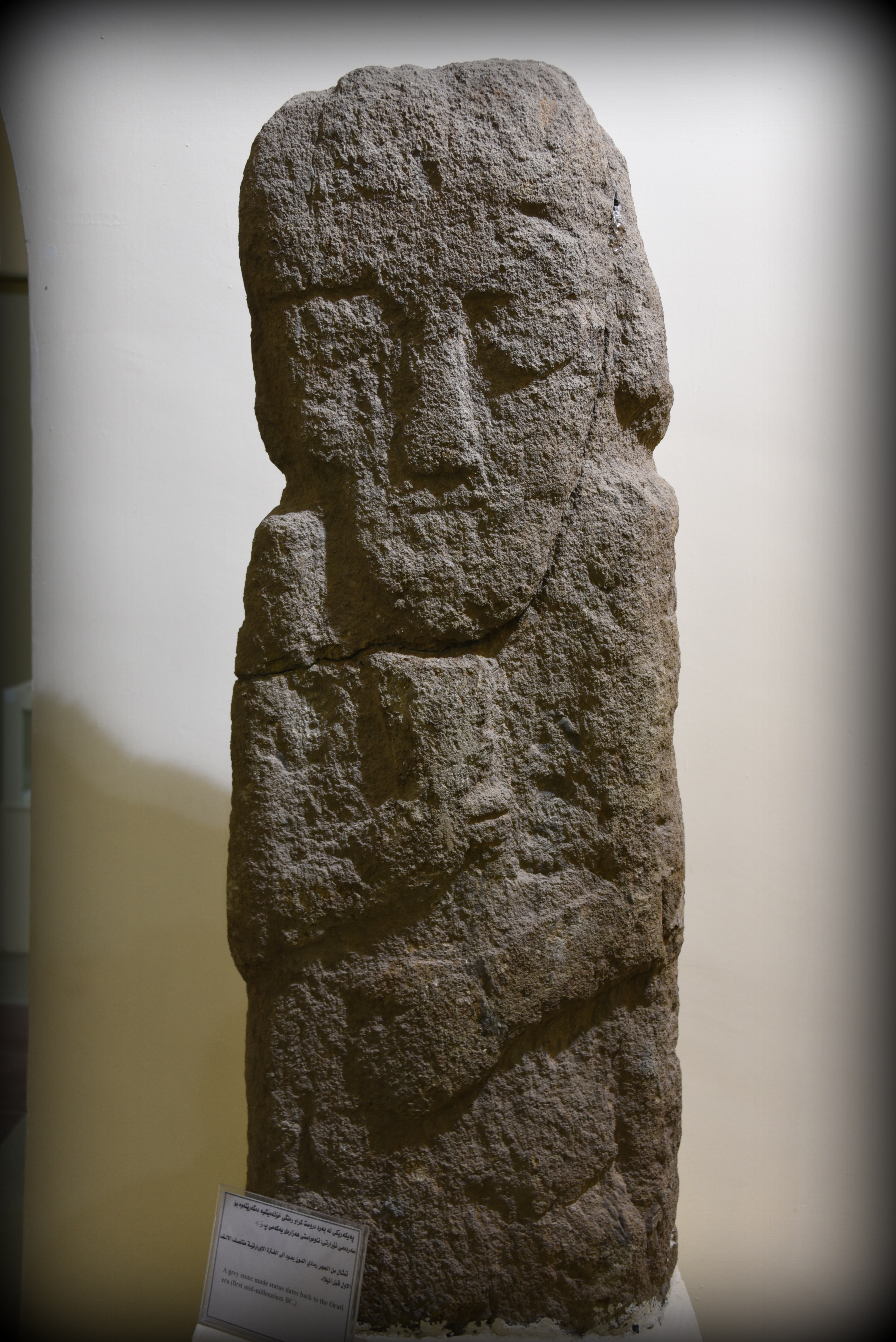
What Musasir has yielded, through controlled excavation and through the less traceable channels of the antiquities trade, speaks to a culture of considerable sophistication. Stone statues of limestone, basalt, and sandstone, likely depicting deities or rulers, have surfaced in the Erbil Civilization Museum in Iraqi Kurdistan. The Kelashin Stele, with its bilingual text, remains a cornerstone document for understanding the Urartian language. In 2014, Iraqi villagers near Gund-i Topzawa, north of Erbil, accidentally uncovered what some archaeologists believe may be remains of the long-lost temple itself. The find renewed hopes that the serpent's exit might finally be pinpointed. Yet the political instability of the region, straddling the border between Iran and Iraqi Kurdistan, has made sustained archaeological work difficult. Musasir endures as it has for millennia: present in texts and reliefs, absent from the map.
From the Air
Approximate coordinates at 36.0N, 46.0E in the Zagros Mountains region between Lake Urmia and Lake Van. The exact site is unconfirmed but candidate locations lie in the mountainous border zone between Iran and Iraqi Kurdistan. Nearest major airports include Erbil International (ORER) to the south and Urmia Airport (OITR) to the northeast. Fly at 8,000-12,000 feet AGL to survey the rugged Zagros terrain. The region features deep valleys and ridgelines running northwest-southeast.