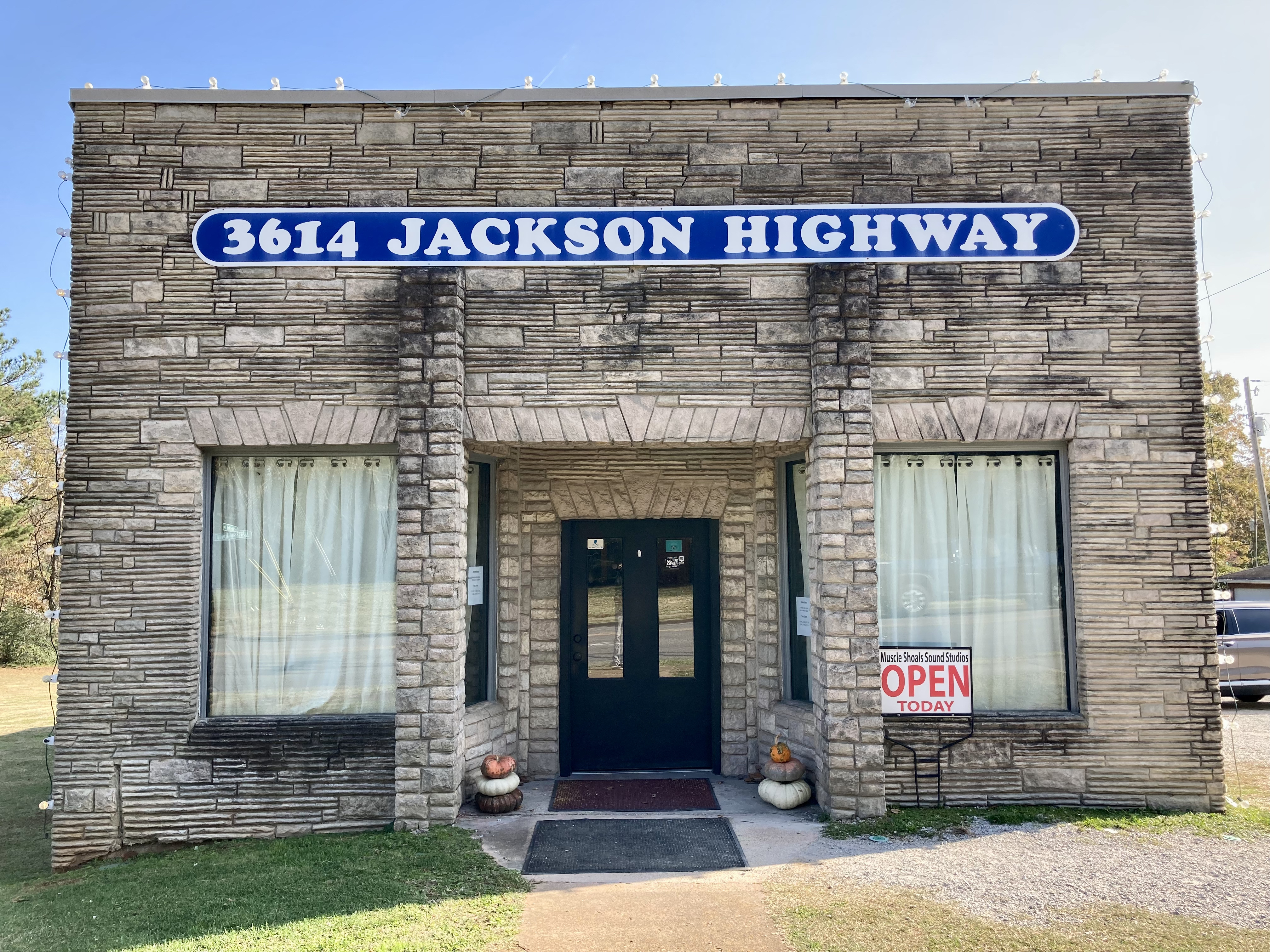
Muscle Shoals Sound Studio
Before it was a studio, it was a coffin showroom. The squat concrete block building at 3614 Jackson Highway in Sheffield, Alabama, built around 1946, had spent years displaying caskets before four musicians walked in and turned it into one of the most consequential recording spaces in American music. In 1969, Barry Beckett, Roger Hawkins, Jimmy Johnson, and David Hood -- session players who had been the engine behind Rick Hall's FAME Studios up the road in Muscle Shoals -- broke away to start their own operation. They called themselves the Muscle Shoals Rhythm Section. Everyone else called them the Swampers. Within months, the Rolling Stones were recording in the old coffin showroom, and a sound that defied geography was pouring out of northwest Alabama.
The Swampers' Gamble
The four founders had first played together in 1967, working sessions at FAME Studios under the exacting direction of producer Rick Hall. They were white musicians in Alabama crafting some of the most soulful sounds in Black music -- backing Wilson Pickett, Aretha Franklin, and the Staple Singers on recordings that defined an era. When they left FAME, they partnered with Atlantic Records producer Jerry Wexler, who provided start-up funding for their new venture. The Muscle Shoals Rhythm Section became the first group of musicians to own their own studio and eventually run their own publishing and production companies. Their initial success was immediate: R. B. Greaves's "Take a Letter Maria" became the studio's first hit, reaching No. 2 on the Billboard charts. By December 1969, Mick Jagger and Keith Richards were in Sheffield for three days, laying down "Brown Sugar" and "Wild Horses" -- tracks that would become cornerstone songs on Sticky Fingers.
A Sound Bigger Than Its Address
Through the 1970s, 3614 Jackson Highway became a pilgrimage site for musicians who wanted something no other studio could offer: the Muscle Shoals sound. It was a groove that lived in the interplay between Beckett's keyboards, Hawkins's drums, Johnson's guitar, and Hood's bass -- tight, funky, and warm in ways that transcended genre. Paul Simon recorded "Kodachrome" and "Loves Me Like a Rock" there. Bob Seger cut "Night Moves," "Mainstreet," and "Old Time Rock and Roll" -- the last of which became the second most-played jukebox single of all time. Rod Stewart tracked Atlantic Crossing, producing the UK No. 1 hit "Sailing." Lynyrd Skynyrd recorded Street Survivors. Cat Stevens, Bob Dylan, Art Garfunkel, and Cher all made the trip to this small Alabama town. The studio moved to a larger facility at 1000 Alabama Avenue in 1979, operating there until financial pressures led to its sale to Malaco Records in 1985.
Coffin Showroom to Appliance Store
After the studio relocated, the original Jackson Highway building cycled through a series of mundane afterlives -- an audiovisual retailer, then an appliance store. By 1999 it sat empty, its history gathering dust alongside the old recording equipment a subsequent owner had kept intact. The building seemed destined for obscurity until a 2013 documentary simply titled Muscle Shoals rekindled public fascination. That same year, the Muscle Shoals Music Foundation was formed and purchased the property with the goal of establishing a museum. Beats Electronics contributed an essential $1 million, and Alabama's state tourism director credited the film directly. Even before its restoration was complete, the Alabama Tourism Department named Muscle Shoals Sound Studio the state's top attraction for 2017.
The Tape Machines Roll Again
Major restoration work began in September 2015, and the studio reopened on January 9, 2017, its interior painstakingly returned to its 1970s appearance. Visitors find guitars, amplifiers, a Hammond organ, a Wurlitzer electric piano, a black baby grand, a recording console, and analog tape machines -- the tools that shaped decades of hit records. Isolation booths for vocals and percussion stand ready, as if the Swampers might walk back in at any moment. The studio had already proven it could still produce: the Black Keys recorded their Grammy-winning album Brothers there in 2009 and 2010, and Chris Stapleton cut his Grammy-winning single "Cold" in December 2018. From coffin showroom to recording shrine to appliance store to museum, 3614 Jackson Highway refuses to stay silent.
From the Air
Located at 34.768N, 87.674W in Sheffield, Alabama, in the Muscle Shoals metropolitan area along the Tennessee River. The studio sits on Jackson Highway (US Route 72) in a commercial district. Nearby airports: KMSL (Northwest Alabama Regional, 5nm west), KDCU (Decatur/Pryor Field, 25nm east). Best viewed at 1,500-2,500 ft AGL. The Tennessee River bends prominently through the area; Sheffield is on the south bank. Wilson Dam, the TVA facility that gave the Muscle Shoals area its original fame, is visible 3nm west. FAME Studios, where the Swampers got their start, is located about 5nm east across the river in Muscle Shoals proper.