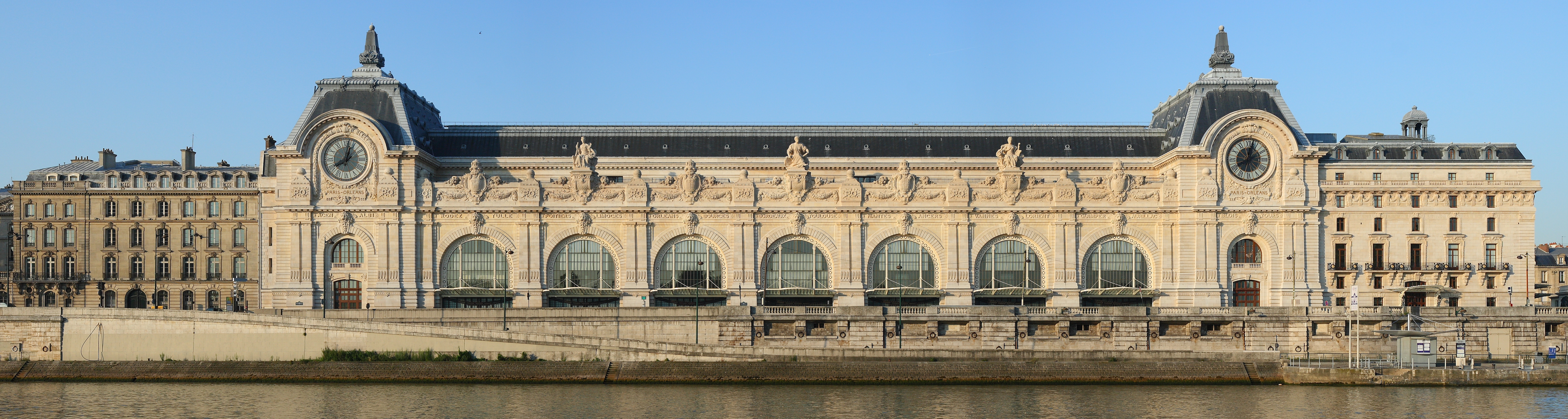
Musee d'Orsay
The great clock still tells time. Mounted in the glass wall at the far end of the nave, its translucent face was designed to be read from the platforms of a busy railway terminus. Passengers checking it in 1900 would have been catching the train to Orleans. Visitors checking it today are standing in front of Renoir's Bal du moulin de la Galette or Cezanne's Card Players. The Musee d'Orsay is a building that changed careers - from railway station to art museum - and in doing so saved both itself and the art that needed a home between the Louvre's ancient collections and the Pompidou Centre's modern ones.
Built for Speed, Dressed for a Ball
The Gare d'Orsay was commissioned by the Chemin de Fer de Paris a Orleans for the 1900 Exposition Universelle, and its architects faced an unusual constraint: the station sat directly across the Seine from the Louvre and the Tuileries, in the heart of official Paris. An industrial train shed would not do. Victor Laloux, whose competition-winning design beat proposals from Lucien Magne and Emile Benard, disguised the station behind an ornate Beaux-Arts facade of limestone, statues, and a grand hotel. Inside, the iron-and-glass train shed spanned the platforms, but electric traction replaced steam to keep the palatial interiors free of soot. The station opened in July 1900 - modern engineering in period costume, a building that anticipated the museum it would become by hiding its industrial purpose behind art.
A Station Without Trains
By 1939, the Gare d'Orsay's platforms had become too short for modern electric mainline trains. Suburban services continued, but the grand station gradually emptied. During World War II, it served as a mailing center for packages to prisoners of war. After the war, it became a set for Orson Welles's film adaptation of Kafka's The Trial. By the 1960s, the building was decrepit, and in 1970 the demolition permit was approved. But Jacques Duhamel, the Minister for Cultural Affairs, blocked the plans. The station was listed as a historic monument in 1978, and the idea emerged to create a museum that would fill the chronological gap between the Louvre, which covered art through the mid-19th century, and the Pompidou Centre, which began with the 20th century. President Georges Pompidou approved the conversion study in 1974.
The Cathedral of Impressionism
Italian architect Gae Aulenti won the commission to design the museum's interior in 1981, and her solution was ingenious: she treated Laloux's barrel-vaulted nave as a central spine, lining it with stone exhibition structures that echoed the old train platforms. Three levels of galleries rose within the original shell. The museum opened in December 1986 under President Francois Mitterrand, with 2,000 paintings, 600 sculptures, and thousands of other works installed over the preceding six months. The collection spans 1848 to 1914 - the decades when French art reinvented itself. Monet's 86 paintings anchor the Impressionist galleries. Van Gogh's Starry Night Over the Rhone, Bedroom in Arles, and Self-Portrait share space with 24 of his other works. Manet's Olympia and Luncheon on the Grass challenged conventions when painted; now they draw reverential crowds. Degas, Renoir, Cezanne, Gauguin, Seurat - the roster reads like a syllabus of modern art's origins.
Beyond the Canvas
The Musee d'Orsay holds far more than paintings. Over 2,200 sculptures fill the nave and galleries, including Rodin's Gates of Hell and The Thinker. A 1:100 scale model of the Paris Opera and its neighborhood, built by Richard Peduzzi and embedded beneath glass flooring that visitors walk across, has become one of the museum's most popular installations. The photography collection documents the medium's evolution during the same period the paintings cover. Furniture, decorative arts, and architectural models round out a collection that treats the late 19th century not as a series of masterpieces but as a complete visual culture. In 2016, Texas collectors Marlene and Spencer Hays donated some 600 works - the largest gift of foreign art to France since World War II - favoring Post-Impressionists like Bonnard and Vuillard.
The Clock's Second Life
In 2022, 3.2 million visitors walked through the Musee d'Orsay, making it the sixth-most-visited art museum in the world and the second in France after the Louvre. A renovation project called Orsay Grand Ouvert, funded in part by an anonymous American patron's 20-million-euro gift, aims to expand gallery space and educational programming through 2026. The building itself remains as much an attraction as its contents. The cafe behind the station clock - where visitors can look through the translucent face at the Seine and the Louvre beyond - offers one of Paris's most extraordinary views. Laloux designed a train station that was too beautiful to tear down. Aulenti filled it with art that was too important to scatter. The result is a museum where the architecture and the collection enhance each other, where the light through the barrel vault falls on van Gogh's brushstrokes the way it once fell on travelers rushing for the 8:15 to Orleans.
From the Air
The Musee d'Orsay (48.860°N, 2.326°E) occupies the south bank of the Seine directly opposite the Tuileries Gardens and the Louvre, in the 7th arrondissement. From altitude, the building's long, narrow footprint and barrel-vaulted glass roof are distinctive, paralleling the river. The Pont Royal and Pont du Carrousel frame it to the east and west. The Louvre across the river provides an unmistakable geographic anchor. Nearest airports: Paris Charles de Gaulle (LFPG) 25km northeast, Paris Orly (LFPO) 14km south. Best viewed at 2,000-4,000 feet, where the museum's relationship to the Seine riverfront and the opposing Louvre complex is clearly visible.