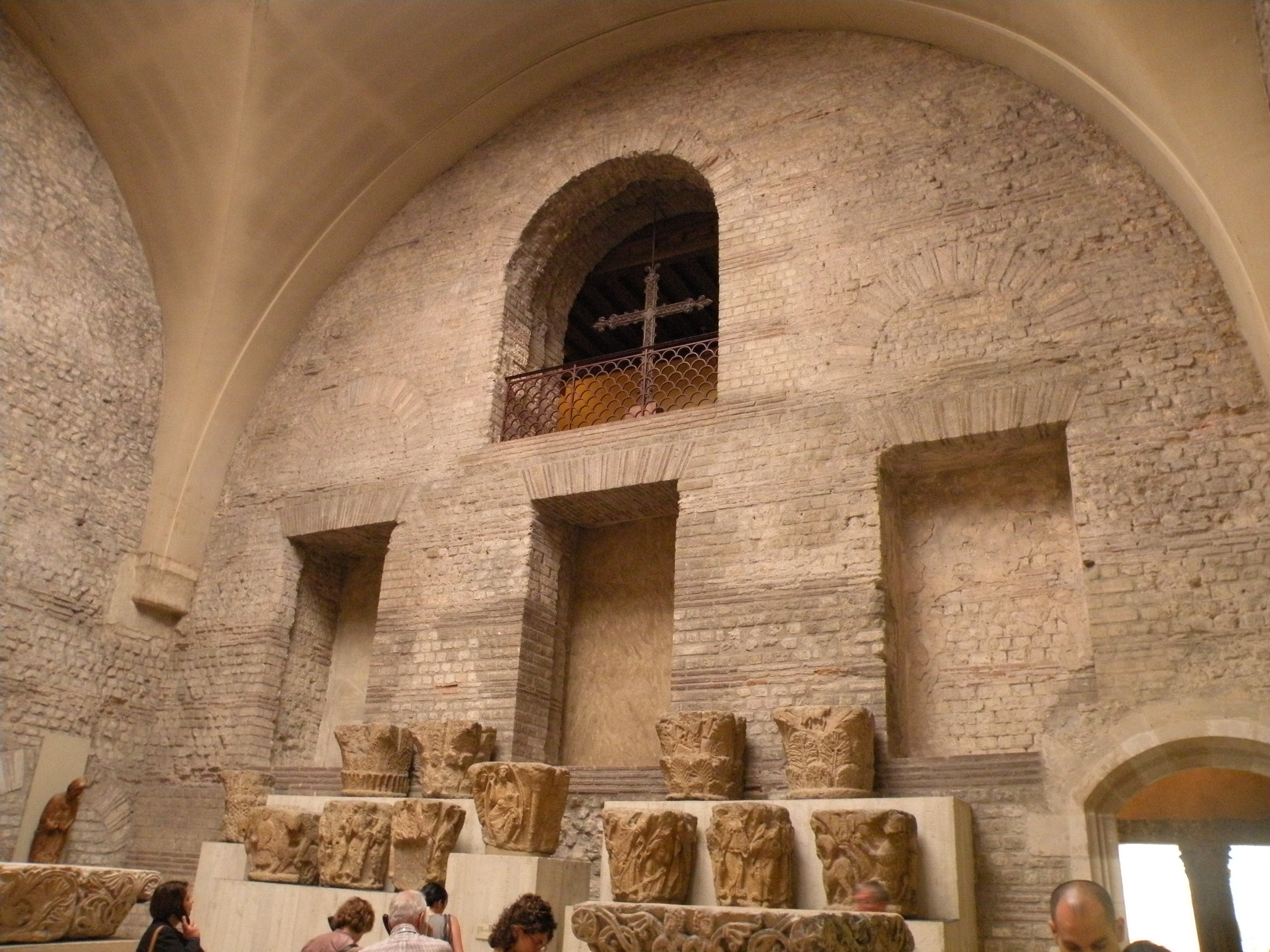
Musée de Cluny
Somewhere beneath the busy intersection of Boulevard Saint-Michel and Boulevard Saint-Germain, Roman engineers once heated water for the baths of Lutetia. Their frigidarium still stands -- not as a ruin fenced off behind glass, but as a functioning room inside one of Paris's most extraordinary museums. The Musée de Cluny, officially the Musée de Cluny — Musée national du Moyen Âge, occupies a site where the ancient and medieval worlds literally share foundations. A 15th-century mansion built by the abbots of Cluny sits atop and alongside 1st-century Roman thermae, creating a layered structure that is itself the museum's most remarkable exhibit.
Stones of Lutetia
The Roman baths date to around the 1st to 3rd centuries AD, when Paris was still Lutetia, a modest Gallo-Roman settlement on the left bank of the Seine. The frigidarium -- the cold bath hall -- survives with its original vaulted ceiling intact, soaring roughly 14 meters high. Ship prows carved into the stone corbels hint at the importance of Seine boatmen to the Roman city's economy. These are not reconstructions; the vault has held for nearly two millennia. Nearby, the Pillar of the Boatmen, discovered under Notre-Dame in 1710 and now displayed here, is the oldest known monument from Roman Paris, dedicated both to Jupiter and to Celtic deities -- a reminder that even in antiquity, this city blended cultures.
The Abbots' Mansion
In the late 15th century, the abbots of the powerful Burgundian Abbey of Cluny built their Parisian residence directly against the Roman ruins. The Hôtel de Cluny is one of the finest surviving examples of medieval domestic architecture in Paris, with its turrets, carved dormers, and a chapel whose fan-vaulted ceiling remains a masterpiece of Flamboyant Gothic design. The abbots chose this location deliberately -- proximity to the university quarter on the Left Bank placed them at the intellectual heart of medieval Paris. After the Revolution seized Church properties, the mansion passed through various hands before antiquarian Alexandre du Sommerard filled it with his personal collection of medieval objects. When he died in 1842, the French state purchased both the building and the collection, opening the museum in 1843.
The Lady and the Unicorn
The museum's collection spans 23,000 objects, but one set of six tapestries dominates the imagination. The Lady and the Unicorn, woven around 1500 in the southern Netherlands, depicts a noblewoman attended by a lion and a unicorn across six panels, five representing the senses and the sixth bearing the enigmatic inscription "À Mon Seul Désir" -- "To My Sole Desire." The meaning of that sixth tapestry has fueled scholarly debate for over a century. Are the senses being renounced or embraced? Is it love, free will, or spiritual devotion? The millefleurs backgrounds -- dense fields of flowers and small animals on deep red ground -- remain astonishingly vivid. Discovered in 1841 in Boussac Castle, where they had hung in obscurity for centuries, the tapestries entered the museum in 1882 and now occupy a specially designed circular room.
Fragments of a Lost City
Beyond the tapestries, the Cluny holds objects that reconstruct a vanished medieval Paris. Twenty-one of the original stone heads from the Kings of Judah gallery on Notre-Dame's western facade are here -- decapitated during the Revolution by crowds who mistook them for French monarchs. They were unearthed in 1977 during construction work near the Opéra, having been buried by a sympathetic citizen who purchased them from the demolishers. Stained glass panels from the Sainte-Chapelle, gold altar frontals, carved ivory caskets, illuminated manuscripts, and an entire room of medieval ironwork fill the galleries. Each object carries a story of survival: hidden, buried, smuggled, or simply overlooked during the convulsions that repeatedly reshaped Paris.
A Museum Renewed
The Cluny completed a major renovation in 2022, adding a new entrance pavilion designed by architect Bernard Desmoulin. The addition threads a contemporary glass-and-stone structure between the Roman baths and the medieval mansion without competing with either. Inside, the galleries have been reorganized to guide visitors chronologically from the Roman foundations upward through the Middle Ages. Standing in the frigidarium, you can look up at a ceiling that Roman bathers saw, then walk into rooms where medieval abbots dined, and emerge into galleries housing some of the finest Gothic art in the world. Few museums anywhere compress so much time into so little space, or make the layering of history so physically tangible.
From the Air
Located at 48.8506°N, 2.3433°E in the Latin Quarter of Paris's 5th arrondissement, at the intersection of Boulevard Saint-Michel and Boulevard Saint-Germain. Best viewed from 2,000-3,000 feet AGL approaching from the south along the Seine. The museum sits on the Left Bank, roughly 400 meters south of Notre-Dame. Nearest airports: Paris-Orly (LFPO) 14 km south, Paris-Le Bourget (LFPB) 12 km northeast, Paris-Charles de Gaulle (LFPG) 25 km northeast.