Museo Iloilo
When the Philippine government decided, in the late 1960s, to build a museum outside Metro Manila for the first time, it chose Iloilo. Not Cebu, not Davao, not any of the larger cities clamoring for cultural recognition - Iloilo, the former sugar capital on Panay's southeastern coast, a city whose wealth had faded but whose history had not. Architect Sergio Penasales designed the building, which opened in 1971 near the Provincial Capitol on Bonifacio Drive. Museo Iloilo became the first government-sponsored museum in the Philippines outside the capital, a distinction that says as much about the national government's assessment of Iloilo's cultural weight as it does about the museum itself.
From Stone Age to Shipwreck
The museum's permanent collection traces the cultural heritage of Iloilo and the broader island of Panay across a span that defies easy summarization. Stone-age pottery sits alongside traded ceramics from China and Thailand, evidence of the commercial networks that connected the Philippine archipelago to mainland Asia centuries before the Spanish arrived. Weaponry and armor from the Filipino-Spanish conflicts of the 1800s occupy one section; jars and ceramics from the Japanese occupation fill another. Fossils and jewelry round out the archaeological holdings. Among the more unexpected items are remnants of a British sunken ship - pieces of a vessel that found its end in Philippine waters, now preserved as fragments of a maritime encounter that most histories have forgotten. The collection is not curated for spectacle. It is curated for depth, each case a window into a different century of a region's continuous habitation.
Saints, Milk, and Hardwood
Iloilo is a province of baroque churches, and the Hiligaynon people are known for the intensity of their Catholic devotion. Museo Iloilo reflects this through a section dedicated to religious figures of varying sizes and periods. One piece stands out: a late 18th-century high-relief carving in hardwood, originally polychromed and still showing traces of gesso. The relief depicts the conversion of Saint Augustine to Christianity - not the Bishop of Hippo but a heretic convert, shown kneeling before the crucified Christ. Beside him stands Santa Monica, depicted with a bare breast, a reference to how she nourished her son with her milk. The image is startling in a modern context, but it reflects an earlier Catholic visual tradition where the maternal body carried theological meaning rather than scandal. The carving is both art and theology, a document of how 18th-century Filipino Catholics understood the relationship between sacrifice, nourishment, and faith.
The First Outside Manila
The significance of Museo Iloilo's founding extends beyond its collection. In a country where national cultural institutions had been concentrated exclusively in the capital, the decision to build a government museum in Iloilo was an act of decentralization with lasting consequences. It established the precedent that provincial cities could and should house national-caliber cultural institutions. Today, Iloilo has capitalized on this early investment - the city now hosts the Museum of Philippine Economic History, the Museum of Philippine Maritime History, the Iloilo Museum of Contemporary Art, and the Western Visayas Regional Museum, among others. Museo Iloilo was the seed. Its 1971 opening cracked the assumption that serious museums belonged only in Manila, and every museum that followed in the Visayas and Mindanao owes something to that first building on Bonifacio Drive.
Reading the Ati and the Hiligaynon
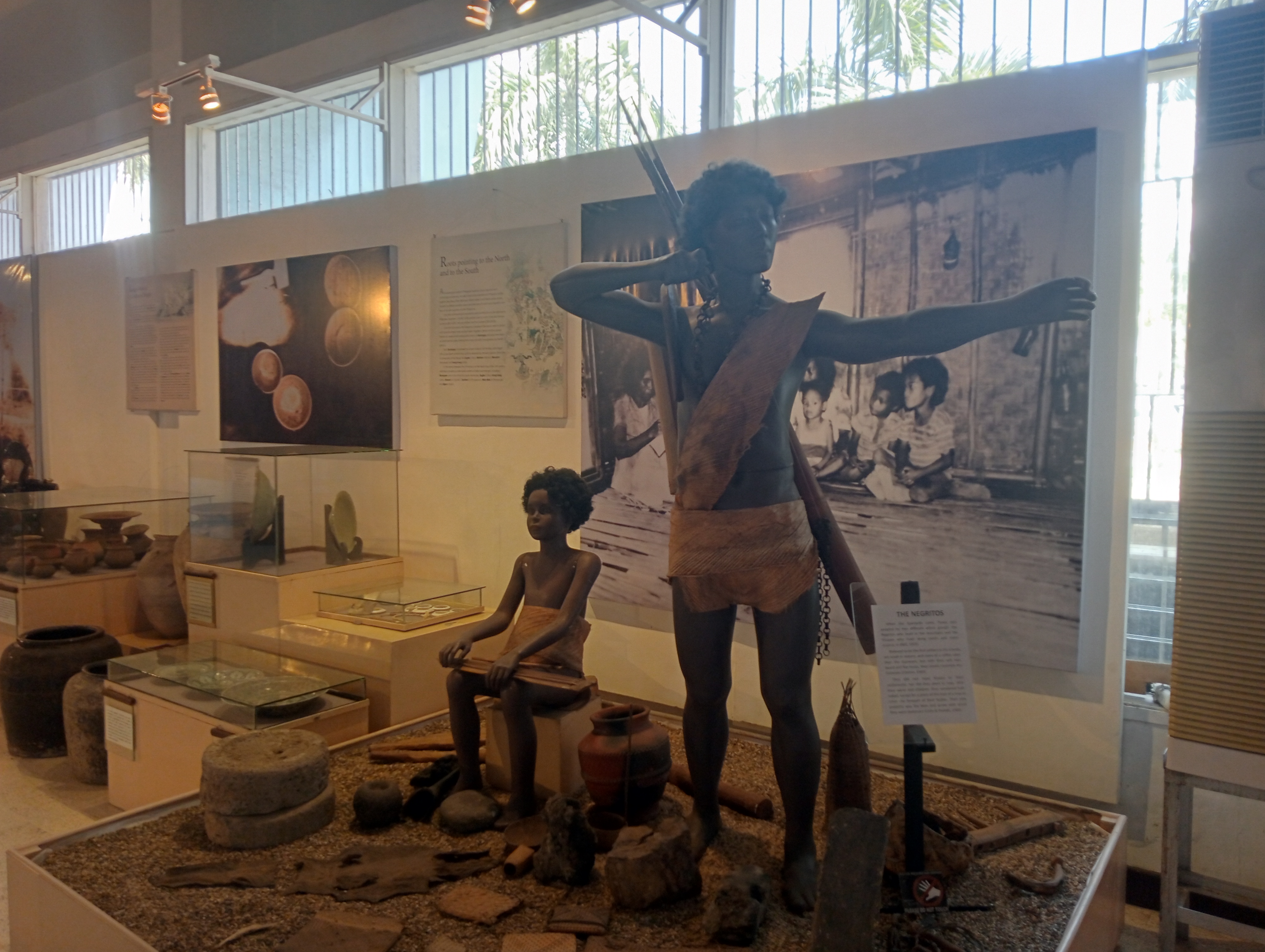
Among the museum's displays are statues representing the Ati people, the indigenous Negrito population of Panay who predated both the Malay settlers and the Spanish colonizers. The Ati are the people honored - and sometimes controversially depicted - during Iloilo's famous Dinagyang Festival each January, where performers paint their skin dark and dance in celebration of the Santo Nino. Museo Iloilo presents the Ati with the sobriety of an anthropological institution rather than the exuberance of a festival, providing didactic panels that explain their history and relationship to the land. The juxtaposition of Ati statues with Spanish-era religious carvings and Chinese-traded ceramics makes visible the layered reality of Panay's population - indigenous, Malay, Chinese, Spanish, American - each stratum leaving artifacts that ended up, eventually, in the same provincial museum on the same street as the provincial capitol.
From the Air
Located at 10.703°N, 122.568°E near the Iloilo Provincial Capitol on Bonifacio Drive in Iloilo City Proper. The museum building sits within the civic campus that includes the capitol complex and the Western Visayas Regional Museum. Iloilo International Airport (RPVI / ILO) is approximately 19 km northwest. Best viewed at 1,500-3,000 ft AGL. The concentration of government and cultural buildings along Bonifacio Drive is identifiable from altitude.