Museo Memoria de la Ciudad
In 1989, with Stroessner's dictatorship freshly toppled, a group of architecture students in Asunción launched a campaign with an urgent name: "Salvemos la Manzana frente al palacio" -- Let's save the block in front of the government palace. The buildings across from the Palacio de los López were crumbling, and there were plans to demolish them entirely and replace them with a park. The students won. Among the nine structures they saved was the Casa Viola, a colonial house built between 1750 and 1758, now home to the Museo Memoria de la Ciudad -- a museum dedicated to the memory of a city that has been accumulating stories for nearly five centuries.
Walls Older Than the Grid
The Casa Viola predates the city as it looks today. Its layout follows the disposition of streets before the dictator José Gaspar Rodríguez de Francia imposed a rigid grid on Asunción in the early nineteenth century, squaring off the organic colonial street pattern that had developed over two and a half centuries. The house itself is a lesson in traditional Paraguayan construction: a tile roof set with a mud-based cement, a front gallery leading to a blacksmith's shop built over wooden beams and columns, and a rear passage demonstrating the culata yovai style of antique Paraguayan architecture. The roof combines palm and tacuara, a native bamboo. Where the city around it was rebuilt, straightened, and modernized, the Casa Viola preserved the texture of the old way of building.
From Ruin to Repository
The restoration began in 1991, driven by the Comisión V Centenario Paraguay as part of celebrations marking five hundred years since the European arrival in the Americas. The Paraguayan writer Augusto Roa Bastos, winner of the Premio Miguel de Cervantes, presented the Casa Viola project to the Agencia Española de Cooperación Internacional, securing international support. Architect Carlos Colombino became the cultural center's first director and guided the museum's creation. It opened on August 14, 1996, its collections drawn from across Paraguay and from New York, Madrid, Paris, Montevideo, and Buenos Aires. In 2005, the United States Embassy sponsored a conservation project to further preserve the site. The museum occupies just one building within the nine-structure Manzana de la Rivera complex, but it carries the weight of the entire city's narrative.
Guaraní Urns and Colonial Doors
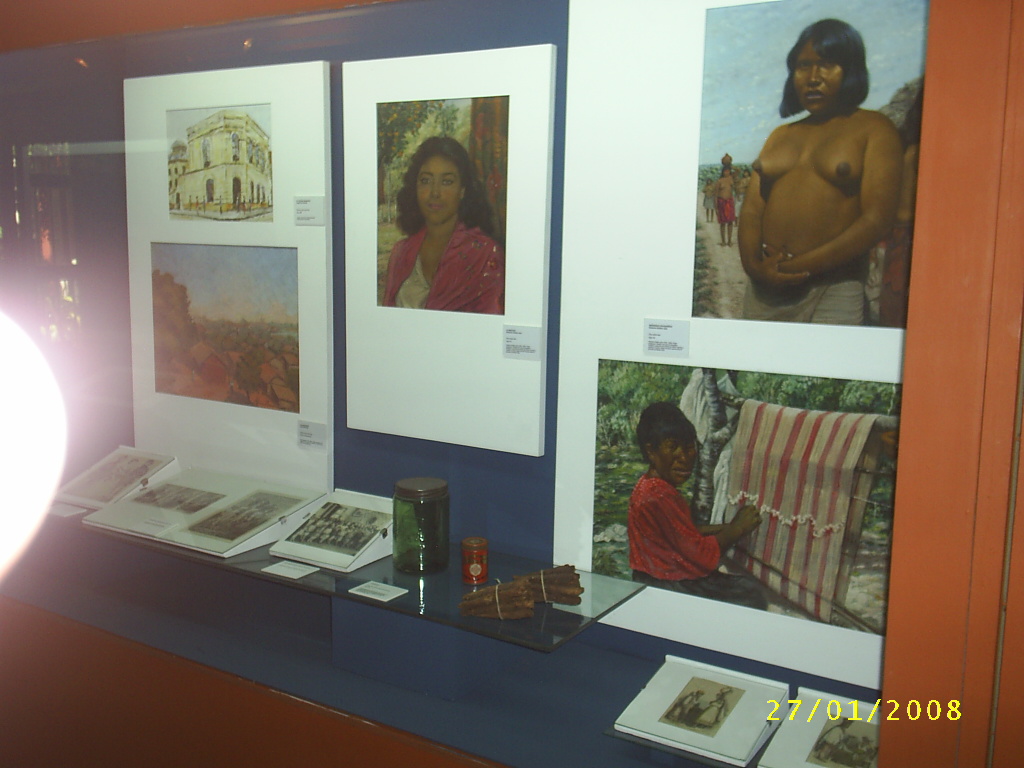
The collection moves through time without hurrying. Guaraní funeral urns, decorated with finger impressions and natural dyes, represent the indigenous pottery traditions that predated Spanish contact. A carved wooden door from the National Club, designed by architect Alejandro Ravizza and finished in 1860, speaks to the ambitions of the López era. Paraguay's national shield, created by José Gaspar Rodríguez de Francia in 1820, appears in concrete relief. Colonial tiles from the Castelví House illustrate the blend of European and local architectural influences that shaped the city's built environment. A copy of the 1578 will of Doña Ysabel Venegas -- described as a "cross-bred and main woman, neighbor of Asunción city" -- offers a glimpse into the personal lives of the colonial period.
Maps, Music, and Mate
The museum's maps alone justify a visit. A colored map produced in Amsterdam in 1694 shows Paraguay as a province of the Río de la Plata, with the adjacent regions of Tucumán and Santa Cruz de la Sierra. A seventeenth-century map includes Asunción's early street plan. Musical scores from composer Carlos Federico Reyes, born in Asunción in 1909, sit alongside the original score of the polka "Recuerdos de Caacupé." In the colonial bedroom display, a wedding bed shares space with hammocks for adults and children, a saint's niche, and a candlestick beside the spot where families would have prayed the rosary together, a child passing the adults their mate. Jars of yerba from the Asunción Company recall the economic engine that mate represented. Each object is small. Taken together, they compose a portrait of daily life across four centuries.
From the Air
The Museo Memoria de la Ciudad is at 25.28°S, 57.64°W, directly across from the Palacio de los López on Asunción's riverfront. It is part of the Manzana de la Rivera complex, a cluster of nine historic buildings visible as a low-rise block amid the modern city center. Silvio Pettirossi International Airport (ICAO: SGAS) is approximately 15 km northeast. Best viewed on approach from the west over the Paraguay River, where the waterfront cultural district contrasts with the surrounding urban fabric.