Museu Picasso
Pablo Picasso could have had his museum in Malaga, the Andalusian city where he was born in 1881. His lifelong friend and secretary Jaume Sabartes originally proposed it. But Picasso refused. Barcelona, he insisted -- the city where he arrived as a teenager, where he haunted the cafes of the Gothic Quarter, where he painted his first major works and began the experiments that would shatter the conventions of Western art. When the Museu Picasso opened on March 9, 1963, it became the first museum anywhere devoted to the artist's work, and the only one created while he was still alive. That it exists at all is a story of friendship, political defiance, and a 14-year-old's love affair with a city that changed him forever.
A Friendship Made Visible
The museum owes its existence to Sabartes, whom Picasso had known since 1899. Over more than six decades of friendship, Picasso had given Sabartes paintings, drawings, and prints -- a personal collection that grew into something museum-worthy through sheer accumulation of generosity. On July 27, 1960, Sabartes signed an agreement with the city of Barcelona to establish the museum, donating 574 works from his collection. The gesture was not simple. Picasso detested Franco's regime, and opening a museum bearing his name in Spain meant navigating political currents that ran against the artist's convictions. The museum opened under the neutral title of the Sabartes Collection. Barcelona's mayor, Josep Porcioles, defied the central government's reservations to make it happen. Among the first year's donations: a book of Picasso's engravings for Ovid's Metamorphoses, given by Salvador Dali, and a 1913 collage donated by Dali's wife Gala.
Five Palaces, One Street
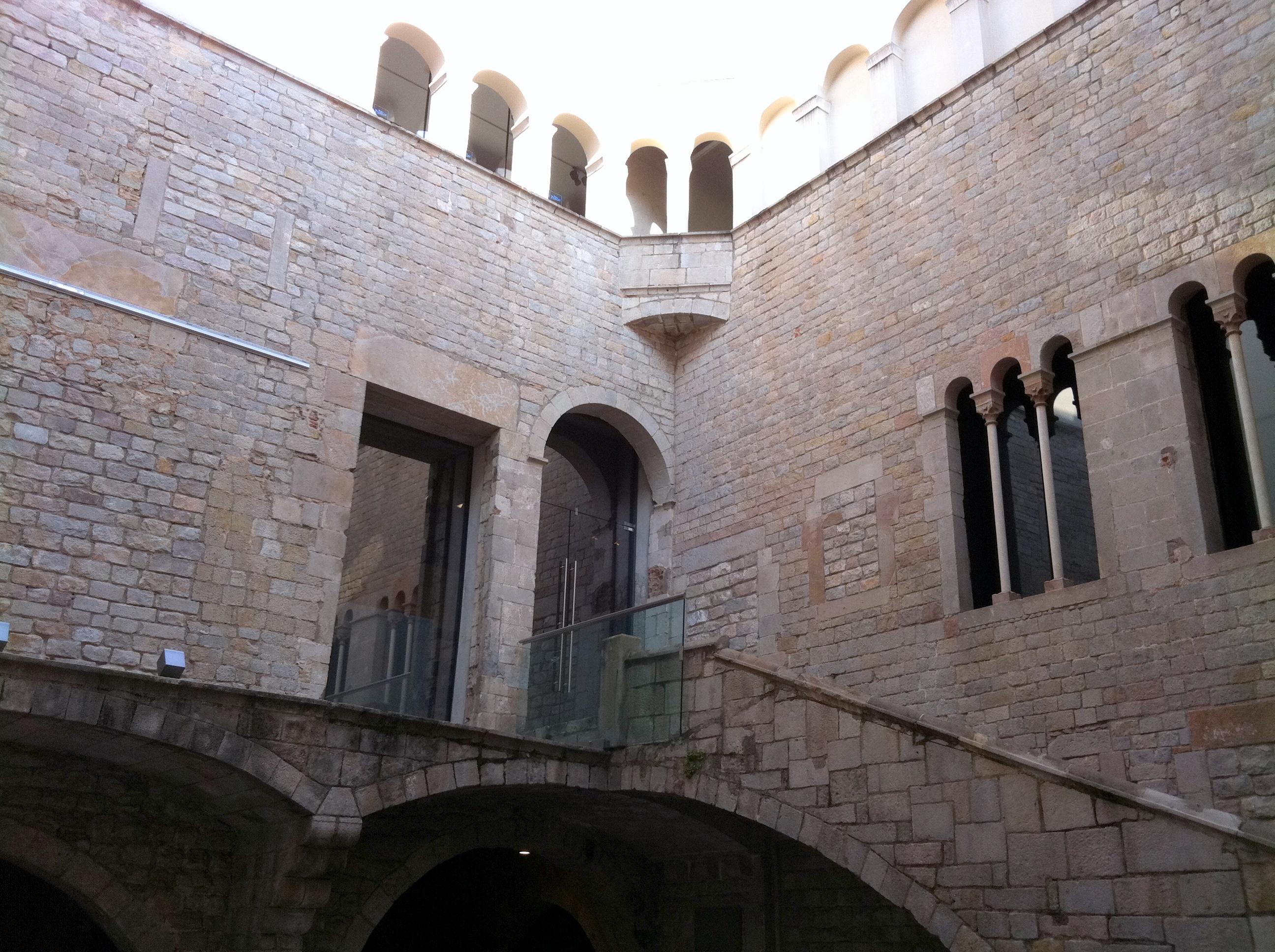
The museum occupies five adjoining medieval palaces along Carrer de Montcada in the La Ribera neighborhood, spanning 10,628 square meters of Gothic civil architecture. Each palace is organized around a central courtyard with an exterior staircase leading to the main floors -- a pattern typical of medieval Barcelona's merchant aristocracy. The oldest, Palau Aguilar, dates from the 13th century and served as the museum's first home. During a 1960 restoration, workers removing plaster uncovered the remains of a 13th-century fresco depicting the conquest of Majorca in 1229 -- an accidental archaeological discovery that now hangs in the National Art Museum of Catalonia. Casa Mauri, acquired in 1999, contains structures dating to Roman times, when the space fell within the suburbs of Barcino. Palau Finestres was built over a Roman necropolis. The buildings are not just containers for Picasso's art; they are artifacts themselves, their foundations reaching back nearly two thousand years.
The Young Picasso
The collection's strength lies in Picasso's early work -- the years between 1890 and 1917 that track his evolution from gifted student to revolutionary artist. Two paintings anchor this period: The First Communion, completed in 1896 when Picasso was fourteen, and Science and Charity from 1897, both ambitious large-scale works that demonstrate technical mastery far beyond his years. The Blue Period paintings from 1901 to 1904 trace his move into emotional territory that academic painting could not contain, their somber palettes reflecting the poverty and suffering he observed in Barcelona and Paris. After Sabartes died in 1968, Picasso made a final, enormous donation in 1970: 920 works, including school notebooks, academic studies, and paintings his family had kept since he first left for France. In 1968, Picasso also donated a series of 58 paintings on Las Meninas -- his sustained meditation on Velazquez's masterpiece, painted in 1957 -- in memory of Sabartes.
A Living Collection
The museum has never stopped growing. Picasso's widow Jacqueline Roque donated 41 pieces in 1982. The Louise Leiris Gallery gave 117 engravings the following year. By 2009, the collection had swelled enough to place the museum among the world's forty most visited art institutions, according to The Art Newspaper. The total now exceeds 4,251 works spanning paintings, drawings, engravings, and ceramics. A Knowledge and Research Center, designed by architect Jordi Garces and opened in 2011, added 1,500 square meters of library, archive, and educational space in a new building on Plaza Sabartes. The transparent glass facade, protected by a cantilevered overhang, makes an architectural argument about openness that echoes the museum's founding impulse. Picasso chose Barcelona because it was where he became Picasso. The museum exists because Sabartes believed that story deserved a permanent home.
From the Air
Located at 41.385N, 2.181E in Barcelona's La Ribera / Born neighborhood, along the narrow medieval street of Carrer de Montcada. The five palace complex is not easily distinguished from the air due to the dense Old City fabric, but the neighborhood sits between the cathedral to the west and the Parc de la Ciutadella to the east. Nearest airport: Barcelona-El Prat (LEBL), approximately 13 km southwest. The Born Market glass-and-iron structure nearby provides a useful aerial landmark. Best viewed at low altitude or on approach.