Museum Bredius
Abraham Bredius spent his life looking at paintings closely, and he was very good at it. Born in Amsterdam in 1855 into a gunpowder fortune, he became director of the Mauritshuis, the international authority on Rembrandt, and the connoisseur whose attributions could double the price of a canvas. He was the man you wanted on your side at auction. But in 1937 - already 82 years old, retired to Monaco for his health, his eyes weary - he was shown a painting called Christ at Emmaus. He pronounced it the greatest Vermeer ever discovered. It was actually painted by a small-time Dutch forger named Han van Meegeren, who would later confess. The forgery of the century fooled the greatest eye of its generation. That eye, and the collection it built, lives now in a Hague canal house on the Lange Vijverberg.
The House on the Vijverberg
Number 14 Lange Vijverberg stands in a terrace of three houses raised together by Pieter de Swart in 1755 - the court architect who supplied decorative work for the royal palace at Huis ten Bosch. A Herenhuis is a Dutch grand townhouse, and for two centuries the Lange Vijverberg's row of them looked out over the Hofvijver pond at the seat of Dutch government. In the 1930s, Frits Lugt bought number 14 to house his enormous collection of drawings - the seed crystal of what became the RKD, the Netherlands Institute for Art History. In 1955, the city of The Hague bought the house for the Bredius collection. The decisive move came thirty-five years later, when a private sponsor funded a full remodel in the original Louis XV style. The museum has occupied the house since 1990, and the rooms feel exactly the way Bredius wanted his rooms to feel: walls crowded with small dark paintings, silver glinting on side tables, the canal light arriving sideways through tall windows.
What a Connoisseur Kept
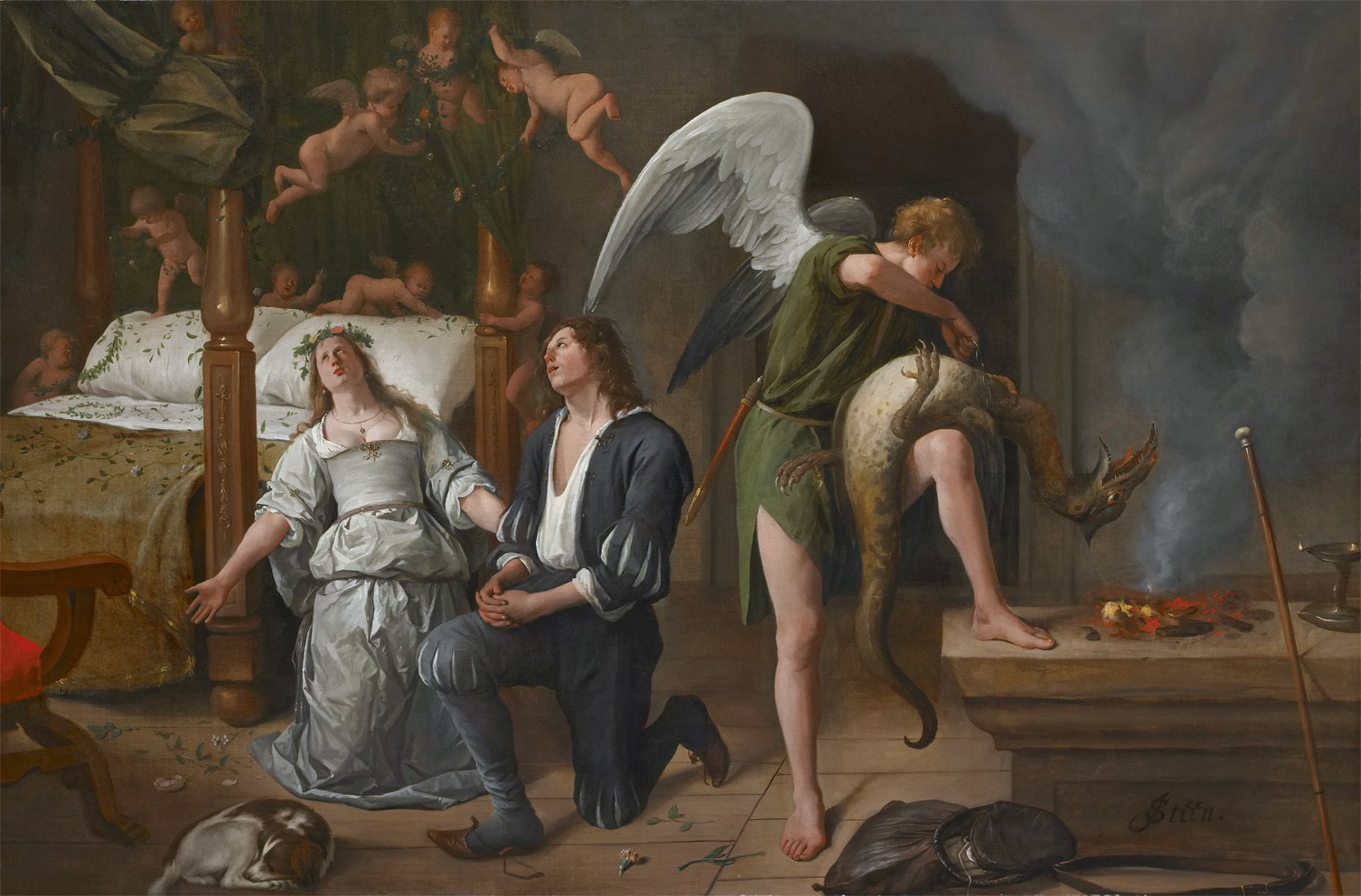
Bredius was rich enough to keep what he wanted and ruthless enough to know what he wanted. Of the paintings he attributed himself, he donated more than 46 to the Rijksmuseum in Amsterdam. The ones he kept are the more idiosyncratic. The collection runs to more than 150 artists - Aelbert Cuyp, Anthony van Dyck, Melchior de Hondecoeter, Adriaen van Ostade, Quiringh van Brekelenkam, and Rembrandt himself. Bredius hunted for first works: the painting an artist made when accepted as a master into the local Guild of Saint Luke. He also hunted for oddities. There is the only known landscape by the seascape painter Cornelis Claesz van Wieringen, a man who otherwise painted nothing but ships. There is a Jan Steen biblical scene of Tobias and Sarah praying as the angel Raphael binds a demon - a painting that nineteenth-century dealers had hacked in two and sold separately as genre scenes, half angel and half marriage bed. In 1996 the museum had it rejoined. The marriage-bed half had belonged to the Jewish dealer Jacques Goudstikker, and the reunification settled an old Nazi-plunder dispute.
A Difficult Man
Bredius's life had the shape of a quarrel. He fought publicly over attributions, over how museums should be built, over who could be trusted to tell a Rembrandt from a follower of Rembrandt. His most lasting feud was with Cornelis Hofstede de Groot, his nearest equal as a Dutch art historian. The two men could not work together. They could not even bear, in the end, to share an institution. The result is the slight historical comedy that Museum Bredius is the only major Bredius institution that does not contain the RKD: the institute Hofstede de Groot's collection helped found is now housed elsewhere, even though it began life in the very same Lange Vijverberg house. Personality made the geography. In 1922, in failing health, Bredius moved to Monaco, convinced the wet Hague climate was bad for his paintings. He left the collection in his Prinsengracht house with a promise that on his death it would go to the city. He died in Monaco in 1946 at the age of 90, having outlived almost everyone he had argued with. In Monaco he wrote his major books on Jan Steen and on Rembrandt, two artists who had been his lifelong project.
Silver, Porcelain, and the Smell of Wax
Painters are only one part of what Bredius kept. The museum holds a large silver collection, including seventy pieces by Amsterdam silversmiths working from the 17th to the 19th century - chalices, ewers, salt cellars, the heavy domestic gleam of Dutch merchant houses at their wealthiest. There is porcelain too: Chinese blue-and-white from the export trade that made Delft rich, German pieces, and Delftware itself in the shapes the Dutch invented to copy what they could not yet import. A Herenhuis museum is partly about objects and partly about the rooms holding them. You smell the wax on the parquet. You hear the silence of a house designed for quiet conversation. The Lange Vijverberg outside has not really changed since 1755.
The Last Vermeer
It is hard to talk about Bredius without circling back to the forgery. Van Meegeren spent years before the war learning to imitate seventeenth-century technique - using badger-hair brushes, grinding his own pigments, baking the painted canvases in an oven to crack them. Christ at Emmaus was his masterpiece. Bredius wrote that no Vermeer he had ever seen approached it. The painting fooled museums, dealers, the Dutch state itself. When Van Meegeren was arrested in 1945 for selling another fake Vermeer to Hermann Goring, he confessed in court and painted a final one to prove it. Bredius was already dead by then. The Bredius collection does not pretend otherwise. The forgery is part of the connoisseur's story - the reminder, in a house full of careful attributions, that even the best eye on earth can want a painting to be real.
From the Air
Located at 52.0813 degrees N, 4.3127 degrees E at Lange Vijverberg 14, on the north side of the Hofvijver pond facing the Binnenhof parliamentary complex. Best viewed at 1500-2500 ft AGL on approach to Rotterdam The Hague Airport (EHRD, about 6 nm south-southeast). From the air, identify the rectangular Hofvijver reflecting pool; the Bredius and the Haags Historisch Museum sit side by side on its north shore, with the Mauritshuis (home of Vermeer's Girl with a Pearl Earring) directly across the water. The Hague is uncontrolled VFR below the Schiphol TMA - check NOTAMs for royal-family movements that occasionally restrict the city center.