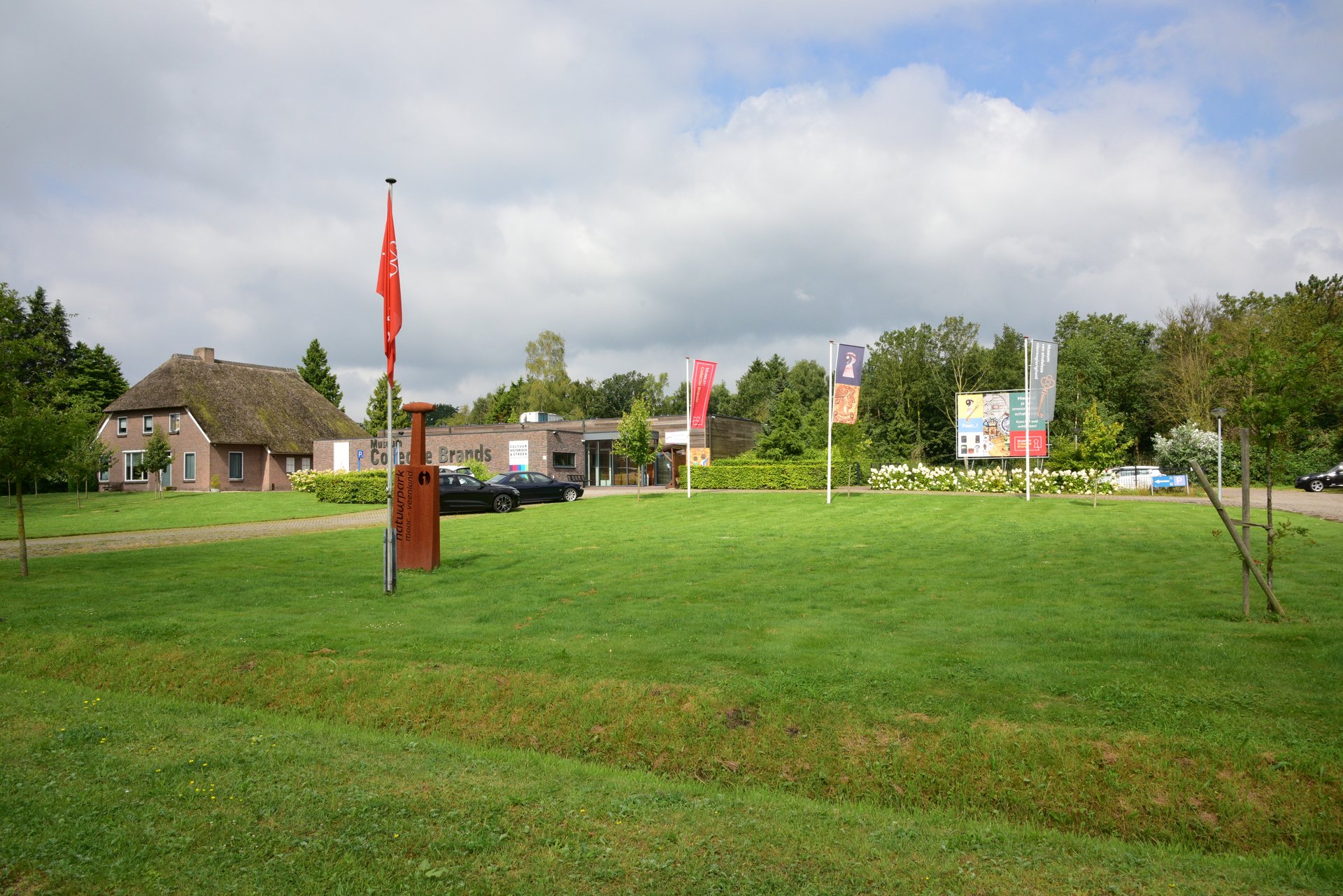
Museum Collectie Brands
Jans Brands could not let things go. Old newspapers, garage-sale oddments, a calculator no one made anymore, a coin minted under a Frankish king dead twelve hundred years, the handwritten will of a Dutch princess: he kept them all. For sixty-five years, in a rebuilt farmhouse along the Herenstreek in the Drenthe village of Nieuw-Dordrecht, he stacked his hoard around the dining table and the 1950s kitchen where he lived almost his entire adult life. By the time he died in 2019, the collection had passed seventy thousand objects, and the farmhouse had become a museum.
The Boy Who Saved Things
Brands was born into a farmhouse marked, literally, by the last war. An Allied bomber had crashed nearby during the Second World War and damaged the house his parents lived in; a new one was built after the fighting ended, and Jans grew up among salvaged things. He realized early that ordinary objects, the ones other people threw away, told the most honest stories. He bought books at jumble sales and bid carefully at auctions for the rarer pieces. There was no grand plan and no museum studies degree behind it. There was simply a man who treated the past as something you could rescue, one item at a time, from the bin and the bonfire.
Becoming a Museum, Slowly
The wider world caught on in 1978, when an exhibition celebrating the 125th anniversary of Nieuw-Dordrecht showed off pieces from the collection. Visitors were stunned by what had been quietly accumulating up the road. In 1991 a foundation was set up to protect the hoard. In 1999 the province of Drenthe formally assessed the cultural-historical value of what Brands had gathered, confirming it was worth preserving for Drenthe. The farmhouse opened to weekend visitors in 2002. A purpose-built library went up alongside in 2011, and on 5 June 2015 Collectie Brands was formally recognized as a museum. By 2020, with the pandemic emptying out reading rooms across Europe, the library was reshuffled to make even more room for exhibition.
The Crown Jewel
The single object the curators call the crown jewel is unassuming: a leather-bound register made in 1382, listing the feudal lords sworn to Floris van Wevelinkhoven, bishop of Utrecht, and the lands they held in his name. The book is a kind of medieval property database, the closest thing the fourteenth century had to a deeds office. A second copy exists in the Utrecht archives, but it is incomplete. The fullest surviving copy lives, improbably, in a renovated peat-colony farmhouse in Drenthe.
The Odd Inventory
Around the register clusters a magpie's idea of treasure. The handwritten last will of Princess Marianne of the Netherlands sits near a fragment of the Sikhote-Alin meteorite, which slammed into the Soviet Far East in 1947. A small Austrian Curta calculator, the pepper-grinder of mid-century engineering, shares space with a gold solidus struck under Dagobert I, king of the Franks, in the early seventh century. There is A.E. van Giffen's 1926 atlas of the Dutch hunebedden, the Neolithic stone tombs that still dot the Drenthe landscape, and a capstone from the gate of Camp Dalum, one of the grim Emsland camps just across the German border. Works by Hendrik Werkman, Jan Dekkers, Hendrik de Vries and Janny Jalving line the exposition walls. A few reproductions of Van Gogh round out the eclectic chorus.
Visiting the Hoard
The dining room, the sitting room and the kitchen still wear their 1950s skin, a quiet stage set in which one man's life took place. The old working spaces have been converted into exhibition halls, and a connected modern building added in 2011 holds the second gallery, the shop and the cafe. Plans for a further expansion, with a courtyard and a second exhibition hall, were already underway in 2021. The whole place still feels less like an institution than a long, ongoing argument that even the smallest, oldest, dustiest things deserve to be looked after.
From the Air
Located at 52.77 N, 6.97 E in southeast Drenthe, on the edge of Nieuw-Dordrecht near the German border. From cruise altitude the area reads as a chessboard of canalized peat fields, with the Bargerveen nature reserve to the southeast and the larger town of Emmen visible to the north. Nearest airports: Groningen Airport Eelde (EHGG) about 65 km north, Munster/Osnabruck (EDDG) about 75 km southeast. The Herenstreek runs as a faint straight line through the village.