Museum De Cruquius
Schiphol Airport sits on the bed of a lake that no longer exists. For roughly two centuries, the Haarlemmermeer was a shallow inland sea covering 18,000 hectares of the Dutch heartland, swallowing villages during storms and creeping toward Amsterdam itself. Then, in 1849, three colossal steam pumping stations went to work. Within three years, the lake was gone. One of those machines still stands at the southern edge of the new polder, its eight cast-iron beams motionless inside a Gothic brick fortress, and Cruquius is thought to be the largest steam engine ever built.
A Lake Worth Killing
Nicolaas Kruik, who Latinized his name to Cruquius in the fashion of his century, was a Dutch land-surveyor born in 1678 who became obsessed with a problem. The Haarlem lake grew. Storms tore at its banks, swallowing farmland one season and homes the next, and by the eighteenth century the water lay close enough to Amsterdam and Leiden to threaten both. Cruquius spent decades arguing that the lake could be pumped dry. The technology of his time could not match his ambition. By 1751 the project was international news. A Virginia Gazette dispatch that May relayed the Dutch engineers' proposal to drain the lake with 150 windmills running for three years, at a cost of a million and a half florins, alongside a rival German scheme to do the job with fifty machines in fifteen months. Both plans died on cost. The lake won, again, for another century.
The Cornish Giant
What finally killed the Haarlemmermeer was steam from Cornwall. The dike around the lake went up through the 1840s. Three pumping stations rose along it, named for the men who had dreamed of this moment: Leeghwater, Lijnden, and Cruquius. Cruquius started work in 1850, and in the three years the eighteenth-century engineers had predicted, the lake was gone. The engine itself came from Harvey & Co. of Hayle, on the Cornish coast - the same firm that built mining pumps for the deepest tin works in Europe. It is an annular-compound steam engine with two cylinders nested one inside the other. The outer low-pressure cylinder measures 144 inches across. Eight rocking beams transfer the power outward through the building's walls to lifts that raised water nine meters from the polder up to the ringvaart canal. Stand behind the museum today and you can still see that drop, the canal level riding above your head while the old lake bed stretches flat to the horizon.
What the Lake Became
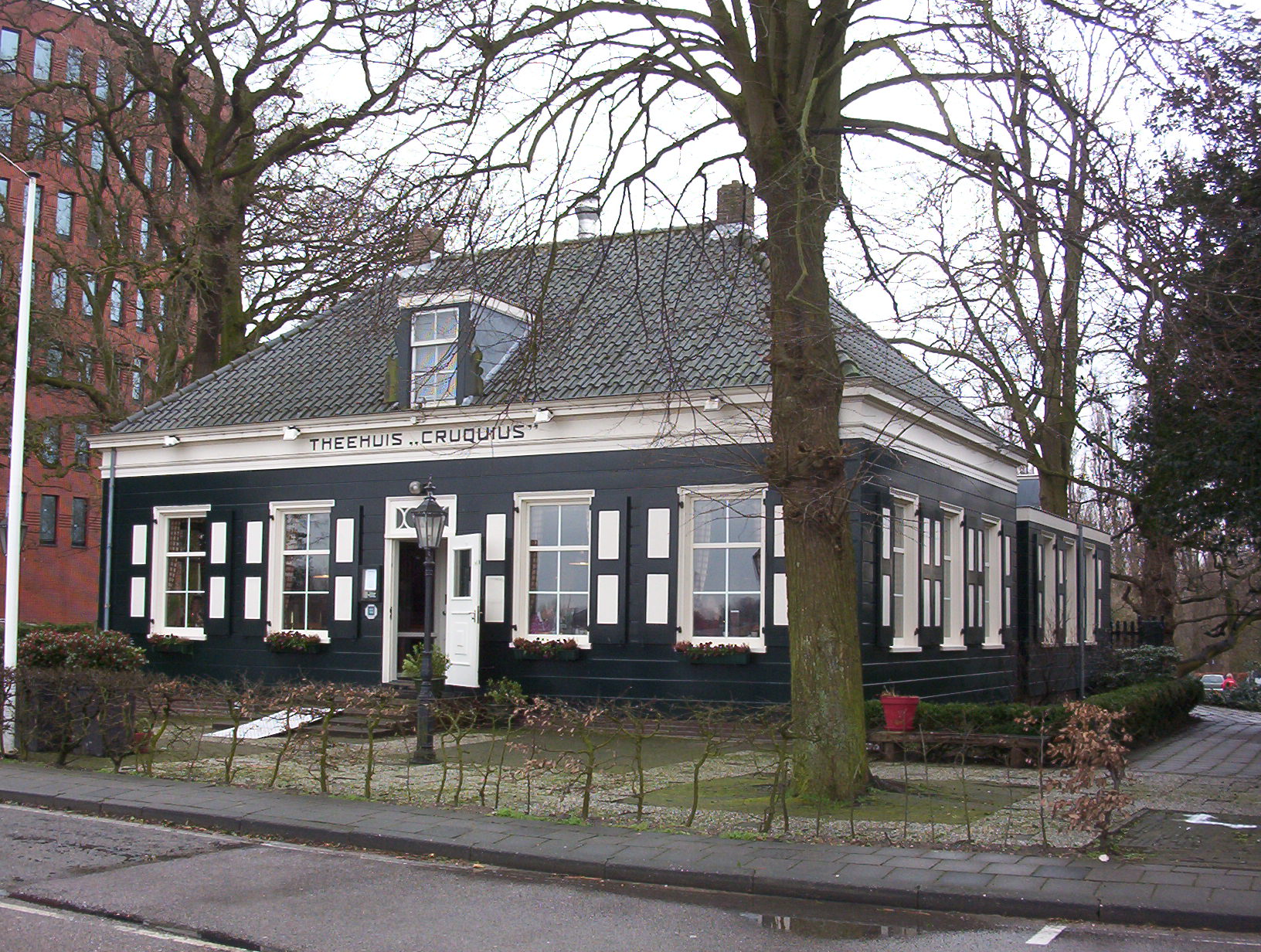
The Haarlemmermeer polder is one of the largest pieces of land ever reclaimed by a single act of engineering. Roughly 18,000 hectares of new earth appeared where the lake had been - and on the western edge of that fresh ground, a hundred years after the pumps stopped the water, the Dutch built Schiphol. The airport's main runways sit four to five meters below sea level, on soil that owes its existence to a Cornish boiler. Every flight in and out of Amsterdam takes off from the floor of a vanished sea. The Cruquius engine itself ran on and off until 1932, then became a museum. The American Society of Mechanical Engineers named it a Historic Mechanical Engineering Landmark in 1991. The foreman's house next door, where the man responsible for keeping eight beams in time once lived, is a café today.
Stelling and Sluice
Cruquius sits inside a larger landscape of Dutch water defense. The ringvaart canal that rings the old lake is part of the Stelling van Amsterdam, the late nineteenth-century ring of forts and inundation works that could flood the countryside on command to defend the capital. Fort Vijfhuizen lies a short walk north along the dike, now used for art exhibitions. Fort Cruquius lies just south of the museum, and both forts carry UNESCO World Heritage status as part of the Stelling. The country's relationship with water is rarely simple. The Dutch drained this lake to make farmland; they ring the new farmland with forts designed to flood it again. Engineering against the sea, engineering against an army, engineering against the slow patient gravity of the polder sinking below the canals that surround it - all of it visible from one brick pumphouse on the Spaarne.
The Beams at Rest
Inside the engine hall the beams hang in silence now, painted dark, the rods and joints catching the light from the upper windows. The museum runs the mechanism on compressed air a few times a year. When the beams move, the whole building works as a machine - that was always the point. The walls themselves transfer thrust. The arches above carry load. Harvey & Co. did not build an engine inside a building; they built the building as part of the engine. A steam engine that erased a lake, made a polder, and prepared the ground for an airport that would one day be the busiest in Europe. Not bad for a machine named after a seventeenth-century surveyor who never lived to see his idea pay off.
From the Air
Coordinates 52.338°N, 4.638°E, on the southern ringvaart of the Haarlemmermeer polder near Heemstede. Best viewed from 1,000-2,500 ft on approach or departure from Schiphol (EHAM), roughly 10 km southwest of the airport. The brick Gothic pump house is unmistakable on the dike between Heemstede and the polder, with the canal sitting visibly higher than the surrounding fields. Nearest small field: Rotterdam-Hague (EHRD) to the south, Lelystad (EHLE) to the northeast.