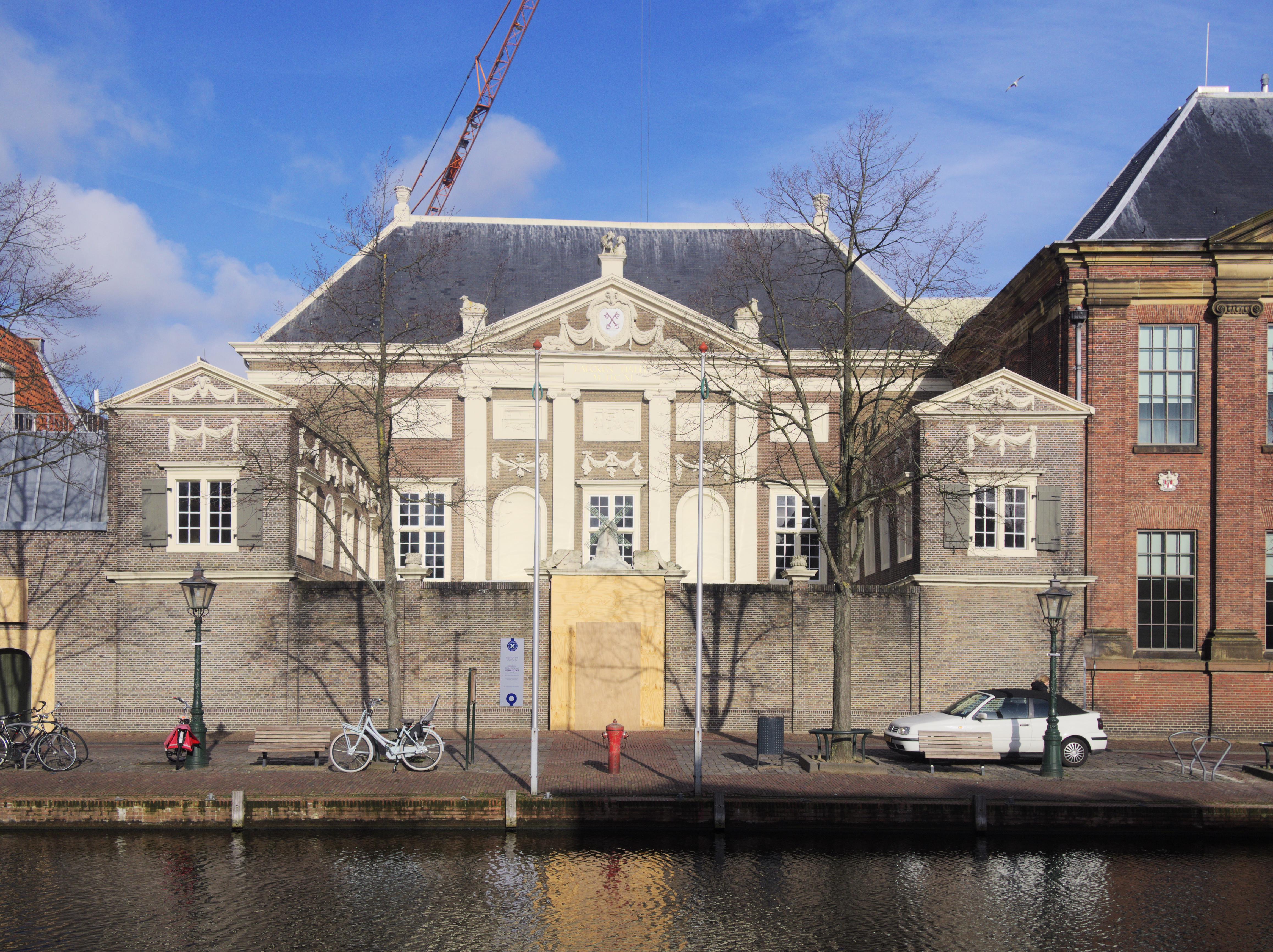
Museum De Lakenhal
In a back room of the old cloth hall, four large paintings by Isaac van Swanenburg still hang in the exact spots their seventeenth-century commissioners chose for them. The room is the Staalmeesterskamer - the staal masters' chamber - and four hundred years ago, samples of Leiden wool were brought here under the gaze of those paintings to be measured, judged, and stamped with a lead seal. Pass the inspection and your cloth could be exported across Europe under the Leiden quality mark. Fail, and your livelihood went unsold. The room is now part of Museum De Lakenhal, but the paintings have never moved, and the slightly intimidating geometry of judges and judged is still legible in the way the chairs face the door.
Built for Cloth
The building went up in 1640, designed by Arent van 's-Gravesande as a guild hall for the merchants who controlled the most important industry in seventeenth-century Leiden. Leiden was, in that decade, the cloth capital of Europe. Tens of thousands of weavers worked looms in attics and back rooms across the city; the population doubled, then tripled, as Flemish refugees fleeing Spanish persecution brought their skills north. The Lakenhal was where the finished bolts were inspected and certified. The painter Isaac van Swanenburg, who delivered four giant canvases tracking the wool's journey from shearing to dyeing to weaving to finished cloth, had to know the trade intimately - he had been a Leiden burgomaster, and was the father of one of the city's most famous painting workshops. His son Jacob van Swanenburg ran that workshop, and Jacob's most famous student was a boy named Rembrandt.
The Earliest Rembrandts
Among the Lakenhal's Rembrandt holdings is A Pedlar Selling Spectacles (Allegory of Sight), one of the earliest known paintings in Rembrandt's hand, made around 1624 when he was barely seventeen. It belongs to a series of five small panels depicting the Senses, painted before he had yet signed his name on a canvas. Five years later he would leave Leiden for Amsterdam and change European painting. These early panels hang in the city where he learned to paint, a few streets from the house where he was born.
The Hidden Catholic Room
After the Reformation, Catholic worship was officially banned in the young Dutch Republic. Officially. In practice, Dutch tolerance had a quietly transactional shape: Catholic congregations could meet in unmarked buildings, often above shops or behind ordinary front doors, as long as the buildings did not look like churches from the street. These semi-hidden churches were called staties or mission stations, and they were tolerated, taxed, and well-known to everyone in the neighborhood. The Lakenhal has reconstructed one inside the museum - a fully fitted Catholic worship space behind an ordinary facade, with altars, statues, and benches arranged for Mass. It is an honest portrait of how religious freedom actually worked in the Netherlands: not formal equality, but a practiced and profitable looking-the-other-way.
From Cloth Hall to City Museum
The wool trade declined in the eighteenth century, slowly and then quickly, and the Lakenhal lost its commercial purpose. In 1874 the city converted the building into a stedelijk museum - a municipal museum - and started filling it with the art and artifacts of Leiden's past: stained glass windows by Willem Thibaut commissioned for the old city hall, altarpieces ceded to the state in 1572 during the iconoclasm, allegorical paintings by Abraham van den Tempel of Minerva crowning the Maid of Leiden. The collection grew haphazardly through the late nineteenth and early twentieth centuries, gaining wings and exhibition halls. Between 2016 and 2019 the museum closed for a complete renovation costing roughly nineteen million euros. It reopened with a newly attributed Rembrandt, Suffer Little Children to Come Unto Me, on temporary display - a homecoming for a painter who had run out of room in his hometown four hundred years earlier.
What to Look For
The Lakenhal rewards slow looking. The Senses series by Rembrandt - five small panels of which the museum holds A Pedlar Selling Spectacles, the Allegory of Sight - is among the earliest works in his hand. The De Stijl room holds early Mondrians from when the painter still signed his name 'Piet Mondriaan,' before the move to Paris and the dissolution into pure rectangles. Contemporary works by Claudy Jongstra and Atelier van Lieshout share space with seventeenth-century fijnschilder paintings whose surfaces are so smooth and detailed they reward a magnifying glass. The Staalmeesterskamer remains the museum's quiet center: a room that has been inspecting things for nearly four hundred years.
From the Air
Museum De Lakenhal sits at 52.163°N, 4.487°E, along the Oude Singel canal at the northern edge of Leiden's historic core. Its tall pale brick facade, with a steep central gable, is set back from the canal behind a small forecourt. The museum's two wings - the original 1640 cloth hall and the 2019 contemporary expansion - read clearly from above as two distinct rooflines. Recommended viewing altitude is 1,500-3,000 ft AGL. Nearest airports: Rotterdam The Hague (EHRD) about 15 nm south, Schiphol (EHAM) about 16 nm northeast.