Museum Geelvinck-Hinlopen
Sara Hinlopen was twenty-seven when she moved into the wide canal house on the Keizersgracht in 1687, married seven years to a lawyer thirteen years her senior. She and her sister had won the inheritance lottery as orphans — among the items that fell to them by lot at their father's estate were paintings by Rembrandt and Gabriel Metsu. The house her husband Albert Geelvinck built backed onto a quiet garden running through to the Herengracht, double-wide, with cellars and an attic warehouse. Three centuries later, between 1991 and 2015, those rooms operated as Museum Geelvinck-Hinlopen, a canal-house museum in the Rembrandtplein neighborhood. The mansion is closed to the public now. The museum kept going, moved twice, and built its life around a single peculiar passion: historic fortepianos.
The Sister Who Inherited Rembrandts
Sara Hinlopen's biography reads like the script of a Dutch novel. Orphaned at six. Raised briefly by a stepmother, Lucia Wijbrants, before that arrangement broke down. Moved with her sister Johanna in 1672 into the household of an uncle, Jacob J. Hinlopen. The girls had already inherited, by random lot, the paintings their father Jan J. Hinlopen had collected — a small fortune in art, including works by Rembrandt and Metsu. Sara was eager to leave the uncle's house. In 1680, at twenty, she married Albert Geelvinck. He was thirty-three, a lawyer, the son of one of the Geelvinck merchant family that built its wealth on shipping to Spain, Africa, Suriname, and the West Indies. The Geelvincks supplied Amsterdam five burgomasters across two centuries. Sara had married into the regenten — the small ruling class of patrician families that ran the Dutch Republic from inside its canal houses.
Four Rooms of Wallpaper
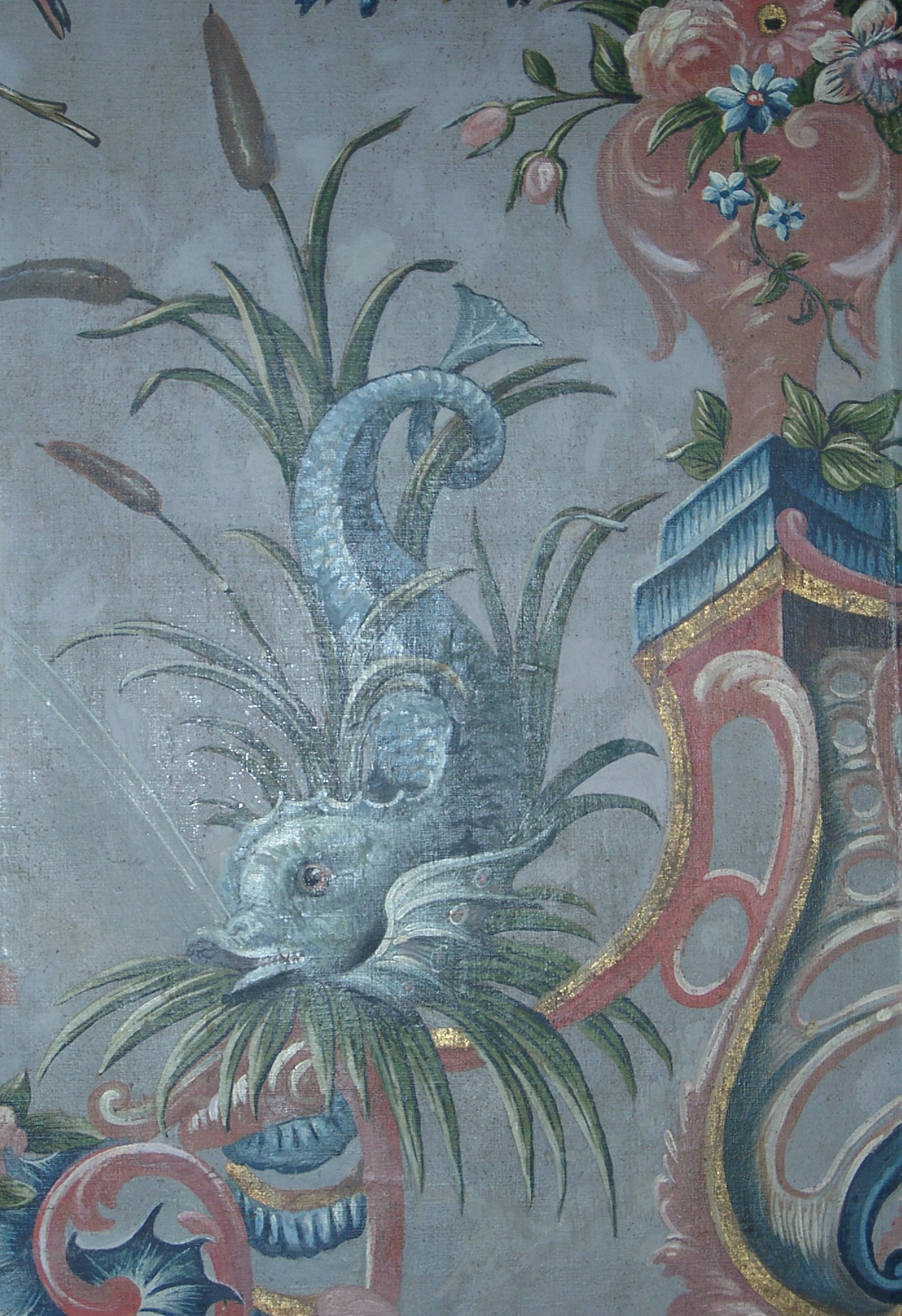
What the museum opened to the public in 1991 was a remarkably intact set of four reception rooms upstairs. The Blue Room held five wallpaper panels painted around 1788 by Egbert van Drielst, a romantic landscape painter whose work owed something to Hobbema and Ruisdael — idealized nature, horizon held steady at eye level. The panels had wandered: designed originally for a Keizersgracht house, then displayed in rooms in New York and Miami, then returned in 1990. The Red Room held six seventeenth-century paintings, including a Daniel Seghers flower still life painted by a Jesuit in Antwerp and a winterscape by Antonie van Stralen. The Chinese Room had eight rococo wallpaper panels from somewhere between 1765 and 1775, painted in a Brussels cuir-de-Cordoue workshop and probably based on engravings by Jean-Baptiste Pillement. The table in that room had once belonged to Frederick William III of Prussia.
The Garden Hiding in Plain Sight
The garden between the Keizersgracht entrance and the mansion is one of those Amsterdam secrets you would never guess from the street. The back half is laid out as a Renaissance garden; the front is a formal, symmetrical French garden with a pond and a fountain. Most of the time it held an exhibition of statues. Every June the museum opened its garden as part of Amsterdam's Open Garden Days, when the city's hidden courtyards along the canals briefly become public space. Stand in this garden and the city falls quiet. The canal traffic is fifty meters away through brick walls, but you cannot hear it. The Geelvincks built privacy as carefully as they built status.
Pianos That Tinkle, Not Boom
The other obsession of the museum was sound. Museum Geelvinck collected fortepianos — the smaller, gentler ancestors of the modern concert grand, with thinner strings and leather hammers that produce a quieter, brighter, more conversational tone. A Broadwood square piano. Other instruments from the Beethoven era and earlier. The museum programmed concerts on them, in the Red Room and the Blue Room and the Chinese Room, so visitors heard the music of the eighteenth and early nineteenth centuries played on the kind of instrument it was actually written for. The effect is startling the first time you hear it. Modern grand pianos roar. Fortepianos talk. Mozart sounds like a conversation, not a thunderstorm.
A Museum on the Move
By the end of 2015 the museum had to leave the Herengracht mansion. In spring 2017 it reopened as the Geelvinck Muziek Museum in the historic house De Wildeman in Zutphen, two hours east of Amsterdam. That venue lasted only until the end of 2019. The collection moved again, this time to the country estate Kolthoorn House in Heerde, with a satellite venue at the Posthoornkerk in Amsterdam where the historic pianos are available by appointment. Geelvinck Salon concerts continue weekly. The collection partners with the Pianola Museum and Huis Midwoud. It is a museum that has lost its original house but kept playing its instruments — a fitting outcome for a collection that was always more about the sound a room could hold than the room itself.
From the Air
The original mansion at Keizersgracht 633 sits at 52.3647 N, 4.8946 E in central Amsterdam, near the Rembrandtplein. Note that the museum collection moved out at the end of 2015 and is no longer on view here. Current viewable venues are at Kolthoorn House in Heerde (52.39 N, 5.97 E) and the Posthoornkerk in Amsterdam. Nearest airport: Amsterdam Schiphol (EHAM/AMS), 14 km southwest.