Museum Island
The bust of Nefertiti is not supposed to be in Berlin. The German Egyptologist Ludwig Borchardt found her at Amarna in December 1912 and, according to Egyptian officials and most subsequent historians, misled the inspector at the partition of finds about her quality and value. She was crated to Berlin and put on display in 1924. Egypt has been formally requesting her return since 1925. She is currently on the second floor of the Neues Museum, looking left, the painted limestone of her face still as sharp as the day she was finished by Thutmose's workshop around 1340 BCE. About 800,000 people come to see her every year. None of the official tours start by saying she was probably looted.
Five Museums on a River
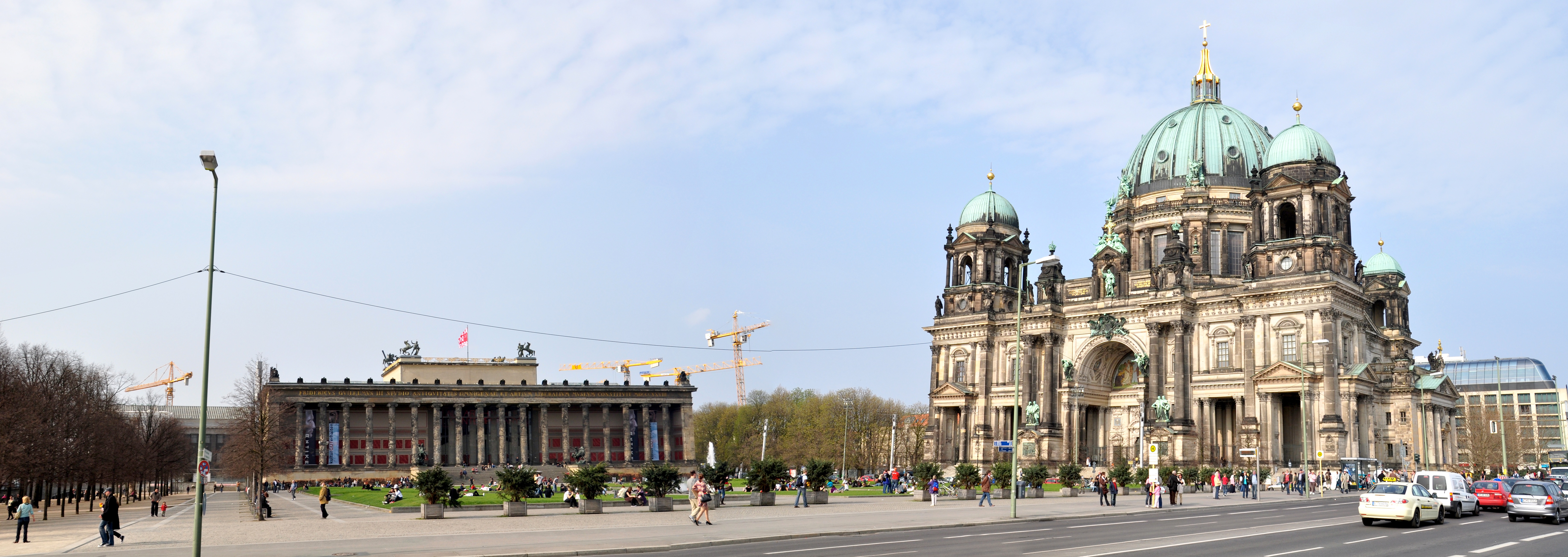
Spree Island sits in the historical center of Berlin, the city's first settled ground. The northern half, Museumsinsel, holds five museums built in the order Prussia could afford them. Karl Friedrich Schinkel's Altes Museum opened in 1830, the first purpose-built public museum in Berlin, with classical antiquities filling its first floor and exhibitions on its second. The Neues Museum followed in 1859, holding Egyptian and prehistoric collections, including Nefertiti. The Alte Nationalgalerie, completed in 1876, gathered nineteenth-century European painting. The Bode-Museum at the island's tip opened in 1904 with sculpture and Byzantine art. The Pergamon, the largest, opened in 1930, named for the Greek altar that fills its central hall. King Frederick William IV of Prussia formally dedicated the island to art and science in 1841. The buildings took a hundred years to complete. UNESCO listed the entire ensemble in 1999.
The Pergamon Closure
The Pergamon Museum closed for renovation in October 2023 and is not expected to fully reopen until 2037. The north wing alone may return to the public around 2027. The closure is the largest single project on Museum Island in living memory, addressing structural failures in the building and a complete redesign of how visitors approach the Pergamon Altar, the Market Gate of Miletus, and the Ishtar Gate from Babylon. None of these objects are uncontroversial. The Pergamon Altar was excavated by Carl Humann from the Ottoman Empire in the 1870s under an arrangement with the sultan that would not pass any modern museum ethics review. The Ishtar Gate was reconstructed in Berlin from glazed bricks shipped out of Iraq while it was under Ottoman rule. The arguments about return are quieter than the Egyptian arguments about Nefertiti, but they have not gone away.
Schinkel's Stairs and the Bombed-Out Neues
The Neues Museum was hit hard by Allied bombing in 1943 and 1945. By the war's end, sections of the building were open to the sky and the murals on the surviving walls were exposed to weather. East Germany sealed the wreck and waited. After reunification, the British architect David Chipperfield was given the commission to rebuild it without erasing the wounds. Chipperfield's restoration, finished in 2009, left bullet holes visible in the brick, kept the surviving frescoes where the bombing had not destroyed them, and connected old fragments with deliberately new concrete and brick. It is one of the most discussed museum buildings of the twenty-first century, and easily the most moving on the island. Nefertiti sits inside it, in a domed room that survived. The room was designed for her in 1855, before anyone had heard of her.
The Treasure That Went East
Heinrich Schliemann smuggled Priam's Treasure out of Ottoman Turkey in 1873, then smuggled it out of Germany to Moscow at the end of the Second World War. The Soviet army took the gold along with thousands of other artifacts as trophies. Today, Priam's Treasure is on display at the Pushkin Museum in Moscow. Russia has not returned it. After the Berlin Wall came down, the East German museum holdings on the island reunited with the West German collections that had been displaced to Dahlem and Charlottenburg, but the war losses to Russia did not come back. Walk through Museum Island today and you are walking through a collection that has been split and reunited and split again, partly by Prussian acquisition, partly by Allied bombing, partly by Soviet trophy commissions, partly by ongoing arguments about who has the right to keep what.
James Simon and the New Entrance
David Chipperfield returned to Museum Island in 2019 with the James Simon Gallery, the first new building on the island in nearly a century. It is named for the Berlin Jewish silk merchant who funded the original Amarna excavation and donated objects to the city, including the Nefertiti bust itself. Simon died in 1932; his foundations were dismantled by the Nazis and his name was largely erased until reunification. The gallery serves as the new central entrance, ticketing point, and visitor orientation for the island, connecting underground to the Neues, Altes, Pergamon, and Bode Museums through what the architects call the Archaeological Promenade. It is a quiet, white-stone building with tall colonnades, deferential to its older neighbors. Putting Simon's name on it is one of the small acts of correction that the island has been working through, slowly, for thirty years.
From the Air
Located at 52.521 N, 13.396 E in central Berlin's Mitte district, on the northern half of Spree Island. The five museums and the Berlin Cathedral are clearly grouped together with the Spree splitting around them. Berlin Brandenburg (EDDB) is about 18 km southeast. Best viewed from the south or east at low altitude, with the green dome of the Berlin Cathedral as the most prominent visual marker. The Pergamon Museum scaffolding will be visible through 2037.