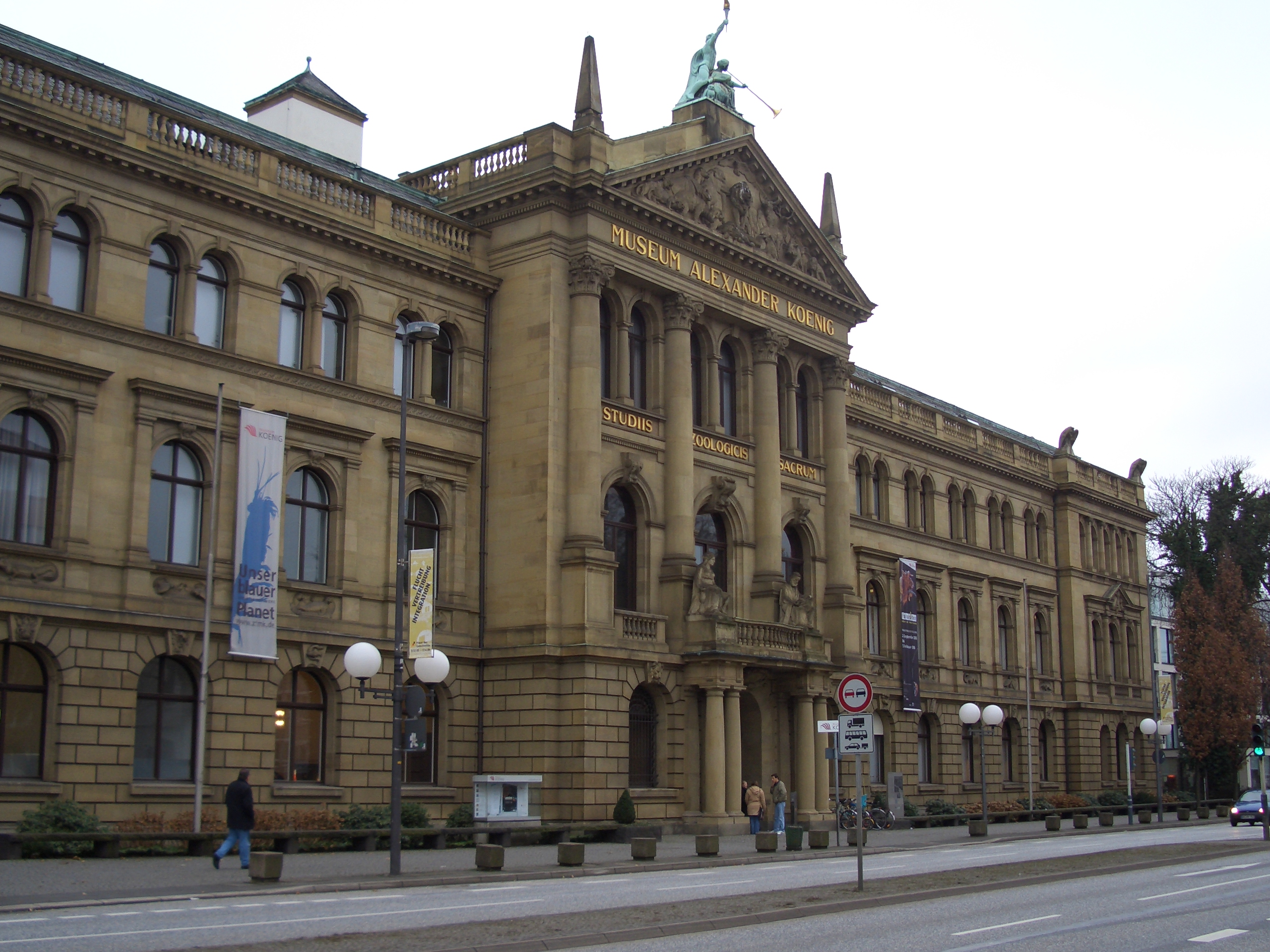
Museum Koenig Bonn
The room had been a giraffe hall. On 1 September 1948, in a side room of a zoological museum in Bonn, sixty-one men and four women sat down with a pile of legal pads and the impossible task of inventing a constitution for a country that did not yet legally exist. The Parlamentarischer Rat — the Parliamentary Council — had its opening session in the Museum Koenig for the most practical reason imaginable. After the bombing campaigns of 1944 and 1945 the museum was the only large, intact, presentable hall in occupied Bonn. So they pushed the dioramas aside and got to work. Nine months later they had the Grundgesetz, the Basic Law of the Federal Republic of Germany, and modern Germany had its founding text. If you want to point at the literal building where West Germany was born, this is the one.
Alexander Koenig's Birds
The museum exists at all because of one rich Bonn boy who liked birds. Alexander Koenig was born in 1858, the son of the wealthy merchant Leopold Koenig, and started collecting birds and small mammals as a child. He took a doctorate in zoology in 1884, married Margarethe Westphal the same year, and was given the family villa on the Rhine flats south of Bonn by his father as a wedding present. By 1900 he had built a private museum behind the villa to house specimens from his expeditions to the Arctic and to Africa. Then, after his father died in 1903, Alexander made the move that would shape Bonn for the next century: he started planning a public natural history museum to share the whole collection. The foundation stone was laid on 3 September 1912.
Twenty-Two Years to Open
The First World War interrupted everything. The unfinished museum was confiscated by the German military in 1914 and used as a military hospital. After the war French occupying forces took it over and ran it as a barracks until 1923. Koenig himself lost most of his fortune to the postwar inflation, and in 1929 — old, ruined, and stubborn — he donated the entire building and his private collection to the German government. Five more years of work followed. The museum finally opened its doors to the public on 13 May 1934, twenty-two years after the foundation stone was laid. Alexander Koenig died six years later in 1940. The building he had nursed into existence had not yet had its strangest assignment.
The Parlamentarischer Rat
Bonn became the provisional capital of the new West Germany essentially by default — a quiet university town, well away from any traditional centre of Prussian power, agreeable to all four occupying powers. The trouble was that Bonn had no buildings ready for a national government. The actual drafting sessions of the Parliamentary Council would happen in the nearby Pädagogische Akademie, soon to be rebuilt as the Bundeshaus. But there was nowhere big enough and dignified enough for the formal opening. The Museum Koenig had survived the war essentially undamaged. Its central exhibition hall, with the African savannah dioramas and the glass roof, was the only large representative space in the city. So on 1 September 1948 the giraffe was politely moved to one side and Konrad Adenauer, presiding, gavelled the Council into session. There was even brief discussion of using the museum building itself as the Bundeskanzleramt — and it did serve as Adenauer's working office for the first two months of his chancellorship in 1949 before he moved into the Palais Schaumburg.
Back to Being a Museum
The constitution was promulgated on 23 May 1949. The chancellor moved out. The dioramas returned, and the Museum Koenig went back to its day job: a major natural history museum and one of Europe's best zoological research institutions. Its main public exhibition today is called Unser blauer Planet — Leben im Netzwerk, 'Our Blue Planet — Living in a Network,' a tour through ecosystems built around full-scale dioramas of the African savannah, tropical rain forest, deserts, polar regions, and central Europe. The Villa where Alexander Koenig grew up is still part of the complex, rebuilt after war damage and housing the vertebrate department. The modern Clas M. Naumann Building, opened in 2006, holds the arthropod collection and the laboratories. In 2021 the institution merged with the Museum of Nature Hamburg to form the Leibniz Institute for the Analysis of Biodiversity Change. A plaque in the central hall, installed in 1978, remembers the morning in 1948 when the place briefly served as the birthplace of a republic.
From the Air
50.7222 N, 7.1134 E on Bonn's Adenauerallee, on the west bank of the Rhine just south of the city centre, at the northern end of the Museumsmeile. Cologne-Bonn (EDDK / CGN) is about 20 km north; Bonn-Hangelar (EDKB) is around 5 km northeast. From 2,000 feet the museum reads as a long pale rectangle with a tree-lined courtyard, set back from the river behind the line of the Bundesstraße 9 — and visually anchoring the cluster of cultural and government buildings that together formed the working core of the Bonn Republic.