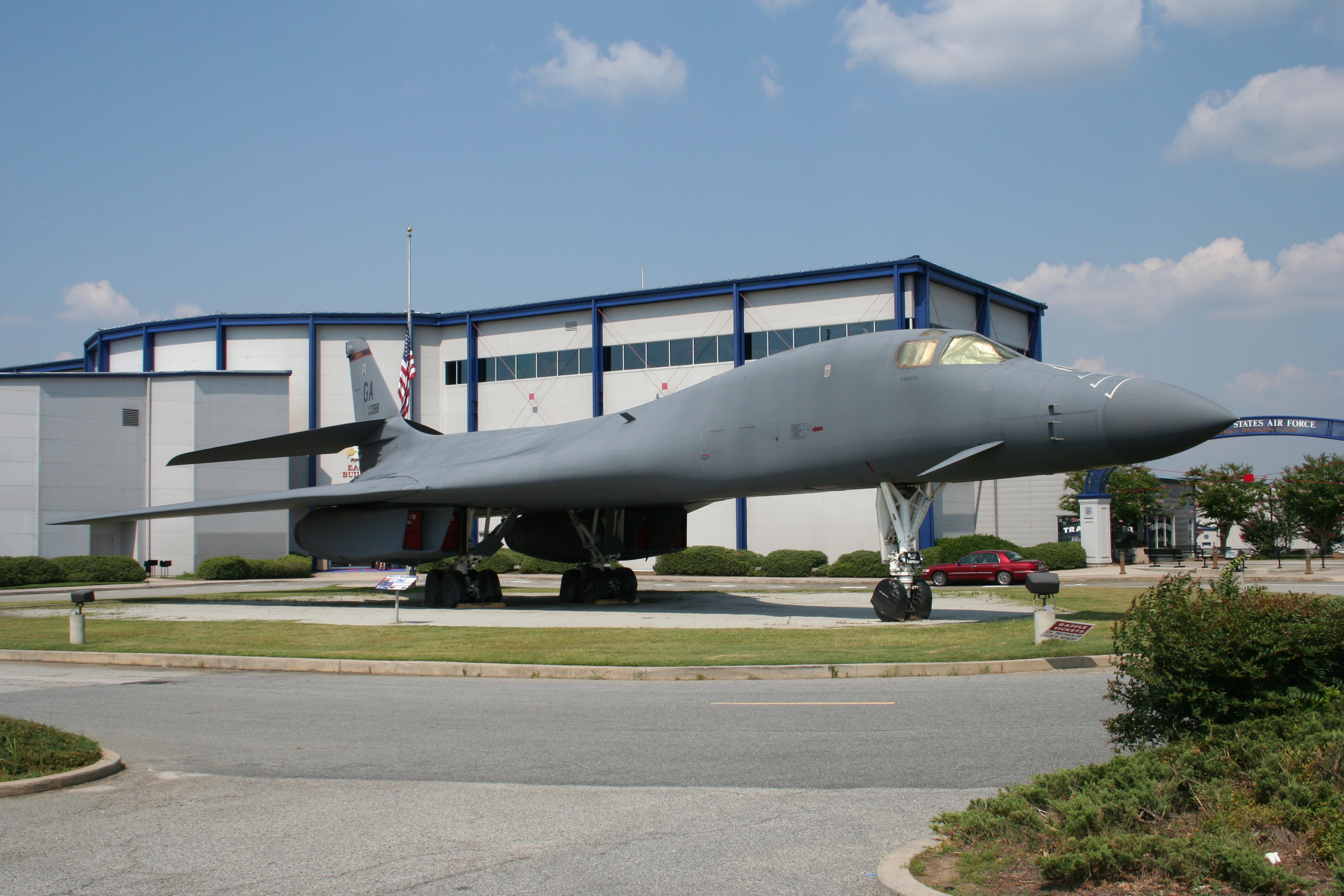
Museum of Aviation
SR-71 Blackbird serial number 61-7958 sits on its pedestal in central Georgia, looking like it could still outrun anything in the sky. On July 28, 1976, this exact aircraft set the absolute world speed record at 2,193 miles per hour -- a record that has never been broken. It is one of more than 85 historic aircraft displayed across four exhibit buildings at the Museum of Aviation, just outside Warner Robins, Georgia, adjacent to Robins Air Force Base. The second-largest aerospace museum of the United States Air Force draws nearly half a million visitors each year, all without charging a cent for admission. What began in 1980 as one man's private collection of aviation memorabilia has become a sprawling monument to a century of American flight.
A Collector's Bargain
The museum exists because of a deal struck by a World War I aviator named Guy Orlando Stone. Stone had spent decades accumulating aviation memorabilia, and in 1980 he offered the entire collection to Robins Air Force Base -- on one condition: the base had to build a museum to house it. The base agreed, and the Southeastern Museum of Aviation was born. By 1988, the growing institution had been renamed the Museum of Aviation at Robins. A year later, Georgia Governor Joe Frank Harris signed legislation creating the Georgia Aviation Hall of Fame, to be permanently housed at the museum. Among its original inductees was Stone himself, the collector whose single condition had launched the whole enterprise.
Wings Across Every War
Walking the museum's exhibit halls is a chronological journey through American air power. A Curtis P-40N Warhawk represents the fighters that held the line in the early days of World War II. A Boeing B-17G Flying Fortress and B-29B Superfortress recall the strategic bombing campaigns that helped end it. The Cold War era fills entire hangars: F-86H Sabres and F-100D Super Sabres from Korea, F-4D Phantom IIs and F-105D Thunderchiefs from Vietnam, the imposing B-52D Stratofortress that could carry nuclear weapons across continents. More modern airframes stand alongside them -- the F-15A Eagle, the F-16A Fighting Falcon, the swing-wing F-111E Aardvark, and the A-10A Thunderbolt II, beloved by ground troops for its devastating close air support.
The Fastest and the Secret
The crown jewel needs no introduction to aviation enthusiasts. The Lockheed SR-71A Blackbird on display is not just any example of the legendary spy plane -- it is the specific aircraft that holds the absolute world airspeed record. Piloted by Captain Al Joersz with Major George Morgan as reconnaissance systems officer, serial number 61-7958 reached 2,193.2 miles per hour on July 28, 1976. Nearly five decades later, no manned aircraft has gone faster. Nearby sits a Lockheed U-2D, another product of Lockheed's secretive Skunk Works program, designed to fly at extreme altitudes for reconnaissance over the Soviet Union. Together they represent the Cold War's most ambitious and dangerous intelligence-gathering missions.
Eugene Bullard's Homecoming
In 2019, the museum unveiled a bronze statue honoring Eugene Bullard, the first African American pilot to fly in combat. Born in Columbus, Georgia, Bullard left the United States as a young man and made his way to France, where he enlisted in the French Foreign Legion during World War I. After being wounded, he volunteered for the French Air Service, earned his pilot's license, and flew more than twenty combat missions. When America entered the war, the U.S. Army Air Service recruited American pilots serving in France -- but accepted only white aviators. Bullard was passed over by his own country. It took until 1994, decades after his death, for the U.S. Air Force to posthumously commission him as a second lieutenant. His statue at the Museum of Aviation marks a long-overdue recognition in the state where he was born.
Beyond the Aircraft
The museum is more than static displays. Its National STEM Academy runs educational programs that weave science, technology, engineering, and mathematics into the humanities, offering field trips, workshops, and live virtual programs for schools across Georgia. The collection extends well beyond airplanes to include missiles and drones -- from Cold War-era AGM-28 Hound Dog cruise missiles to the Northrop Grumman RQ-4A Global Hawk unmanned reconnaissance aircraft. Helicopters from every era of rotary-wing flight line the halls, from the Sikorsky H-19D Chickasaw to the massive MH-53M Pave Low. As the fourth-most-visited museum in the Department of Defense, it proves that a World War I veteran's personal collection, and a well-placed condition, can grow into something that inspires generations.
From the Air
Located at 32.59N, 83.59W, directly adjacent to Robins Air Force Base (KWRB) in central Georgia. The museum complex and its outdoor aircraft displays are visible on the base's western perimeter. Warner Robins sits in the flat coastal plain of central Georgia, with Macon (KMCN) approximately 15 nautical miles to the northwest. At low altitude, the museum's collection of large aircraft -- including the B-52D and C-141C Starlifter -- can be spotted on the tarmac. Perry-Houston County Airport (KPXE) is also nearby to the south.