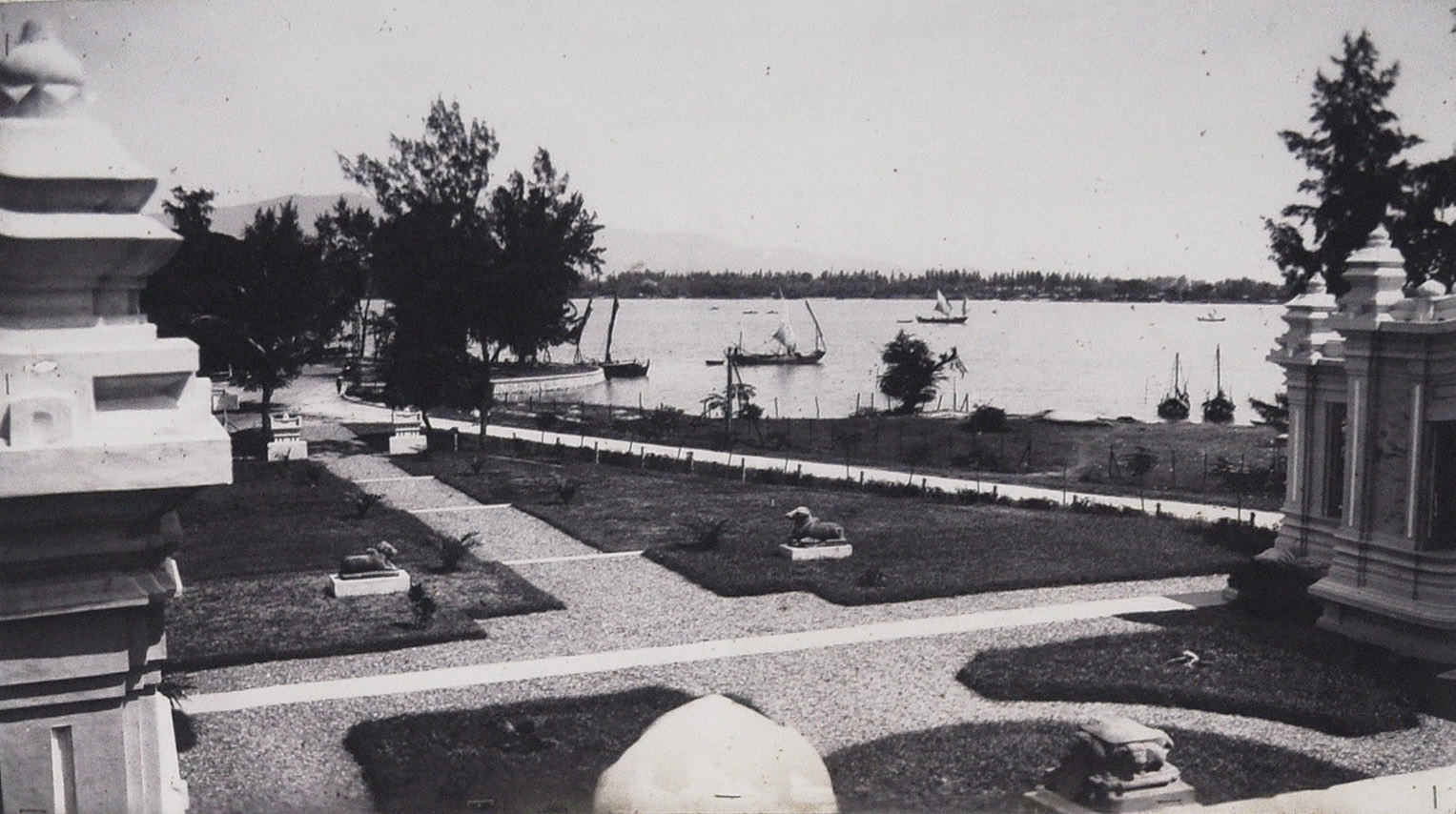
Museum of Cham Sculpture
For nearly two centuries, the Champa kingdom left its gods in stone across central Vietnam. Hindu deities, Buddhist bodhisattvas, celestial dancers frozen mid-step, mythical garudas with wings outstretched. When the kingdom fell, the jungle swallowed their temples. But the sculptures survived, and in 1902, a French archaeologist named Henri Parmentier began arguing that they deserved more than the open-air "garden of sculptures" where Da Nang had been collecting them for twenty years. It took over a decade to convince the colonial bureaucracy. When the Museum of Cham Sculpture finally opened its doors in 1919, it gave the world its first dedicated window into one of Southeast Asia's most artistically accomplished civilizations.
A Frenchman's Obsession
Henri Parmentier was not the kind of archaeologist who stayed behind a desk. As a leading figure in the Department of Archaeology at EFEO, the French school for Asian studies, he spent years traveling central Vietnam documenting Cham ruins. He understood what the scattered sculptures represented: not isolated curiosities, but the coherent artistic output of a maritime civilization that had traded with India, China, and the Malay world for centuries. His campaign for a proper museum began in 1902, and when two French architects, M. Deleval and M. Auclair, finally designed the building, Parmentier insisted they incorporate traditional Cham architectural elements into the composition. The result was a museum that honored its contents rather than overshadowing them. Its first building opened near the Han River in Da Nang's Hai Chau District, a location that Parmentier himself had selected.
Stone Voices from Lost Temples
The sculptures inside span roughly a thousand years of Champa's artistic evolution, drawn from temple sites scattered across central Vietnam. Parmentier organized the galleries by place of origin: pieces from the sacred complex of My Son, from the ancient capital at Tra Kieu, from the Buddhist monastery at Dong Duong, from the towers of Thap Mam. The arrangement tells a geographic story as much as a chronological one. A 7th-century pedestal from My Son shows early Indian influence, its forms still close to Gupta models. By the 10th century, the art has become unmistakably Cham: apsara dancers curve with a sinuous grace that owes nothing to any imported tradition, while a flying warrior from My Son achieves a dynamism that feels startlingly modern. A 13th-century garuda from Thap Mam marks the kingdom's late period, its style already absorbing the influences of neighboring Khmer art.
Expansions and Endurance
The original 1919 building filled quickly. By the mid-1930s, two new galleries were added to accommodate the sculptures collected during the 1920s and 1930s, bringing the display space to roughly 1,000 square meters. Parmentier directed the layout of these expanded galleries himself, ensuring each collection retained its geographic identity. The museum survived the upheavals that followed: the end of French colonial rule, the partition of Vietnam, the American war that turned Da Nang into one of the country's largest military bases. Through all of it, the Cham sculptures remained. In 2002, a two-story addition doubled the floor space, adding not just display room but also a restoration workshop, library, and storage facilities. The museum shifted from Da Nang Museums to the city's Department of Culture, Sport and Tourism in 2008, reflecting its growing importance as both a scholarly resource and a tourist destination.
What Champa Left Behind
Champa was never a single unified empire. It was a collection of coastal principalities stretching from Quang Tri in the north to Binh Dinh in the south, united by shared Hindu and Buddhist traditions and by the sea trade that made them wealthy. At their peak, the Cham kingdoms controlled the central Vietnamese coast for more than a millennium, building brick tower-temples that rivaled Angkor in ambition if not in scale. Vietnamese expansion from the north gradually absorbed Cham territories, and by the 17th century, the last Cham kingdom had fallen. Today, the museum in Da Nang holds the world's largest collection of Cham sculpture, a distinction that speaks as much to the scale of what was lost as to what was saved. Each piece in the collection was once the focus of worship, the product of a living faith. Walking through the galleries, that original purpose still comes through in the intensity of the carved faces, the precision of the ritual gestures, the weight and presence of stone shaped to hold the divine.
From the Air
Located at 16.06°N, 108.22°E in Da Nang's Hai Chau District, on the south bank of the Han River. Da Nang International Airport (VVDN) is approximately 3 km to the west. The museum is visible from low altitude near the distinctive curve of the Han River. The Dragon Bridge, another Da Nang landmark, crosses the river nearby. Recommended viewing altitude: 1,500-2,000 feet for context of the riverside setting.