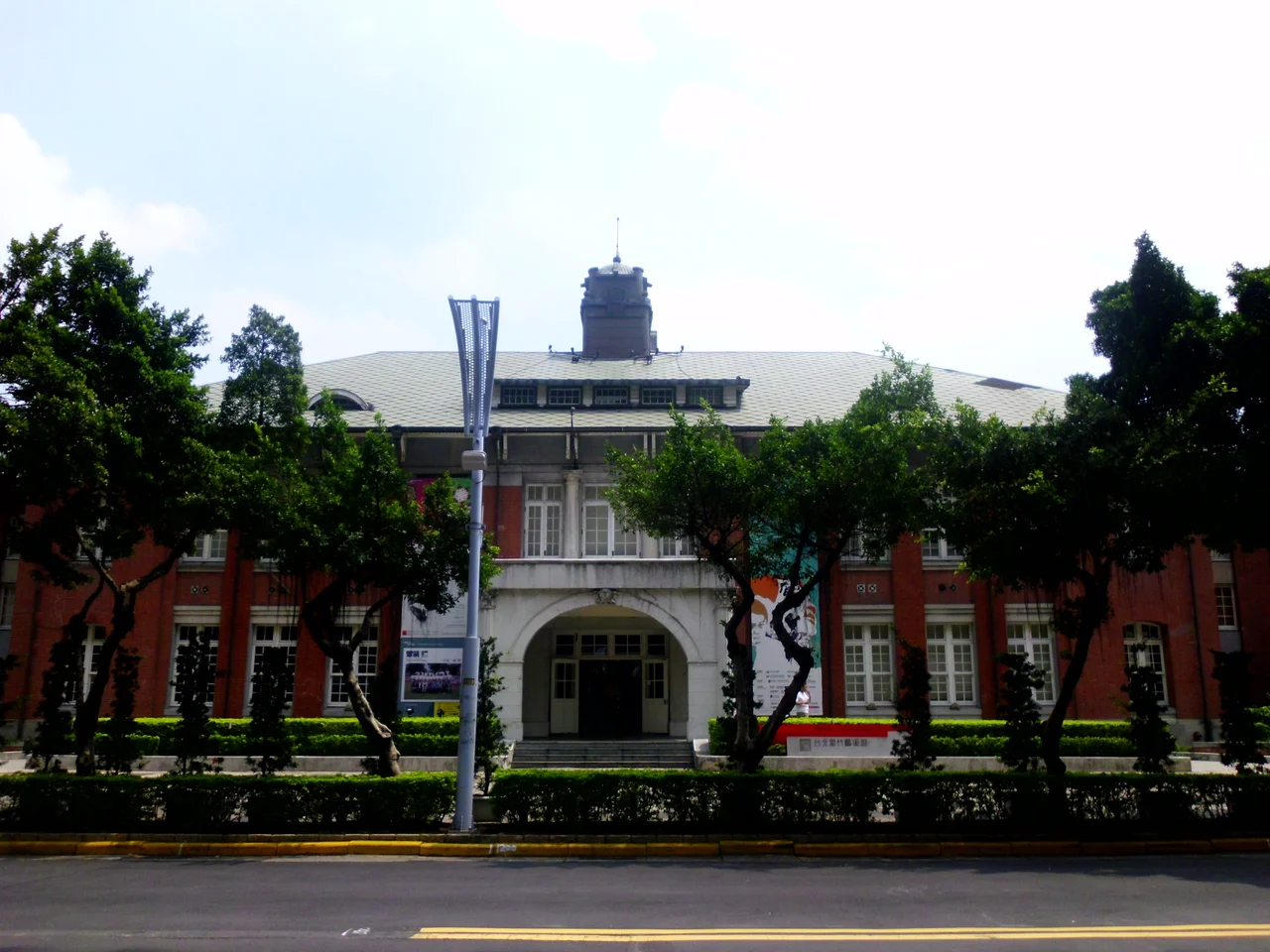

Museum of Contemporary Art Taipei
The building was a school before it was a city hall, and a city hall before it became a museum — and somehow, at each stage, its symmetrical red-brick facade kept the same quiet authority. Completed in 1921 during Japanese colonial rule, the structure in Datong District was designed for what would become a prominent educational institution, then repurposed in 1945 when the Republic of China took over Taiwan and needed a home for the Taipei City Government. Decades later, when the city government relocated to the gleaming new Xinyi District in 1993, preservationists stepped in. In 2001, the Museum of Contemporary Art Taipei — MoCA Taipei — opened its doors in a building that had already outlasted two eras. Contemporary art, it turned out, was a very good fit for a place shaped by history's habit of recycling itself.
Red Brick, Long Memory
Stand outside MoCA Taipei and you immediately sense it was built to impress. The symmetrical facade, the bell tower at center, the red brick and neoclassical proportions — this is the confident grammar of Japanese colonial architecture, a style meant to signal permanence and order. Built in 1921, the building occupied a slice of the city where colonial planners intended to anchor institutions of governance and learning. For more than seven decades, it did exactly that: first as a school, then as the seat of the Taipei City Government after 1945, when Taiwan passed from Japanese administration to the Republic of China.
When the city government packed up and moved to Xinyi District in 1993, the building could have been demolished or repurposed into offices. Instead, it was designated a protected historical building. The renovation that followed preserved the bones while making space for white gallery walls — a respectful act of reimagining that let the architecture breathe without pretending the past hadn't happened.
Where Taiwan's Art Talks to the World
MoCA Taipei opened in 2001 with a clear mission: to showcase contemporary Taiwanese art, particularly work that engaged with the wider world rather than turning inward. Under director Shih Jui-jen, the museum built a reputation for international dialogue, organizing, for example, a solo pavilion for Taiwanese artist Yang Maolin at the Venice Biennale in 2009. That same year and in 2010, MoCA partnered with MoCA Shanghai, Today Art Museum Beijing, and Guangdong Museum of Art to co-organize the Animamix Biennial, a cross-strait collaboration that felt striking given the political sensitivities of the moment.
The museum continued to evolve under director Loh Li-chen, who led from 2019 to 2025. Her tenure leaned into global connections alongside local talent. MoCA Taipei became a presenting partner of the Han Nefkens Foundation, bringing works by the foundation's awardees to Taiwanese audiences. It wasn't a museum trying to become something it wasn't. It was a museum confident enough in its own identity to reach outward.
Banksy, the Caribbean, and a Museum in Motion
In 2023, post-pandemic, MoCA Taipei signaled its ambitions with two striking programming choices. The first was NEXUS, the first exhibition in Taiwan devoted exclusively to artists living and working in the Caribbean — a genuinely unusual move for a Taipei institution, and one that ran from May 5 to July 16, 2023. The second was securing the first stop of the international touring exhibition of Banksy's 'Love is in the Bin,' the work that famously self-shredded at auction in 2018. Authorized by Banksy's Pest Control authentication body, the piece was on view at MoCA Taipei from July 1 to August 13, 2023, before traveling onward.
Those two exhibitions, taken together, say something about what MoCA Taipei has become: a place that can pivot from underrepresented Caribbean voices to one of the most recognizable artworks of the twenty-first century, doing both in the same summer, inside a century-old building that once housed city bureaucrats.
A Museum You Can Walk To
MoCA Taipei sits just southwest of Zhongshan Station on the Taipei Metro, which makes it unusually accessible for a museum of its caliber. The surrounding Datong District has its own texture — older, less polished than the shiny retail corridors of eastern Taipei, with covered markets and narrow lanes close by. The museum occupies its block with a certain unhurried presence, the bell tower visible from the street, the front courtyard offering a moment to slow down before entering.
Visitors who arrive by metro and walk a few minutes through the neighborhood encounter the museum almost accidentally, the red brick materializing between more modern buildings. That quality — a landmark that doesn't announce itself from across a plaza but rather reveals itself as you approach — suits an institution that has always favored substance over spectacle.
From the Air
MoCA Taipei sits at approximately 25.051°N, 121.519°E in the Datong District of central Taipei, roughly 3 kilometers northwest of Taipei 101. At 2,000–3,000 feet, the symmetrical red-brick building with its central bell tower is identifiable among the surrounding urban fabric. The nearest in-city airport is Taipei Songshan (RCSS), about 5 kilometers to the northeast; Taiwan Taoyuan International (RCTP) lies roughly 35 kilometers to the west. From the air, the museum anchors a neighborhood of colonial-era and mid-century buildings near the elevated Zhongshan North Road corridor.
Nearby Stories
- Dapu Incident 9.3 km away
- Shuanglianpi Wetland 18 km away
- Toufen 41 km away
- North Jiangsu Main Irrigation Canal 980 km away
- General Cliff Rock Paintings 1050 km away
- Sinking of MV Sewol 1061 km away
- Yellow Sea 1111 km away
- Twin Forts of Romblon 1358 km away