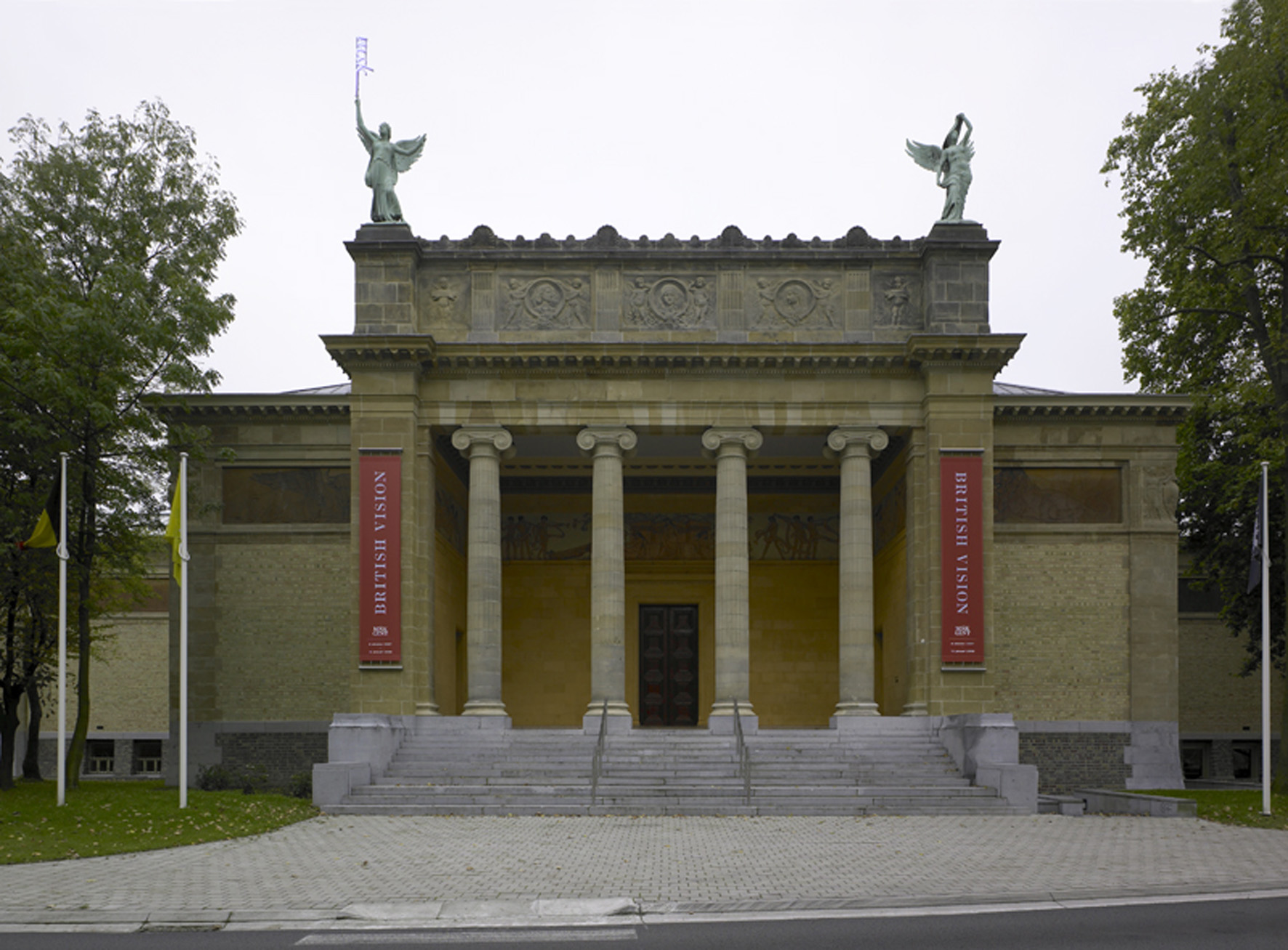
Museum of Fine Arts, Ghent
Eighteen faces fill the frame, leering and laughing and contorted with hate. In the center is the face of Christ, eyes closed, weight pressed down by the cross beam. Around him, around 1510, a master of the Bosch workshop painted a crowd in which nearly every figure is a portrait of cruelty - tongues protruding, teeth bared, foreheads scarred. The painting is long attributed to Hieronymus Bosch himself, though modern scholarship considers it a high-quality workshop piece after a lost Bosch prototype. The painting hangs in the Museum of Fine Arts in Ghent, on the eastern edge of the Citadelpark, in a building that does not advertise itself the way the Belfry or Saint Bavo's Cathedral do. People come specifically to see this picture. They come away quiet.
Built for Art Around 1900
Charles van Rysselberghe designed the building around 1900, a sober neoclassical pavilion meant to give Ghent the proper civic infrastructure of culture. Around 9,000 artworks now live inside it, with roughly 600 on permanent display - the rest cycle through storage or travel for loan. The collection's center of gravity is Flemish art from the Southern Netherlands, but the holdings sweep wider, drawing in French painting, Italian masters, and twentieth-century Belgian work. Between March 2011 and January 2021, the museum mounted 41 temporary exhibitions. The building closed for four years of restoration and reopened in 2007, when the heating, the lighting, and the climate control finally caught up to what the paintings on the walls had been quietly enduring.
Bosch Twice
The museum holds two paintings attributed to the circle of Hieronymus Bosch, which is two more than most museums on Earth. Saint Jerome at Prayer, from around 1485, shows the desert hermit slumped across a stone in a landscape of strange shells, dead trees, and improbable creatures. Christ Carrying the Cross, around 1510, abandons landscape entirely - just faces, all the way to the edges of the panel. Both belong to a painter whose name still functions as shorthand for the medieval imagination at its most fevered, but seeing them in person rearranges that shorthand. Bosch's brush is small. His colors are clear. The horror is not chaotic. It is organized, deliberate, and applied to surfaces with the same patient craft a Dutch still-life painter would later bring to a lemon.
Rubens, Rombouts, Géricault
Peter Paul Rubens shows up twice as well, in The Flagellation of Christ from 1617 and Saint Francis Receiving the Stigmata from around 1633 - paintings done at the height of his Antwerp workshop's powers, where biblical violence and biblical ecstasy were produced on the same easels by the same hands. Theodoor Rombouts, the great Ghent painter of the Caravaggesque generation, hangs nearby with his Allegory of the Five Senses from 1632. Then, in another room entirely, Theodore Gericault's Portrait of a Kleptomaniac from around 1820 - one of a small series Gericault painted of patients diagnosed with what nineteenth-century alienists called specific monomanias. The man in the frame is haunted. Gericault was painting him not as a curiosity but as a person, decades before psychiatry would learn to do the same.
The Modern Walls
Move through the chronological galleries and the centuries thin out. Jacob Jordaens turning Greek myth into Flemish farce. Anthony van Dyck. Pieter Brueghel the Younger painting his father's compositions again. Then James Ensor, Belgian symbolism's anarchic patriarch, with Children at their Morning Toilet from 1886. Leon Spilliaert's strange interior scenes from 1907 and 1908, where the rooms feel emptied of more than people. Rene Magritte's Perspective II: Manet's Balcony of 1950 - an original Magritte in which the four figures from Manet's famous picture have been replaced by coffins. The museum's Flemish Art Collection partnership with the Royal Museum of Fine Arts in Antwerp and the Groeninge Museum in Bruges means these collections are conceived together, telling one continuous story of painting in Flanders from the fifteenth century onward.
Where It Sits
The MSK sits on the east side of the Citadelpark, the green lung of southern Ghent built on the site of a long-demolished Dutch fortress. Just next door is the Stedelijk Museum voor Actuele Kunst (S.M.A.K.), Ghent's contemporary art museum, so a single afternoon walks you from medieval altarpieces to whatever was made last year. The park has plane trees, a bandstand, and the kind of unhurried Belgian benches that make you wonder why everyone in the world is in such a rush. Then you go back inside, and there is Bosch again, eighteen faces and one shut-eyed center, painted half a millennium ago in a small workshop in 's-Hertogenbosch, hanging in Ghent for any visitor willing to walk in.
From the Air
Located at 51.038 degrees north, 3.724 degrees east on the east side of the Citadelpark, in southern Ghent below the historic core. Approach from the south, with Sint-Pieters railway station as a useful landmark slightly northwest. Nearest airport is Brussels (EBBR), about 50 km southeast; alternates Antwerp (EBAW) and Kortrijk-Wevelgem (EBKT). The Citadelpark forms a clearly visible green square within the urban grid; the museum is the larger of the two pavilions on its eastern edge (the smaller is the S.M.A.K. contemporary museum). Brussels-area visibility typically 8-15 km with frequent low cloud in autumn and winter.