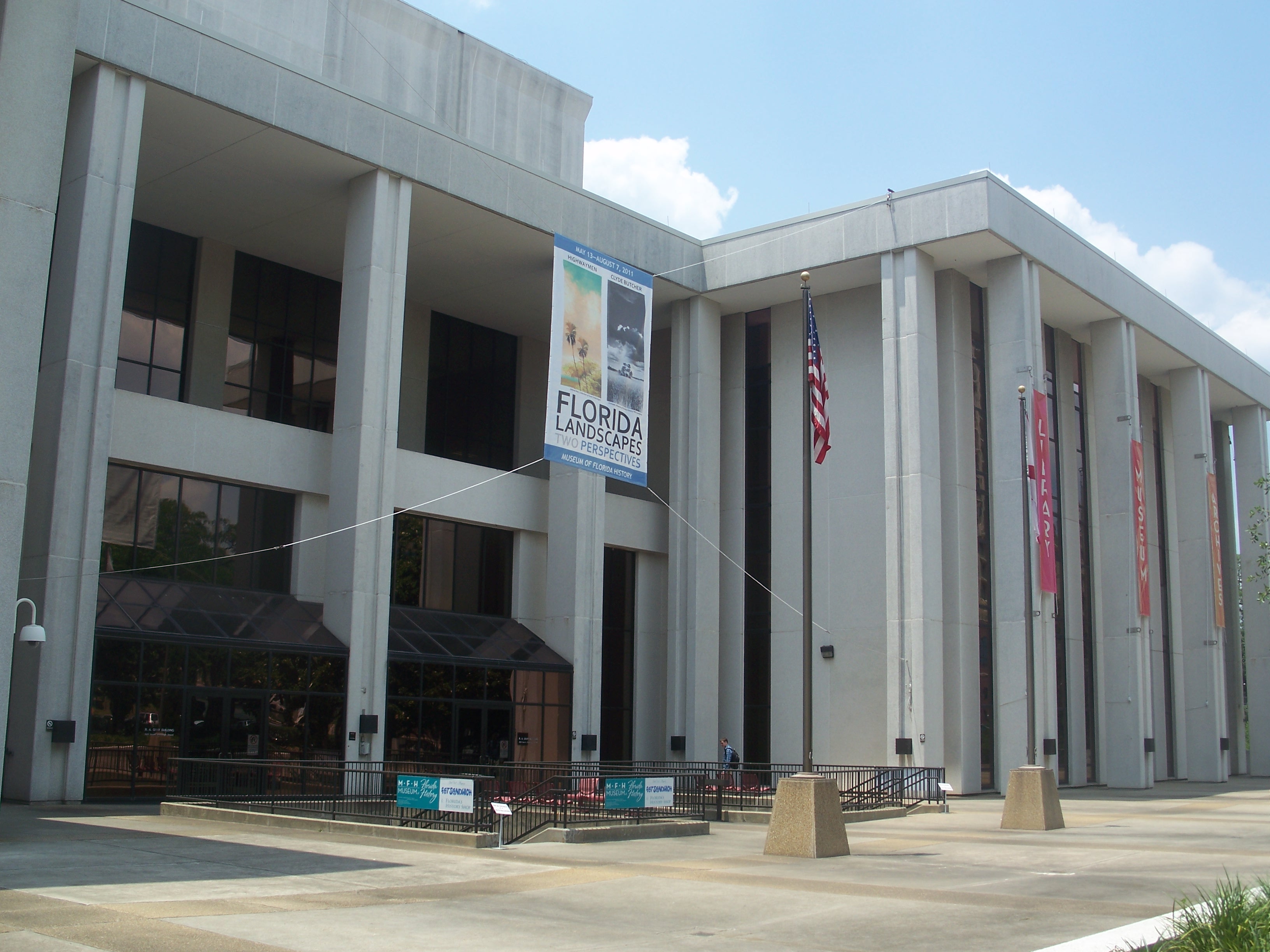
Museum of Florida History
On the steps of a modest columned house at the corner of Park Avenue and Calhoun Street in Tallahassee, a Union officer stood on May 20, 1865, and read the Emancipation Proclamation aloud. The Civil War had ended weeks earlier, but word traveled slowly to the Florida panhandle. That reading -- more than a month after Appomattox -- finally declared freedom for the enslaved people of the region. The house still stands. It is called the Knott House, and it is operated today by the Museum of Florida History, an institution that has spent nearly five decades collecting the physical evidence of a state whose past is far stranger, older, and more layered than most visitors expect.
A Building Named for a Quiet Powerbroker
The museum occupies the R.A. Gray Building at 500 South Bronough Street, a granite-faced structure in the heart of Tallahassee's government district. Robert A. Gray served as Florida's Secretary of State for 31 years, from 1930 to 1961, and the building that bears his name houses not only the museum but also the State Library and Archives of Florida. The Museum of Florida History opened within these walls in 1977, charged with a broad mandate: collect, preserve, exhibit, and interpret evidence of past and present cultures in Florida. Administered by the Florida Division of Cultural Affairs under the Florida Department of State, the museum focuses on artifacts and eras unique to Florida's development, from 12,000-year-old Paleoindian tools to space-age rocketry. Through exhibits, educational programs, and active research collections, it tells the story of how people have shaped -- and been shaped by -- this peninsula's distinctive natural environment.
Twelve Thousand Years in One Building
Florida's history does not begin with Ponce de Leon in 1513. The museum's collections reach back to the Paleoindian period, when Florida was a dry, wide landmass twice its current size, and megafauna roamed grasslands that are now submerged beneath the Gulf of Mexico. The exhibits trace the arc from those earliest human inhabitants through the Mississippian mound-building cultures, the Spanish colonial missions, British occupation, American territorial days, the Seminole Wars, statehood, the Civil War, Reconstruction, the railroad-driven boom of the Gilded Age, and into the twentieth century. Previous exhibitions have included "Beyond the Vote: Florida Women's Activism," which documented the state's suffrage movement and its aftermath, and "Living the Dream: Twentieth Century Florida," which examined how tourism, citrus, and aerospace transformed the peninsula into one of the most populous states in the country. The museum's strength lies in making these disparate threads feel connected -- one long continuum of adaptation, ambition, and reinvention on a landscape that has never stopped changing.
The House on the Corner
The Knott House, built in 1843, stands as one of the most historically significant structures in Tallahassee. During the closing days of the Civil War, it served as the temporary headquarters of the Union Army in the city. The reading of the Emancipation Proclamation from its front steps on May 20, 1865, was a defining moment -- not just for Tallahassee, but for the entire Florida panhandle, where news of emancipation had not yet arrived. After the war, the house gained another chapter: Florida's first Black physician began his medical career working for a doctor on the premises. The house later became the home of William and Luella Knott. William Knott served as Florida's state comptroller, and Luella became known for her eccentric habit of attaching poems to furniture throughout the house -- verses she wrote herself, tied with ribbons to tables, chairs, and bureaus. When the Museum of Florida History took over operations, those poems became part of the interpretation, an intimate and slightly whimsical layer atop the weighty history the house already carried.
Where Florida Keeps Its Memory
Museums dedicated to state history can sometimes feel obligatory -- a dutiful chronological march through dates and governors. The Museum of Florida History has worked to avoid that trap by anchoring its exhibits in the material culture of everyday life. A reconstructed Spanish galleon section, mastodon bones pulled from Florida springs, citrus crate labels from the 1920s boom, and artifacts from the Seminole Wars all coexist in galleries that emphasize the texture of lived experience over the recitation of facts. The museum also serves as a bridge to the broader network of Florida historical resources, including the Florida Historical Society and the State Library and Archives housed in the same building. For a state that has often been caricatured as having no history worth remembering -- all theme parks and retirement communities -- the Museum of Florida History makes a quiet, persistent argument to the contrary. The evidence is in the galleries: Florida's past is deep, contested, and still unfolding.
From the Air
Located at 30.44°N, 84.28°W in downtown Tallahassee, Leon County, within the state government district. The R.A. Gray Building sits near the Florida State Capitol complex, which is the dominant landmark from the air. The Knott House is a few blocks east at the intersection of Park Avenue and Calhoun Street. Tallahassee Regional Airport (KTLH) lies approximately 5nm to the southwest. Best viewed at 1,500-3,000 feet AGL; the government district's clustered buildings and the distinctive old and new Capitol domes are easily identifiable.