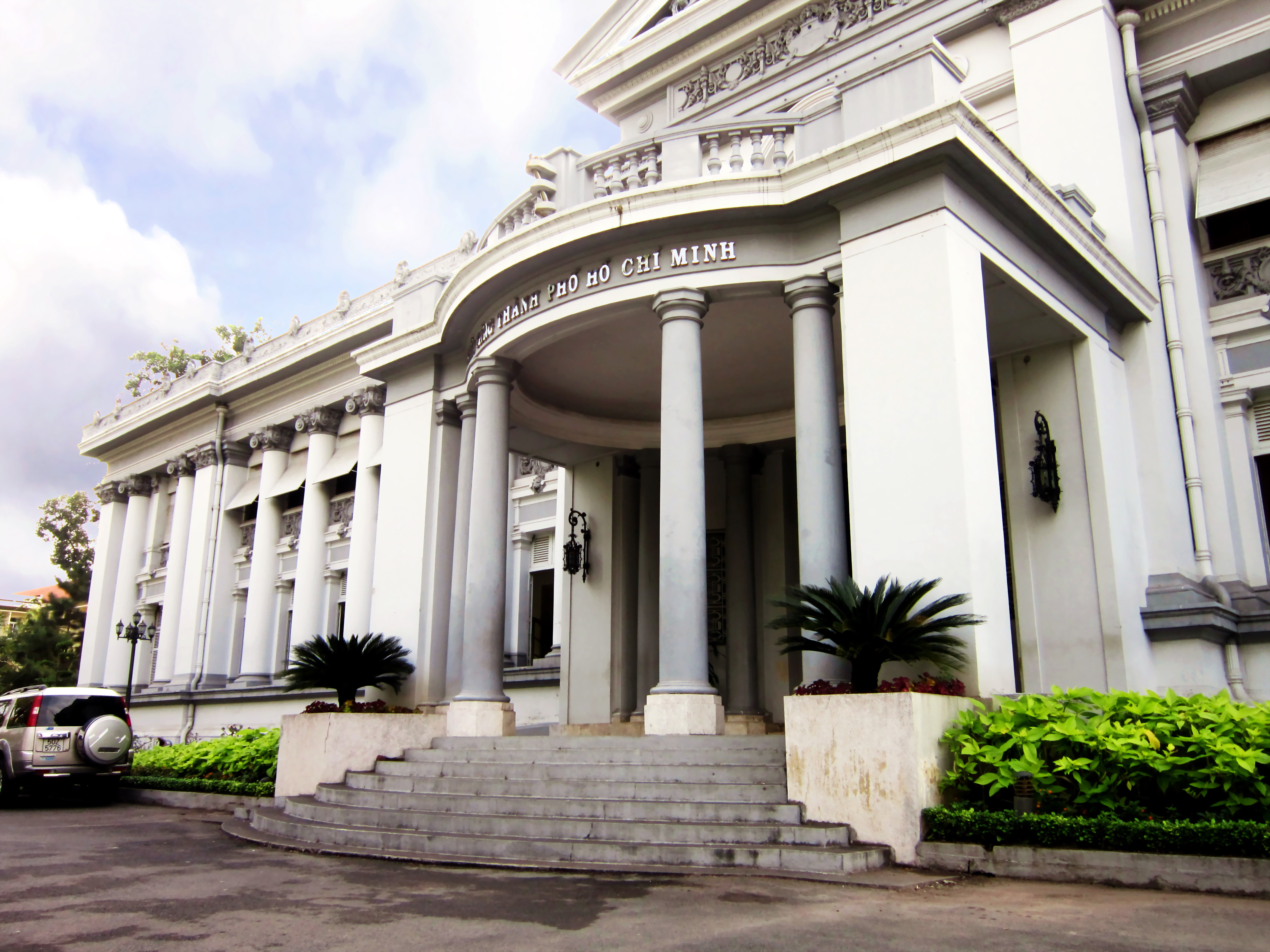
Museum of Ho Chi Minh City
In 1945, this building on the corner of Ly Tu Trong and Nam Ky Khoi Nghia streets changed occupants five times in seven months. The French governor was arrested in March. A Japanese governor moved in. The Japanese handed it to a Vietnamese puppet government in August. The Viet Minh seized it days later. Then a British officer evicted everyone and gave it to the returning French. No single building in Southeast Asia has been so thoroughly passed from hand to hand, and the Museum of Ho Chi Minh City -- formerly Gia Long Palace -- wears every transition in its walls.
A Colonial Showroom
French architect Alfred Foulhoux designed the building in the 1880s, and construction ran from 1885 to 1890. Its original purpose was surprisingly commercial: the Museum of Commercial Trade, a showcase for the products and goods of Southern Vietnam intended to demonstrate the colony's economic value to visitors and investors. The two-story structure covers over 1,700 square meters, rendered in classical Baroque style with European and Oriental influences -- European-styled flooring, staircases, and halls beneath an Oriental-inspired roof. Grotesques decorate the front facade, alongside symbolic chickens representing daytime and owls for nighttime. Greek mythological motifs share roofline space with tropical lizards and birds, the kind of decorative collision that happens when European architects work under equatorial skies. The building quickly outgrew its commercial purpose. Before long, it became the residence of the Governor of Cochinchina, beginning with Henri Eloi Danel, and entered the long parade of political reinventions that would define the next century.
Seven Flags in Seven Months
The palace's most turbulent chapter came during 1945, when World War II's end unleashed a cascade of power transfers across Indochina. On March 9, the Japanese Imperial Army overthrew the French colonial regime, arrested Governor Ernest Thimothee Hoeffel, and installed their own governor, Yoshio Minoda. Five months later, on August 14, Japan surrendered and handed the building to the puppet Empire of Vietnam government. Lieutenant General Nguyen Van Sam barely had time to settle in before the Viet Minh seized the palace on August 25, arresting him and establishing the Provisional Administrative Committee of Southern Vietnam. Their tenure lasted just sixteen days. On September 10, British Lieutenant Colonel B.W. Roe occupied the palace for the Allied Mission. By October, General Leclerc was using it as the French military headquarters. Each transition happened without major renovation -- the same rooms, the same furniture, absorbed occupant after occupant like a stage set repurposed between acts.
Escape Routes and Secret Tunnels
When President Ngo Dinh Diem moved into the palace in February 1962 -- forced there after dissident pilots bombed his residence at the Independence Palace -- he commissioned one of the building's most remarkable features: three deep tunnels leading from the palace to other parts of the city. The tunnels were engineered for survival, with reinforced concrete walls one meter thick, 2.2-meter-high ceilings, and six iron vault doors. Below them lay a basement of six rooms totaling nearly 1,400 square meters, equipped with conference rooms, offices, battery-powered backup electricity, portable radios, and RCA transceivers. When the 1963 coup d'etat came, Diem is believed to have used these escape routes to flee the siege on the palace, which suffered considerable damage in the fighting. He made it to a supporter's house in Cholon but was captured the next day and executed. The tunnels survived their builder -- visitors can still walk through them today.
A Student's Funeral That Drew Thousands
Before Diem, the palace served as the official residence of the Premier of the State of Vietnam. On January 9, 1950, over 6,000 students and teachers gathered outside to demand the release of classmates arrested for advocating Vietnamese independence. Premier Tran Van Huu ordered police to suppress the protest. One hundred and fifty people were arrested, thirty were injured, and one student -- Tran Van On, from Petrus Ky High School -- died of his injuries. His funeral three days later drew 25,000 mourners, transforming a student's death into a national moment of grief and defiance. Tran Van On became a martyr for Vietnamese independence, and January 9 is still commemorated as Vietnamese Students' Day.
From Supreme Court to City Museum
After the completion of the new Independence Palace in 1966, the building took on a judicial role, housing the Supreme Court of the Republic of Vietnam until the Fall of Saigon on April 30, 1975. Three years later, the Ho Chi Minh City People's Committee converted it into the Ho Chi Minh City Revolutionary Museum. In 1999, it was renamed simply the Museum of Ho Chi Minh City. Today, its galleries trace the region's history from prehistoric artifacts through French colonialism, wartime resistance, and reunification. But the building itself may be the most compelling exhibit -- a structure that has been a trade showroom, a governor's mansion, a military headquarters, a presidential refuge, a courthouse, and finally a museum, each layer of history visible in the architecture if you know where to look.
From the Air
The Museum of Ho Chi Minh City (formerly Gia Long Palace) sits at 10.776N, 106.700E in District 1, approximately 500 meters east of Independence Palace. The classical Baroque building with its trapezoid-shaped garden is visible at low altitude. Tan Son Nhat International Airport (VVTS) is about 7 km northwest. The museum is near the intersection of two major streets, Ly Tu Trong and Nam Ky Khoi Nghia, in the dense urban center of Ho Chi Minh City.