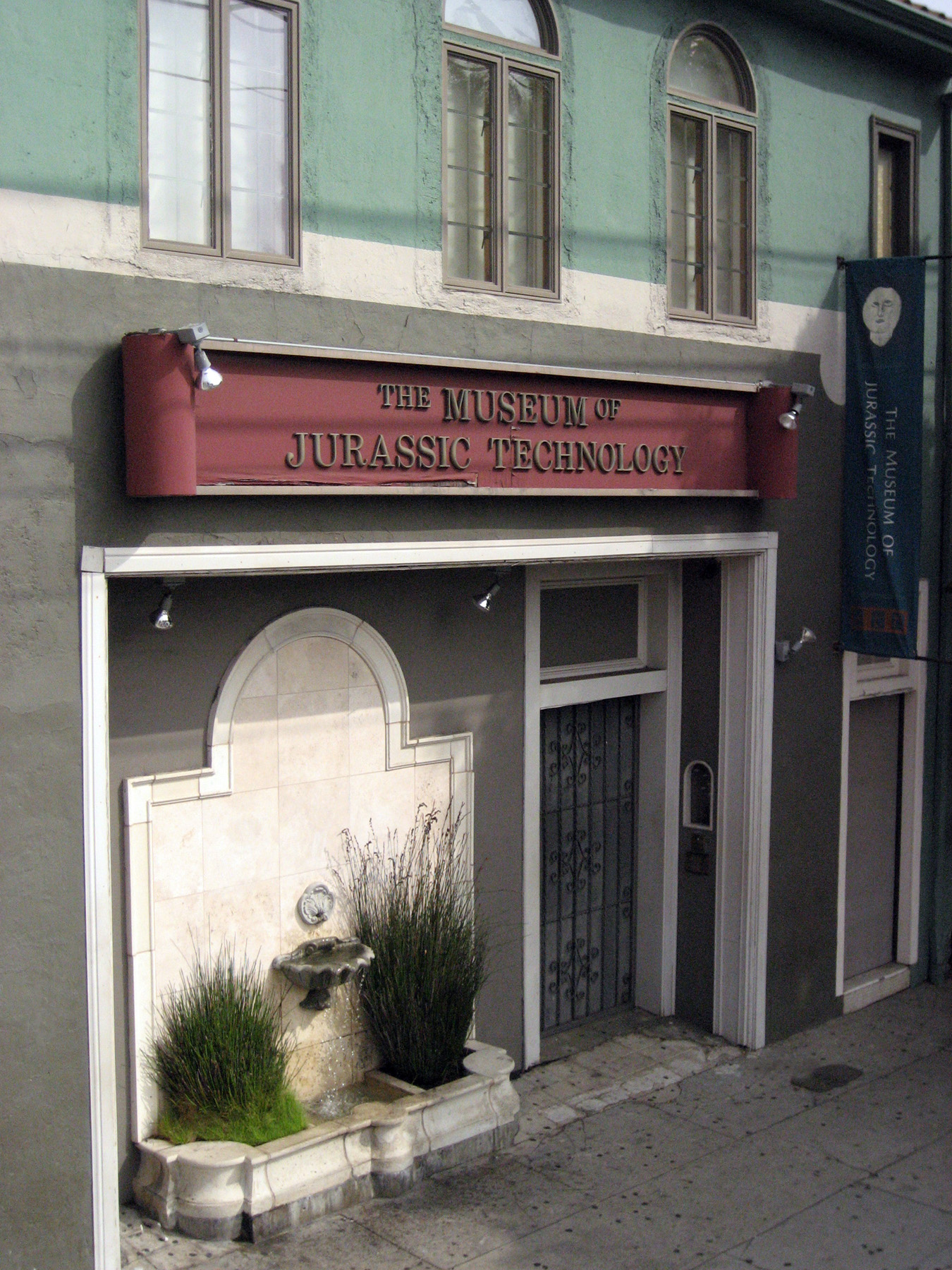
Museum of Jurassic Technology
The sign outside says 'Museum of Jurassic Technology.' Inside, there are exhibits about a bat that can fly through solid matter, about the healing properties of a Cameroon stink ant, about a Soviet space dog named Laika. Some of this is true. Some of it may not be. The museum will not always tell you which is which — and that, it turns out, is the point.
Curators of the Plausible
David Hildebrand Wilson and Diana Drake Wilson opened the Museum of Jurassic Technology in 1988 in a small storefront in the Palms district of Los Angeles. Its self-stated mission — 'the advancement of knowledge and the public appreciation of the Lower Jurassic' — contains a clue for the attentive visitor: there was no Lower Jurassic technology. The Jurassic period predates human existence by roughly 140 million years.
This paradox is not an error. It is the institution's foundational gesture. The Wilsons are not hoaxers in the simple sense; they are curators of a particular experience, one in which the conventions of the museum — the authoritative label, the glass case, the hushed reverence — are deployed in service of material that exists in an ambiguous space between scholarship and invention.
Around 25,000 people visit each year. Many arrive skeptical, leave confused, and remember the place for the rest of their lives. In 2001, the MacArthur Foundation awarded the museum a fellowship — the so-called 'genius grant' — validating, in its own oblique way, whatever the museum is doing.
What the Exhibits Contain
The permanent collection runs to more than thirty exhibits, each presented with the full apparatus of museum scholarship: photographs, explanatory texts, carefully lit objects. The Hagop Sandaldjian exhibit displays microminiature sculptures — figures carved from a single human hair, placed in the eye of a needle, visible only through a microscope. These are real: Sandaldjian, an Armenian-American musician and microsculptor, created them over decades of extraordinary patience.
Other exhibits occupy stranger territory. The bats of Lower Jurassic California, described as navigating through solid matter. The stink ant of the Cameroon highlands, whose brain is parasitized by a fungus that compels the ant to climb to a specific height before dying, allowing the fungus to release its spores. (The ant phenomenon is real; the museum's framing is not always.)
The Tula Tea Room, opened in 2005 on the museum's roof, serves Russian tea and Georgian pastries in a setting designed to evoke a vanished world. It is, like the museum itself, a place of genuine hospitality built around an idea that refuses to be fully explained.
On July 8, 2025, a fire damaged the building. The museum reopened in August 2025, its contents preserved.
The Museum as Argument
Lawrence Weschler, whose 1995 book Mr. Wilson's Cabinet of Wonder examined the museum at length, described it as a meditation on what museums do to knowledge — how they confer authority, how they train visitors to accept rather than question, how the institutional form can be used to make almost anything seem credible.
In this reading, the Museum of Jurassic Technology is less an oddity than a mirror. Every museum presents a curated version of reality, shaped by the assumptions and blind spots of its founders. Most museums do not admit this. The Museum of Jurassic Technology admits nothing — which is, in its way, more honest.
Visitors often report leaving with a heightened attention to the world around them, a new habit of asking: how do I know this? Who told me? Why do I believe it? For a storefront on Venice Boulevard with thirty exhibits and a Russian tearoom, that is a significant thing to leave behind.