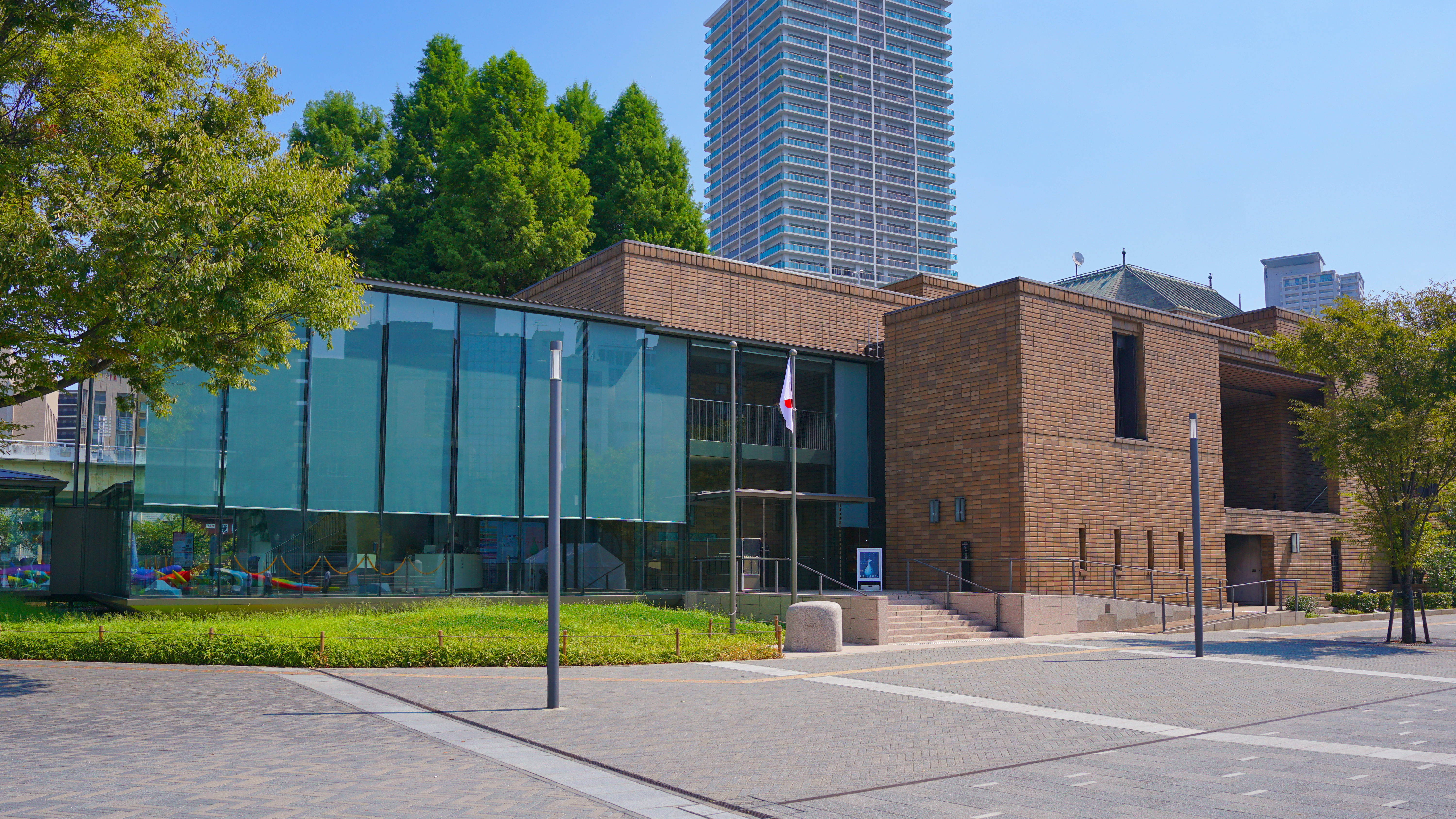
Museum of Oriental Ceramics: Where Starlight Pools in a Tea Bowl
The bowl is small enough to hold in two hands. Its black glaze is scattered with silvery spots that catch the light like oil droplets on dark water -- or, as the Japanese name suggests, like rain falling on a still pond. This is the Yuteki Tenmoku, a tea bowl fired at the Jian kilns of Fujian Province during China's Song dynasty, sometime in the twelfth or thirteenth century. It is one of only a handful of such bowls to survive the centuries, and the only Yuteki Tenmoku designated as a National Treasure in Japan. It once belonged to Toyotomi Hidetsugu, the regent who ruled Japan in the 1590s, then passed through the hands of the Nishi Honganji temple, the Mitsui family of Kyoto, and the Sakai family of Wakasa before arriving at the Museum of Oriental Ceramics in Osaka. Here, on the narrow island of Nakanoshima in the heart of the city, it sits in a gallery whose lighting was designed specifically to reveal the iridescent blue and gold luster hiding within that black glaze.
The Obsession of Eiichi Ataka
The museum exists because one man could not stop collecting. Eiichi Ataka, chairman of the Ataka & Co. trading company, spent decades assembling what became the Ataka Collection: 965 pieces of East Asian ceramics, including 793 Korean works spanning the Goryeo and Joseon dynasties, 144 Chinese ceramics, and additional Vietnamese and other Asian pieces. Ataka's eye was extraordinary -- meticulous, passionate, and deeply informed. When his trading company encountered financial difficulties in the 1970s, the collection's fate hung in the balance. Twenty-one companies of the Sumitomo Group stepped in, purchasing the entire collection and donating it to the city of Osaka. The Museum of Oriental Ceramics opened in November 1982 specifically to house this gift, situated in the quiet greenery near Nakanoshima Park. The Ataka Collection remains the museum's foundation, one of the finest assemblages of East Asian ceramics ever brought together by a single collector.
Two National Treasures, Thirteen Cultural Properties
The museum's collection now numbers approximately 5,700 pieces, but two objects carry the highest honor the Japanese government bestows on cultural artifacts. The Yuteki Tenmoku tea bowl, with its silvery spots suffusing both interior and exterior surfaces, displays a mystical beauty that has captivated collectors for eight centuries. The second National Treasure is a celadon vase with iron brown spots -- a piece whose seemingly accidental decorative pattern was actually the result of deliberate and extraordinarily controlled kiln work. Beyond these two treasures, thirteen objects hold the designation of Important Cultural Property, including stoneware with sgraffito peony decoration, porcelain with carved lotus designs, celadon with phoenix handles, and blue-and-white pieces depicting fish among water plants. Each piece represents a pinnacle of its tradition, selected from centuries of ceramic production across China, Korea, and Japan.
The Korean Collection
While the Chinese ceramics draw the headlines, the museum's Korean holdings are equally significant. The Ataka Collection's 793 Korean pieces span roughly a thousand years of production, from the elegant celadons of the Goryeo dynasty -- prized for their jade-green color achieved through iron oxide glazes fired in reduction kilns -- through the more robust and varied wares of the Joseon period. The museum's Korean collection was further strengthened by the addition of the Rhee Byung-Chang Collection, a major group of Korean ceramics that deepened the museum's ability to tell the full story of Korean ceramic art. Together, these holdings make Osaka one of the most important repositories of Korean ceramic heritage outside the Korean peninsula, a fact that reflects both the deep historical trade connections across the Sea of Japan and the particular passions of the collectors who brought these works together.
Light, Space, and the Art of Looking
Ceramics demand a particular kind of attention. Unlike paintings, which reveal themselves in a single plane, a ceramic piece changes with every degree of rotation, every shift in light. The museum's galleries are designed around this reality, with specialized lighting systems that bring out the subtle variations in glaze color, the depth of celadon greens, the flash of iron spots, the translucency of fine porcelain. The building itself sits in the quiet precinct of Nakanoshima, a sandbank island between the Dojima and Tosabori rivers that has served as Osaka's cultural and administrative center since the Edo period. The museum has published extensively on its collection, with recent titles including studies of celadon ware, the Rhee Byung-Chang Korean ceramics, tenmoku black glaze, and Song dynasty aesthetics. More than 3,700 of the museum's works have been loaned to institutions worldwide, extending Osaka's ceramic riches far beyond the island where they reside.
From the Air
Located at 34.693°N, 135.505°E on Nakanoshima, the narrow island between the Dojima and Tosabori rivers in central Osaka. From altitude, Nakanoshima appears as a slender green strip amid the dense urban grid, flanked by water on both sides. The island also hosts the nearby National Museum of Art (underground) and the Nakanoshima Museum of Art. Osaka Itami Airport (RJOO) is approximately 10 nautical miles to the northwest. Kansai International Airport (RJBB) is about 25 nautical miles to the south-southwest on its artificial island in Osaka Bay. Best viewed at 2,000-4,000 feet AGL to appreciate Nakanoshima's distinctive island geography within the Osaka river system.