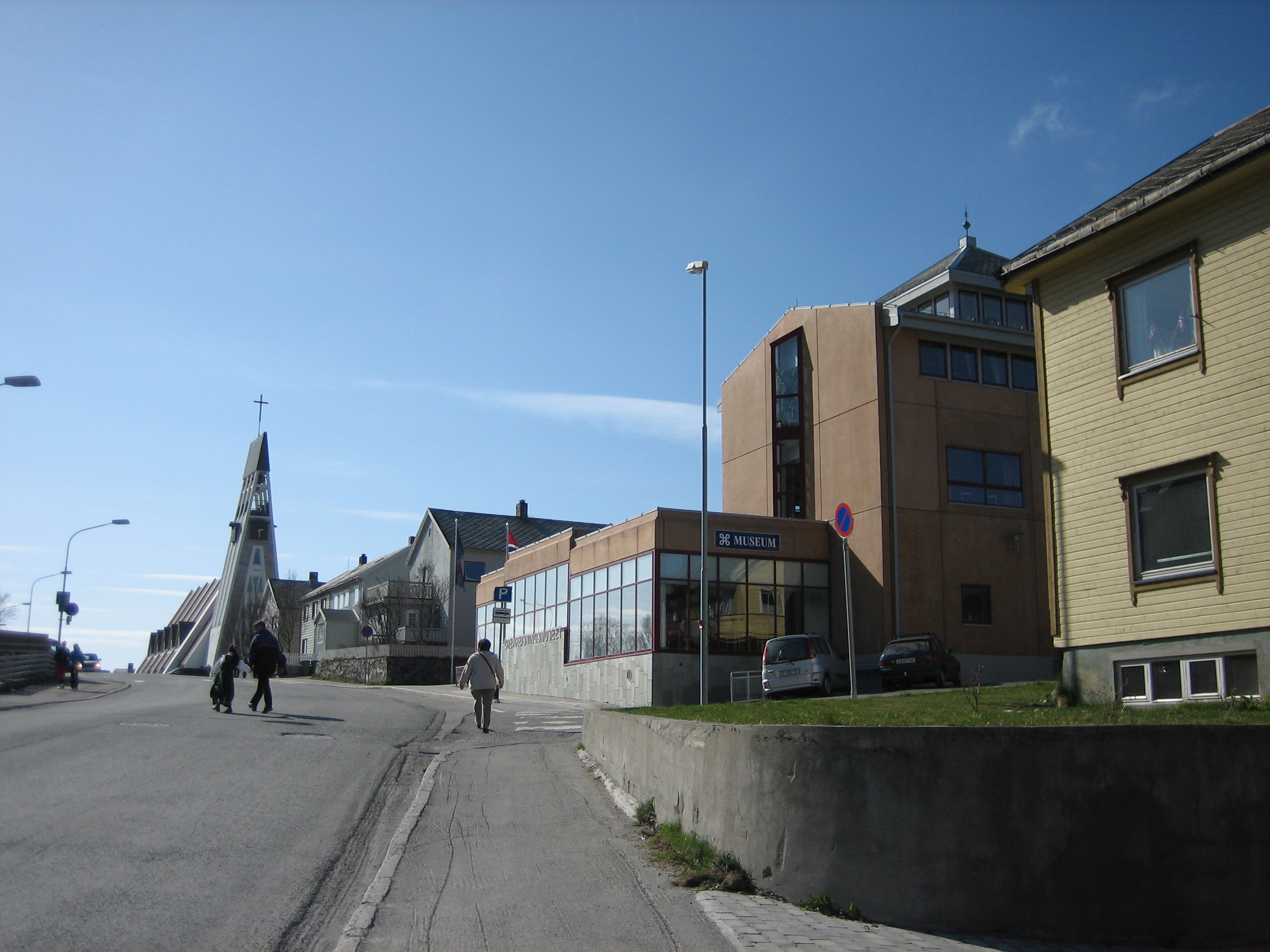
Museum of Reconstruction
Before the Germans left, the barber buried his chair. It was an American barbershop chair, imported from Chicago before the war, and it was the most precious thing he owned. He wrapped it in tarpaulin, dug a hole in his garden, and lowered it in. Then he watched as retreating Nazi forces burned Hammerfest to the ground -- every building, every street, everything. When the town was eventually rebuilt years later, he dug up the chair, installed it in his new parlor, and went back to cutting hair. That chair is now in the Museum of Reconstruction for Finnmark and North Troms, and it tells you everything you need to know about what this museum is really about: not destruction, but the stubborn human refusal to accept it.
Scorched Earth at 70 North
As the Second World War drew to its close in late 1944, German forces retreating through northern Norway carried out a systematic scorched-earth campaign across Finnmark and North Troms. The entire town of Hammerfest was razed -- not damaged, not partially destroyed, but leveled to the ground. The strategy was deliberate: deny the advancing Soviet forces any infrastructure, any shelter, any usable resource. For Hammerfest's residents, it meant watching their homes, workplaces, churches, and schools disappear in a matter of hours. The locals knew the troops were coming and what they intended to do, which gave some a narrow window to prepare. Many buried their most precious possessions, as the barber did with his Chicago chair. But there was no saving the town itself.
Ground Floor: The Ruin
The museum's ground floor depicts the destruction and its immediate aftermath with photographs and authentic objects from the period. What follows on the upper levels is more remarkable: a walk through time, room by room, showing how people actually lived as they rebuilt. The first reconstructed spaces are shockingly basic -- single-room dwellings where entire families slept, cooked, and existed in conditions that would have seemed primitive a century earlier. The museum does not soften this. Composed mostly of authentic items retained from the reconstruction years, the tableaux show what starting over from nothing actually looks like. There is no furniture to speak of, no decoration, nothing beyond the bare essentials of survival at 70 degrees north latitude, where winter darkness lasts weeks and temperatures drop far below freezing.
The Rooms Fill Up
As visitors move through the museum, the rooms gradually change. Single-room dwellings give way to multiple rooms. Furnishings begin to appear -- simple at first, then more varied. By the displays representing the 1950s, Norwegian-language fashion magazines sit on tables, a detail the museum uses to mark a psychological turning point: the moment when people had enough stability and enough income to think about something beyond survival. Choice had returned to daily life. Clothing could be selected rather than merely obtained. The progression from bare floors to fashion magazines spans perhaps a decade, but it captures something universal about recovery -- the slow, incremental return of normalcy after catastrophe, measured not in grand gestures but in the quiet reappearance of small luxuries.
The Tower and the Telegraph
Hammerfest slopes steeply away from its harbor, and the museum sits some distance inland, high enough that its central tower commands panoramic views across the whole region. Each floor of the tower houses a photo gallery showing successive phases of architecture in northern Norway -- a visual timeline of destruction and rebuilding that gains its power from the landscape visible through the windows. The town you see outside is the one these photographs document being born. Attached to the main museum is a subsidiary exhibition on the history of telecommunications in Norway, focusing on the construction of the 19th-century telegraph system that connected the isolated communities of this vast and often impassable country. It is an unexpected companion to the reconstruction story, but the thread is the same: the persistent human effort to maintain connection across hostile geography.
A Stop on the Coastal Route
Most visitors to the Museum of Reconstruction arrive aboard the Hurtigruten coastal steamship line, whose vessels call at Hammerfest daily on their route between Bergen and Kirkenes. A typical port stop lasts only two or three hours -- barely enough time to choose between the museum and Hammerfest's other famous attraction, the Royal and Ancient Polar Bear Society, let alone explore the town. The museum's displays are primarily labeled in Norwegian, though visitors can borrow guidebooks in English, German, French, Spanish, Italian, Russian, Finnish, and Sami. It is, in its way, a museum that knows its audience: primarily Norwegians tracing the contours of their own national story, confronting the fact that within living memory, an entire town in their country was erased and then, with extraordinary determination, rebuilt from the bare earth.
From the Air
Located at 70.66N, 23.68E in Hammerfest, one of the northernmost towns in the world, on the coast of Finnmark in northern Norway. From the air, Hammerfest is identifiable as a compact town on a peninsula jutting into the Norwegian Sea. The museum's tower is one of the tallest structures in town. Nearest airports are Hammerfest Airport (ENHF), a small regional facility, and Alta Airport (ENAT) approximately 140 km to the south. Recommended viewing altitude 2,000-4,000 ft. The coastal landscape of fjords and islands is dramatic from any altitude.