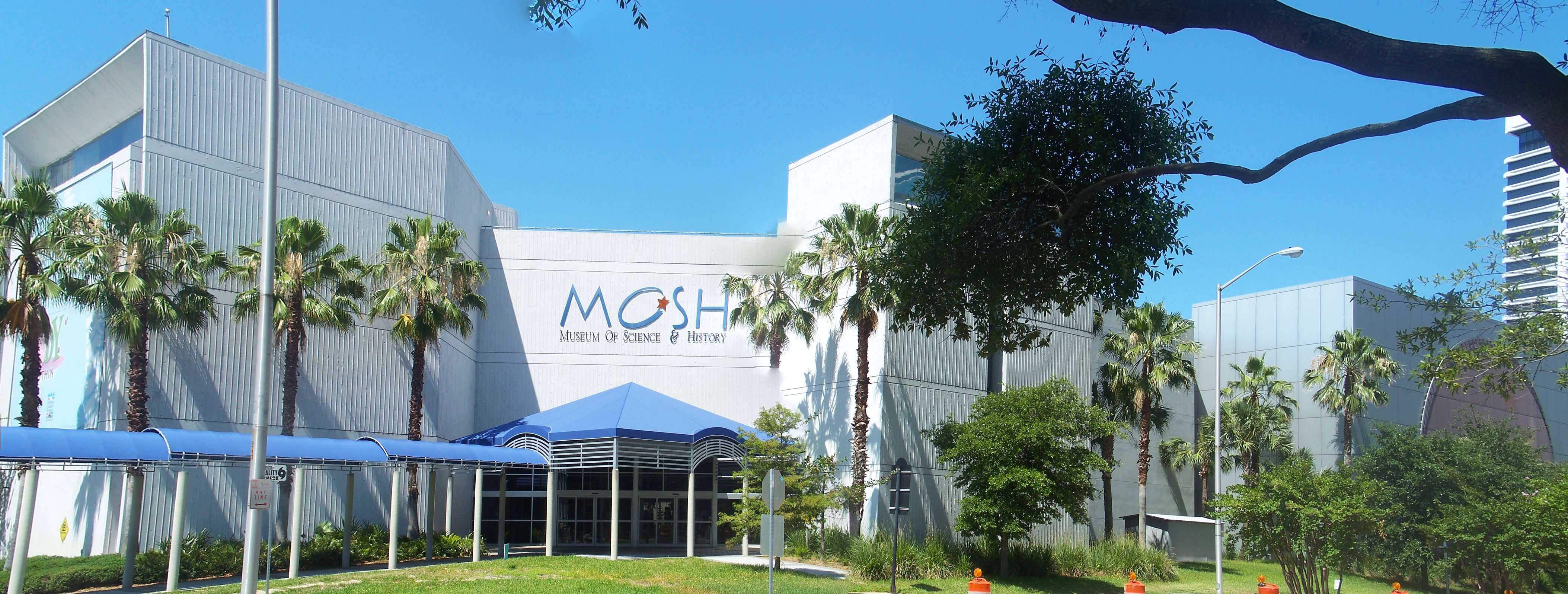
Museum of Science and History
The stars have always been part of the story. Since the Bryan-Gooding Planetarium opened inside the Museum of Science & History on Jacksonville's Southbank Riverwalk, generations of schoolchildren have tilted their heads back in the dark and watched projected constellations wheel overhead. MOSH, as locals know it, is Jacksonville's most visited museum, a private nonprofit institution that has spent more than eight decades teaching the city about itself and the universe beyond. In 2025, the planetarium projector went dark for the last time at this location. The building closed. But MOSH is not ending. It is moving across the St. Johns River to become something far larger, trading a mid-century Southbank facility for a new Northbank campus that promises to be one of the most ambitious museum projects in Florida.
From a Victorian Parlor to the Riverwalk
MOSH traces its origins to 1941, when the Jacksonville Children's Museum was chartered during a time when the nation was focused on anything but children's education. The first permanent home was a Victorian mansion in the Riverside neighborhood, a setting that lent the young institution more charm than space. In 1965, construction began on a purpose-built facility on the city-owned Southbank site downtown, and the museum opened its doors there in 1969. The institution kept evolving through its names: it became the Jacksonville Museum of Arts and Sciences in 1977, earned accreditation from the American Alliance of Museums in 1983, and adopted its current name, Museum of Science and History, in 1988. That same year, the planetarium was added, then known as the Alexander Brest Planetarium. A 1994 renovation expanded the building to its current footprint. In 2010, the planetarium received a new projector and sound system and was renamed the Bryan-Gooding Planetarium.
Three Floors of Wonder
MOSH specialized in the intersection of science and Northeast Florida's local history, a combination that gave it a regional identity no traveling blockbuster exhibit could replicate. Three floors of permanent and signature exhibits anchored the experience, while a large gallery rotated traveling shows on a quarterly schedule. One recent exhibit, Playing With Lights, gave visitors twenty-one stations to poke, prod, and bend laser light. The Bicentennial exhibit traced how fires, floods, disease, and other upheavals shaped Jacksonville's economy and environment. WeaveTales, previously shown at the Museum of Contemporary Art Jacksonville, highlighted the stories of North Florida refugees and their families, following one woman's journey to Jacksonville. These rotating exhibits kept the museum feeling fresh to repeat visitors, while the planetarium remained the constant draw: a darkened dome where the scale of the universe made the concerns of a weekday afternoon feel briefly manageable.
Closing the Southbank Doors
In May 2025, MOSH CEO Dr. Alistair Dove announced that the Southbank location would close permanently on August 31, 2025. Dove called the existing building "an aging cultural facility" and acknowledged that the community was ready for something new. The closure was not a defeat but a deliberate step in what MOSH calls the Genesis Project: a plan, announced in 2021, to relocate to the Northbank of downtown Jacksonville with a dramatically larger facility designed by the architectural firm DLR Group. The new museum is planned to encompass more than seven acres of indoor and outdoor learning environments along East Bay Street, blending museum space, parkland, and waterfront into a single campus. The estimated cost exceeds $131 million, and as of early 2026, the museum was working to raise the final $35 million to $45 million needed to complete the project.
A New Constellation on the North Bank
Construction on the new MOSH is expected to begin in 2026, with a projected completion as early as 2029. The Jacksonville City Council extended the construction timeline, and the city's Downtown Investment Authority retains the option to grant further extensions if needed. The new facility will occupy a 2.5-acre site along the north bank of the St. Johns River, directly across the water from where the museum has operated for more than five decades. From the air, the Southbank Riverwalk location is visible along the river's southern edge, nestled among the parks and walkways that line the waterfront. Soon, the museum's new home will be visible on the opposite bank, a physical manifestation of Jacksonville's ongoing effort to reinvent its downtown around the river that defines it. For a museum that started in a Victorian parlor with a mission to spark curiosity, the leap across the St. Johns feels like the most natural thing in the world.
From the Air
MOSH's current Southbank location is at 30.320N, 81.660W on the south bank of the St. Johns River in downtown Jacksonville. The future Northbank location will be along East Bay Street on the river's north side. The wide St. Johns River curving through downtown provides a strong visual reference. Both banks feature distinctive riverwalk infrastructure visible from low altitude. Nearest airports include Jacksonville Executive at Craig Airport (KCRG) approximately 10 nm east and Jacksonville International Airport (KJAX) about 15 nm north. Best viewed below 3,000 ft AGL to distinguish the Southbank Riverwalk and waterfront institutions.