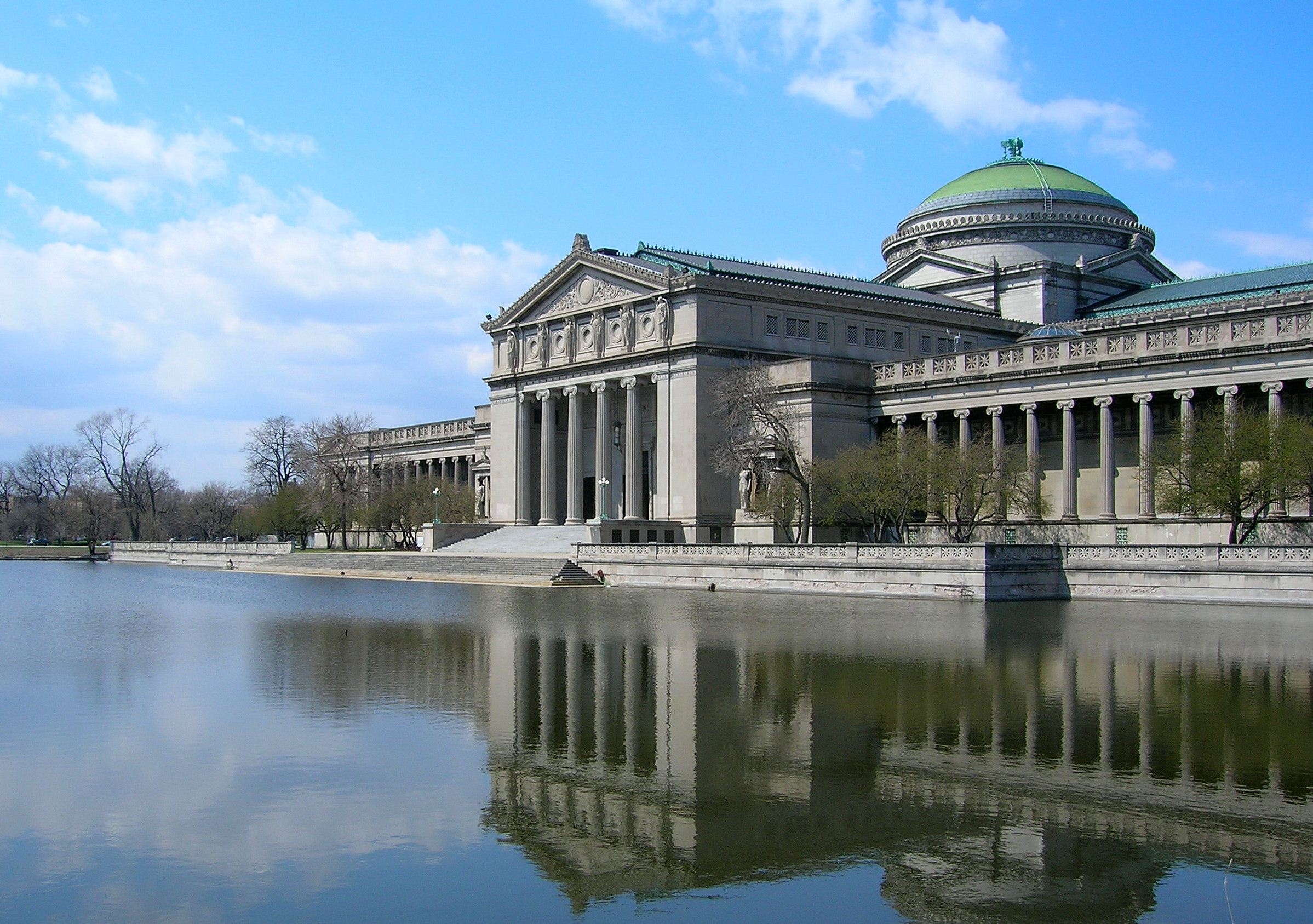
Museum of Science and Industry (Chicago)
There is a German U-boat inside a museum on Chicago's lakefront. The U-505 sits in a concrete bunker beneath the same Beaux Arts dome that once displayed paintings for the 1893 World's Columbian Exposition, and next to it are the capsule that carried the first humans around the Moon and a replica coal mine that has been swallowing visitors since 1933. The Museum of Science and Industry exists because of a collision between a doomed world's fair building, a philanthropist with a vision, and a Munich museum that changed his mind about what a museum could be. It is the largest science museum in the Western Hemisphere, and the building itself - the Palace of Fine Arts - is the last survivor of the legendary White City.
The Palace That Refused to Die
The 1893 World's Columbian Exposition created a temporary city of white plaster buildings along the lakefront. When the fair ended, nearly everything was torn down. The Palace of Fine Arts survived because it was the one structure built with a permanent brick substructure beneath its plaster facade - exhibitors had insisted on real protection for the five million dollars' worth of art displayed inside. Designed by Charles B. Atwood for D.H. Burnham & Company, it first became the Columbian Museum, which evolved into the Field Museum of Natural History. When the Field Museum moved to a new building in 1920, the palace sat vacant, slowly deteriorating. A campaign to turn it into a sculpture museum faltered. The South Park Commissioners sold five million dollars in bonds for restoration, but the building's destiny was about to change direction entirely.
Rosenwald's Vision
In 1911, Julius Rosenwald, president of Sears, Roebuck and Company, visited the Deutsches Museum of science and technology in Munich with his family. The experience transformed his thinking about museums. Rather than passive displays behind glass, the Deutsches Museum invited visitors to touch, operate, and experiment. Rosenwald wanted to bring that spirit to Chicago. He pledged three million dollars toward converting the Palace of Fine Arts, eventually contributing more than five million. He established the museum organization in 1926 but refused to put his name on the building. The exterior was recast in limestone to preserve the 1893 Beaux Arts look, while architect Alfred P. Shaw replaced the interior in Art Moderne style. The museum opened in stages between 1933 and 1940, its first ceremony coinciding with the Century of Progress Exposition. For its first five decades, general admission was free.
Wonders Beneath the Dome
The museum's collection reads like a cabinet of impossibilities. The U-505, captured from the German Navy on June 4, 1944, arrived in 1954 - one of only six U-boats seized by the Allies during World War II, and the only one on display in the Western Hemisphere. It sat outdoors for fifty years before being moved into a purpose-built underground exhibit in 2005, now designated a National Historic Landmark. In the Henry Crown Space Center, the Apollo 8 command module that carried Frank Borman, Jim Lovell, and William Anders around the Moon in December 1968 shares space with the Mercury-Atlas 7 capsule and a SpaceX Dragon cargo craft. The Coal Mine, the museum's oldest exhibit from opening day in 1933, uses original equipment from Old Ben #17, a mine in Johnston City, Illinois that closed in 1923, complete with a genuine mine train ride. A 40-foot water vapor tornado vortex churns in Science Storms. The Great Train Story runs an HO-scale model railroad recreating the Empire Builder route from Chicago to Seattle.
A Living Museum
Over 2,000 exhibits fill 75 major halls across three levels. Yesterday's Main Street reconstructs an early-twentieth-century Chicago street with cobblestones and functioning nickelodeon cinema. Colleen Moore's Fairy Castle, an intricate miniature fantasy house, has been on display since 1949. The Genetics exhibit hatched roughly 8,000 chicks a year for decades before closing in 2025. Every winter since 1942, Christmas Around the World fills the rotunda with trees representing different cultures - a tradition that started with a single tree honoring soldiers in World War Two and grew to more than fifty. In 2024, a $125 million donation from financier Kenneth C. Griffin - the largest single gift in the museum's history - led to a formal renaming as the Kenneth C. Griffin Museum of Science and Industry, along with a new immersive digital gallery. The museum continues to evolve, just as Rosenwald intended.
From the Air
Located at 41.79°N, 87.58°W in Jackson Park on Chicago's South Side, adjacent to Lake Michigan. The museum's distinctive white neoclassical building and large dome are clearly visible from altitude, sitting between the park's lagoons and the lakefront. The Midway Plaisance stretches west toward the University of Chicago campus. Nearby airports include Chicago Midway (KMDW, 9 miles southwest) and Chicago O'Hare (KORD, 20 miles northwest). The Barack Obama Presidential Center is under construction nearby in Jackson Park.