Museum of Sonoma County: The Building That Walked
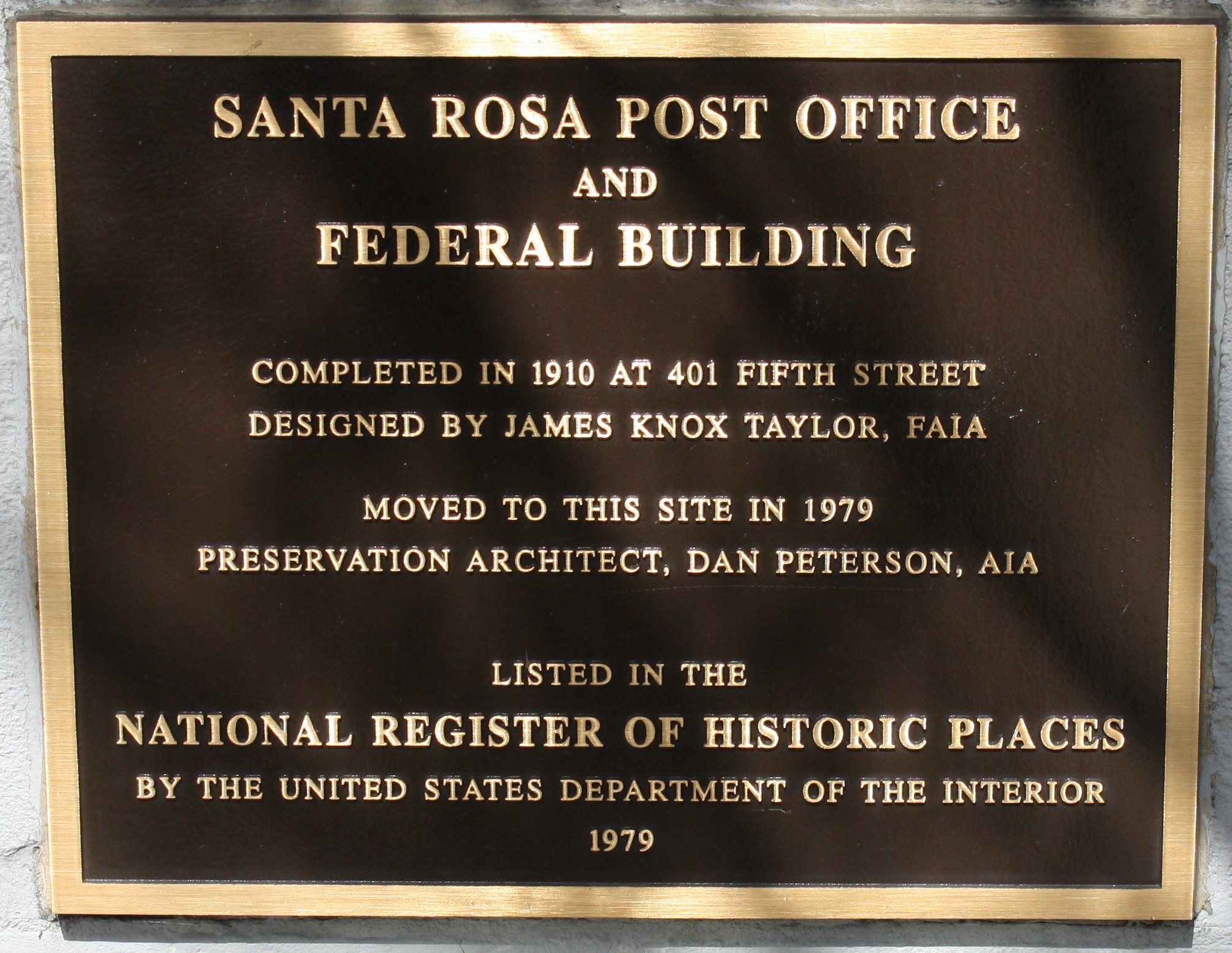
In April 1979, workmen jacked a 69-year-old building off its foundation, laid a bed of steel rails beneath it, and began pulling it down the street. The Santa Rosa Post Office moved at an average of 36 feet per day -- slow enough that you could watch it for an hour and wonder if anything had happened, fast enough that after three weeks it had traveled more than 750 feet to a new lot on 7th Street. The building had already survived the 1906 earthquake that leveled most of downtown Santa Rosa and the 1969 quake that damaged it again. What it could not survive, without intervention, was urban renewal. A mall was planned for the site. Architect Dan Peterson proposed an alternative: don't demolish the building. Move it.
Born from Rubble
The story of the building begins with destruction. On March 8, 1906, Congress introduced legislation to fund a permanent post office for Santa Rosa -- "a suitable building with fireproof vaults therein" -- at a cost not to exceed one hundred thousand dollars. Exactly one month later, the great earthquake struck, and most of downtown Santa Rosa collapsed. The post office operated temporarily out of Jenkins Grocery, surrounded by debris. Local hop dealer C.C. Donovan wrote to James Knox Taylor, the Supervising Architect of Federal Buildings, urging him to prioritize the new construction. Taylor, known for designing federal buildings that reflected local character, created a structure in the Classic Federal style, influenced by the World's Columbian Exposition of 1893. Construction began in 1908. The Santa Rosa contracting firm of Hoyt Bros. hired local craftsmen: Henry Kroncke of the Santa Rosa Planing Mills for the interior woodwork, J.C. Mailer Hardware for the plumbing, and stone contractor George Reilly for the Bedford stone columns and marble terrazzo floors. On March 9, 1910, Postmaster H.L. Tripp moved in.
Ahead of Its Time
The building was technologically ambitious for its era. The Ray Oil Burner Company of San Francisco installed an automatic oil-burning heating system that would not be publicly demonstrated in the Bay Area until the 1915 Panama-Pacific International Exposition -- five years after the Santa Rosa Post Office was already using it. The system did more than heat the building; it provided hot showers for the mail carriers, a luxury that most federal buildings of the period did not offer. The architecture itself was a statement of civic pride and recovery. A city that had been flattened by earthquake was building something meant to last, with materials and craftsmanship that declared Santa Rosa's intention to be more than a town that could be knocked down. The Bedford limestone, the terrazzo, the careful woodwork -- every detail said permanence. That the building would eventually need to be physically relocated to avoid demolition adds a layer of irony that its builders could not have anticipated.
Seven Hundred and Fifty Feet
The 1969 Santa Rosa earthquakes ravaged downtown again, and the ensuing urban renewal plan called for razing the old post office block to build a shopping mall. Dan Peterson, a local architect, recognized what would be lost and campaigned to save the structure by moving it out of the redevelopment zone. The engineering was remarkable: the building was raised on jacks, set onto rails, and pulled by a network of cables and pulleys to its new location on 7th Street between A and B Streets. Peterson then restored it, and the building was placed on the National Register of Historic Places. It reopened in 1985 as the Sonoma County Museum, beginning its second life as a repository for the region's cultural memory rather than its mail.
Running Fence and Eighteen Thousand Objects
The museum's permanent collection spans over 18,000 objects: paintings, photographs, ceramics, textiles, industrial tools, furniture, and documents tracing Sonoma County's evolution from rancho to wine country. The most prominent holding came in 2001, when collector Tom Golden of Freestone donated 125 drawings, sculptures, collages, and photographs by conceptual artists Christo and Jeanne-Claude. The pair are remembered locally for "Running Fence," their 1976 installation of white nylon fabric that stretched more than 20 miles across Sonoma and Marin counties to Bodega Bay. The collection also holds ceramics by Bauhaus-trained potter Marguerite Wildenhain, 19th-century California landscapes by Thomas Hill, and artifacts from Fountaingrove, the utopian community founded by mystic Thomas Lake Harris. Song Wong Bourbeau's collection -- over 200 photographs and artifacts -- preserves the history of Santa Rosa's Chinatown and its Chinese American community, a chapter of local history that might otherwise have been lost.
One Museum, Many Names
The institution has reinvented itself almost as many times as its building has been moved. In 2005, the Museum of Contemporary Art merged with the Sonoma County Museum after scrapping plans for a separate facility at the Luther Burbank Center for the Arts. A decade later, the museum expanded into a remodeled warehouse next door and rebranded as two entities under one umbrella: the Art Museum of Sonoma County and the History Museum of Sonoma County. That arrangement lasted three years before a final simplification in 2018 consolidated everything under a single name: the Museum of Sonoma County. The sculpture garden, designed by landscape architect Frederic Warnecke -- son of the renowned architect John Carl Warnecke -- opened in 2011 between the two buildings. Today the campus encompasses the historic post office, the contemporary gallery in the former warehouse, the sculpture garden, and 10 to 12 rotating exhibitions per year. The building that was once slated for demolition now anchors a cultural destination that refuses to stop evolving.
From the Air
The Museum of Sonoma County is located in downtown Santa Rosa at approximately 38.44N, 122.72W. From the air, downtown Santa Rosa is identifiable by its grid street pattern and the cluster of commercial buildings along the 101 corridor. The nearest airport is Sonoma County Airport (KSTS), roughly 7 nautical miles to the northwest. At 2,000-3,000 feet AGL, the historic post office building and its adjacent campus are not individually distinguishable, but the downtown core and the Highway 101 corridor provide clear orientation.