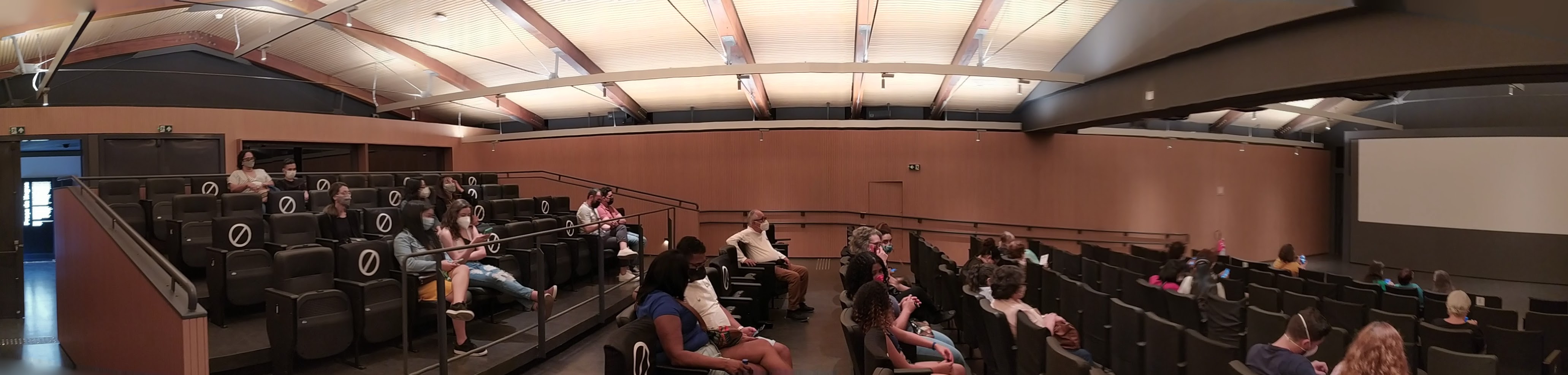
Museum of the Portuguese Language
There is no collection behind glass. No velvet ropes guarding silent artifacts. The Museum of the Portuguese Language occupies the upper floors of Estação da Luz, a working railway station in downtown São Paulo, and every day 300,000 commuters stream through the building beneath it — many of them unaware that above the turnstiles and platform announcements, an entire museum is dedicated to the language they are speaking, shouting into phones, murmuring to children, using to ask strangers for directions. The location was deliberate. It was through this station that thousands of immigrants arriving from Europe and Asia in the late 19th and early 20th centuries first encountered Portuguese, a language most of them had never heard before disembarking from the trains that carried them inland from the Port of Santos.
A Language, Not a Collection
When Ralph Appelbaum — the designer behind the United States Holocaust Memorial Museum in Washington, D.C. and the fossil halls of the American Museum of Natural History in New York — was brought in to conceive the museum, he faced an unusual challenge. How do you exhibit a living language? There are no dinosaur bones to mount, no paintings to hang. Appelbaum's answer was immersion: interactive installations exploring etymology, regional dialects, the sounds of Portuguese as spoken across four continents. The museum, which opened on March 20, 2006, does not preserve Portuguese in amber. It lets visitors hear it, play with it, trace its roots through Latin and Arabic and Tupi, and discover the ways a single language fractures and recombines across Brazil, Portugal, Mozambique, Angola, and beyond. A team of thirty language specialists, coordinated by sociologist Isa Grinspun Ferraz, built the exhibitions to surprise native speakers with the strangeness of their own tongue.
Born from a Railway Cathedral
Estação da Luz is itself a monument. Built between 1895 and 1901, its iron-framed structure was fabricated in Glasgow and shipped across the Atlantic — a gesture of ambition from a city made rich by coffee exports. The station's clock tower, visible for blocks in every direction, anchored the Luz neighborhood as São Paulo's gateway. Choosing this building for the museum was the idea of the São Paulo Secretary of Culture and the Roberto Marinho Foundation, and it carried a cost of around 37 million reais. The architectural adaptation was handled by the father-son team of Paulo and Pedro Mendes da Rocha, who carved exhibition space into the upper levels without disrupting the station's daily operations below. The result is a museum that vibrates with transit — the rumble of arriving trains, the murmur of crowds, the announcements echoing up through the floors — as though the building itself were demonstrating that a language lives only when people use it.
Fire and Resurrection
On December 21, 2015, fire swept through the museum. The blaze gutted the upper floors, destroyed installations, and killed one worker. São Paulo watched the smoke rising from the clock tower and wondered whether the museum was gone for good. It was not. Reconstruction began in 2017 and proceeded in three phases: restoring the interior and facades, rebuilding the roof that the fire had consumed, and upgrading the museum's technology and exhibitions for a new era. The work cost an estimated 87.5 million reais. When the museum reopened on July 31, 2021, the ceremony drew the presidents of Portugal and Cape Verde, former Brazilian presidents Fernando Henrique Cardoso and Michel Temer, and dignitaries from across the Portuguese-speaking world. A new rooftop terrace now offers views over the Jardim da Luz, and the rebuilt exhibitions use updated interactive technology. The museum had burned, but the language it celebrated — spoken by over 250 million people worldwide — had carried on without interruption.
The World's Largest Lusophone City
São Paulo is the largest Portuguese-speaking city on Earth, home to over 20 million inhabitants in its metropolitan area. That fact shaped every decision about where to place a museum honoring the language. Here, Portuguese absorbs vocabulary from Japanese, Italian, Arabic, and indigenous Tupi-Guarani, layered by successive waves of immigration that made the city one of the most linguistically diverse places in the Americas. The museum captures this multiplicity. It is not a monument to a single standard dialect but an exploration of how Portuguese adapts, borrows, and transforms — how the same language sounds different in a favela, a boardroom, a fishing village in the Azores, or a market in Maputo. Walking through the exhibitions, visitors encounter their own language as something foreign, full of histories and connections they had never considered. That is the museum's quiet radicalism: making the familiar strange, and in doing so, making it visible.
From the Air
Located at 23.53°S, 46.64°W within the Estação da Luz complex in central São Paulo's Luz neighborhood. The station's distinctive clock tower is the key visual landmark. Nearest airports: Congonhas (SBSP) approximately 8 km south, Guarulhos International (SBGR) approximately 25 km northeast. Best viewed at 2,000-3,000 feet AGL where the station's elongated roof and surrounding Jardim da Luz park are clearly identifiable amid the dense urban grid.