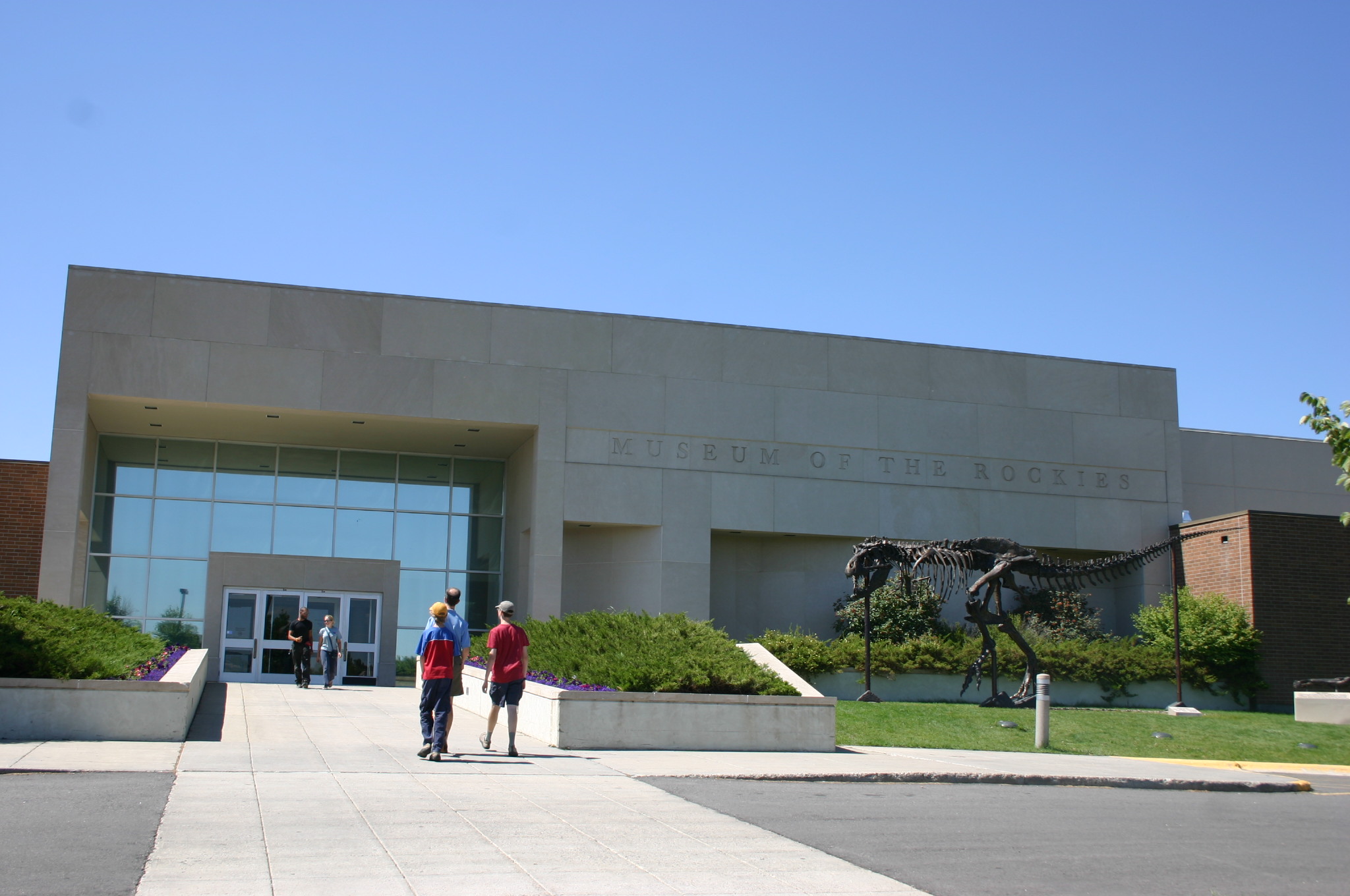
Museum of the Rockies
The skull measures larger than Sue, the famous specimen at Chicago's Field Museum. But this Tyrannosaurus rex never left Montana. For decades, dinosaur fossils found in the state were shipped elsewhere to fill the halls of distant museums. That changed in 1990 when a newly discovered T. rex skeleton stayed home, and the Museum of the Rockies began building what is now the largest collection of North American dinosaur fossils in the United States. Thirteen Tyrannosaurus rex specimens call this place home, including one of only two complete skeletons ever found.
Keeper of Deep Time
The museum's collections span more than 500 million years, from Middle Cambrian marine life to frontier homesteaders. Founded in 1957 with support from physician Caroline M. McGill, the institution has grown to house 300,000 objects. In 1980, it acquired over 10,000 photographs from the Schlechten family, chronicling Bozeman and Yellowstone from 1905 through the 1970s. Native American tribes whose ancestors called this region home share their oral histories through museum symposiums. When the Museum of the Rockies became a Smithsonian affiliate in 2005, it gained access to the resources and expertise of the nation's largest museum complex.
Tyrant Kings and Ancient Bones
Curator Jack Horner transformed the museum's paleontology program through partnerships with the U.S. Fish and Wildlife Service and Bureau of Land Management. His work helped keep Montana fossils in Montana while building a world-class research collection. The Siebel Dinosaur Complex houses one of the first identified female dinosaurs, an ovulating T. rex. In 2005, scientists discovered soft tissue remains in a Tyrannosaurus thigh bone, material brought to the museum for study. Baby Triceratops bones emerged from Jordan, Montana in 2006. Yoshi's Trike, a large Triceratops with 125-centimeter horns, was discovered in 2010. A mobile paleontology lab allows researchers to analyze fossils in the field.
Living History on the Grounds
The Tinsley House sits on the museum grounds, moved from Willow Creek in 1989. William and Lucy Tinsley migrated west during the Civil War, met in Virginia City where both worked, then settled in the Gallatin Valley after marrying. They built their log home in 1889 using timber gathered over two years from the Tobacco Root Mountains. Today, costumed interpreters demonstrate life in a turn-of-the-century Montana home. The functioning outhouse, water pump, and kitchen reveal the daily rhythms of homestead life in the 1800s Gallatin Valley.
Beyond the Dinosaurs
The Taylor Planetarium offers a 104-seat domed theater for exploring the night sky. A $4 million Curatorial Center for the Humanities opened in 2017, providing storage and curatorial space for art, archaeological, historic, Native American, and photographic collections. Students from across Montana participate in school tours, summer camps, and educational programs. Montana State University undergraduates can take courses through the museum, from Museum Practices to independent research. Traveling exhibits have brought African American art, television costumes, and even King Tut to this corner of Montana where the Rockies meet the plains.
From the Air
Located at 45.659N, 111.046W on the southwest edge of Montana State University's Bozeman campus. Look for the distinctive museum building with its modern architecture near the intersection of Kagy Boulevard and South 7th Avenue. A bronze cast of Big Mike, a T. rex femur, stands at the entrance. Nearest airports: Bozeman Yellowstone International (KBZN) 8 miles northwest. The campus and museum are best viewed at 2,000-3,500 feet AGL.