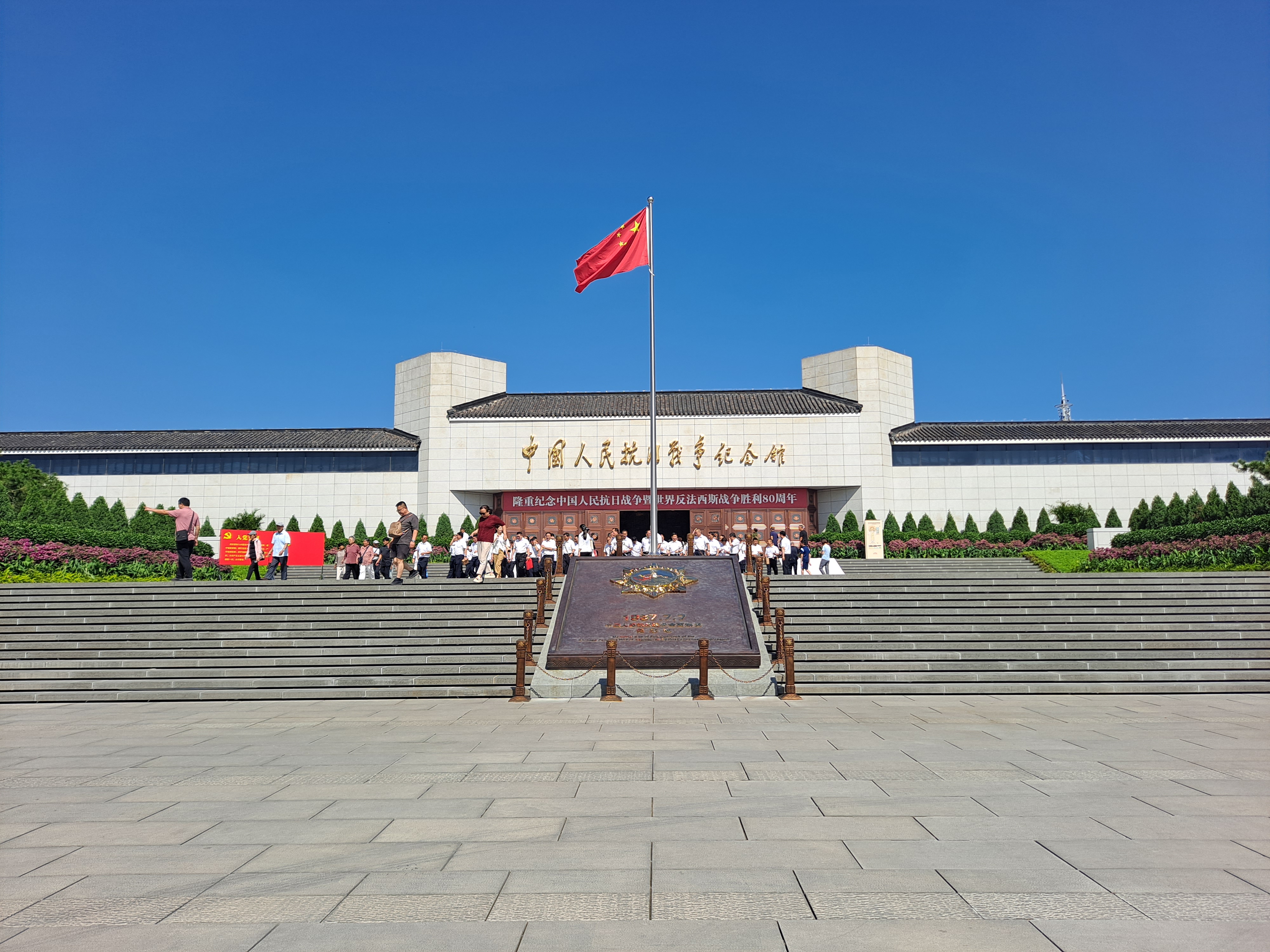
Museum of the War of Chinese People's Resistance Against Japanese Aggression
The museum sits inside the fortress that the war's first shells struck. Wanping Fortress, where Japanese artillery pounded Chinese positions beginning on 7 July 1937, now houses the Museum of the War of Chinese People's Resistance Against Japanese Aggression, the most comprehensive museum in China dedicated to the Second Sino-Japanese War. Opened on 7 July 1987, the 50th anniversary of the Marco Polo Bridge Incident that triggered the conflict, the museum occupies a location where history is not merely displayed but embedded in the walls themselves. Shell damage from 1937 still marks the fortress exterior, now preserved under memorial plaques.
Built to Remember
The museum's creation in the 1980s was a deliberate national project. In October 1984, with support from the Chinese Communist Party and national leadership, an organizing committee was established. The historian and politician Hu Qiaomu played a central role in its founding, alongside the Chinese Academy of Social Sciences and historian Liu Danian. When the museum opened on 7 July 1987, it was Deng Xiaoping, China's paramount leader, who performed the official ceremony. The choice of date, location, and leadership all signaled that this was not a local heritage project but a statement of national memory, placing the war's beginning at a specific point in Beijing's geography and anchoring it there permanently.
Four Halls, One War
The museum spans 30,000 square meters, divided into four main halls that guide visitors through the war in a deliberate sequence. The Main Hall presents the Japanese invasion from 1931 to 1945 in chronological order, tracing the arc from Manchuria to surrender. The Hall of Japanese Military Atrocities documents the violence inflicted on Chinese civilians and soldiers through statistics, photographs, and descriptive displays. The Hall of the People's War describes guerrilla warfare during the Japanese occupation, emphasizing the Chinese Communist Party's role in the resistance. The Hall of Martyrs of the War of Resistance is not a conventional exhibit but a monument, centered on a statue of the Unknown Martyr surrounded by four relief sculptures and name tablets listing fallen soldiers. Dioramas, emotional language, and varied tones throughout the halls create an atmosphere designed to make the scale of suffering tangible.
The Semicircle Screen
A separate Hall of the Marco Polo Bridge Incident, opened on 7 July 1988, employs an unusual approach to historical presentation. A semicircular screen standing 16.5 meters high and stretching 50 meters long plays documentary footage of the incident, surrounding visitors with the sights and sounds of the battle that began the war. The hall combines painting, sculpture, projection, and acoustics to create an immersive environment. Since its founding, the museum has undergone three major renovations and several smaller updates, the most significant completed in 2005. Exhibition space expanded from the original 1,320 square meters to more than 6,000. The 2005 exhibition, "Great Victory," displayed 587 photographs, over 830 relics, 22 groups of sculptures, 14 oil paintings, and 10 reconstructed war scenes.
Memory and Its Uses
Beginning in 2018, the museum added exhibits honoring China's Righteous Among the Nations and other Chinese figures who helped Jewish refugees escape Europe during the Holocaust, broadening the museum's scope from national resistance to international solidarity. The museum has attracted some of the most prominent figures in Chinese and Japanese politics. Prime Minister Tomiichi Murayama of Japan visited in May 1995. General Secretaries Jiang Zemin, Hu Jintao, and Xi Jinping have all made official visits. The museum's location near the Marco Polo Bridge in Fengtai District, accessible via Wanpingcheng Station on Line 16 of Beijing Subway, places it at the geographic point where the war crossed from Manchuria into China proper, a spatial connection that gives the exhibits their particular weight.
From the Air
Located at 39.85N, 116.22E inside Wanping Fortress in Fengtai District, southwestern Beijing, adjacent to the Marco Polo Bridge (Lugou Bridge) crossing the Yongding River. The walled fortress is identifiable from the air at lower altitudes. Beijing Capital International Airport (ZBAA) is approximately 45 km northeast. Beijing Daxing International Airport (ZBAD) is about 40 km south-southeast. Wanpingcheng Station on Line 16 of Beijing Subway serves the site.