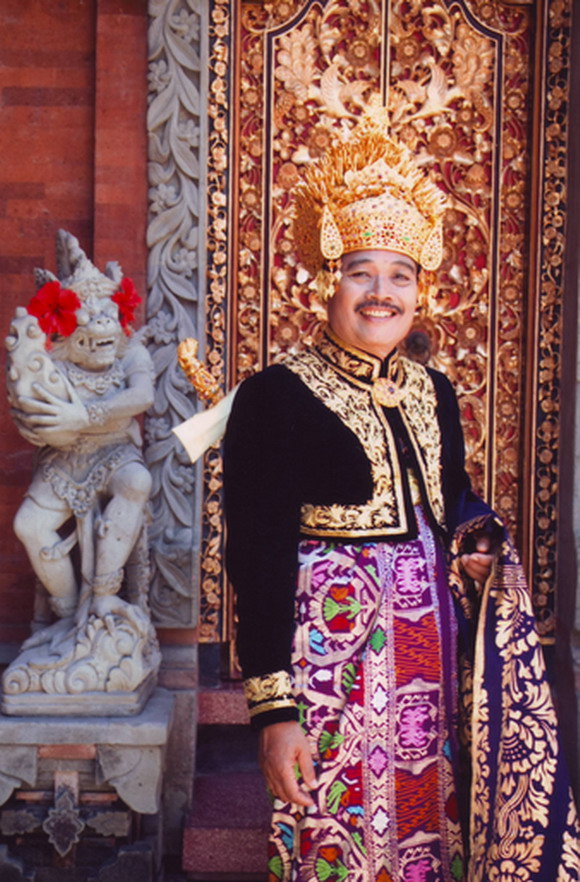
Museum Rudana: Where Philosophy Becomes Architecture
The outer walls announce themselves in red brick and white sandstone, the colors of the Indonesian flag rendered in stone. It is a deliberate choice by Nyoman Rudana, the man who designed and built Museum Rudana in Peliatan, a village in Bali's Gianyar Regency just south of Ubud. Rudana did not set out merely to display art. He built the museum around Tri Hita Karana, the Balinese humanist philosophy that holds art as a contributor to public wellbeing. Every element of the three-story structure encodes meaning: the division of human body into head, trunk, and legs; the partition of the universe into the worlds beneath, intermediate, and above. Walk through this building and you are walking through a cosmology.
A Presidential Opening
The blessing ceremony took place on August 11, 1995, timed to coincide with the commemoration of the 50th anniversary of Indonesian independence. The symbolism was intentional. President Suharto himself arrived on December 26, 1995, to formally inaugurate the museum. (The cornerstone had been laid five years earlier, on December 22, 1990.) At 500 square meters on 2.5 acres of land, the building was modest by Western museum standards, but its ambition was anything but. Rudana envisioned a space where Balinese philosophical principles would shape not just the architecture but the arrangement of every painting on every wall. The harmony of style would mirror the harmony of the building's cosmological framework, each floor ascending toward different artistic traditions.
Three Floors, Three Worlds
The collection exceeds 400 works of fine art and sculpture, and the building's vertical organization maps Indonesia's artistic trajectory. On the first and second floors, the modern masters hold court. Affandi, whose expressionist self-portraits made him Indonesia's most internationally recognized painter. Basuki Abdullah, who painted portraits of presidents and royalty. Srihadi Soedarsono, best known for his luminous Borobudur series, and Nyoman Gunarsa, whose fluid depictions of Balinese dance blur the line between figuration and abstraction. Post-modern voices join them: Nyoman Erawan and Made Budhiana push Indonesian art in directions the older masters might not have anticipated.
Climb to the third floor and the mood shifts. Here, traditional Balinese masters from Ubud and Batuan speak in the intricate, narrative style that predates modernism's arrival. I Gusti Nyoman Lempad, who lived past 100 and drew with a line so precise it seems etched rather than drawn, shares the space with I Gusti Ketut Kobot. Together, these floors construct an argument: Indonesian art is not one story but many, layered like the cosmological worlds the building embodies.
The Expatriates' Gallery
Bali has long attracted foreign artists who came to visit and never left. Museum Rudana honors this tradition with works by painters from four continents. Don Antonio Blanco arrived from Spain via the Philippines and Cambodia, eventually building a flamboyant hilltop studio in Ubud. Yuri Gorbachev brought Russian academic training to Balinese subjects. Jafar Islah from Kuwait and Iyama Tadayuki from Japan each found something in the island's light and culture that their homelands could not provide. Their presence in the collection reinforces Rudana's vision of art as a universal language. These are not souvenirs of Bali. They are the work of artists who were transformed by the place and chose to make their lives within it.
Art During Crisis
In 1997, the Asian financial crisis struck Indonesia with devastating force. The rupiah collapsed, banks failed, and Suharto's regime entered its final months. Against this backdrop, Museum Rudana did something counterintuitive: it sent its art overseas. Exhibitions traveled to Kuwait City in 1997 and 1998, carrying Indonesian art to audiences who might never have encountered it otherwise. In 2000, the museum exhibited in Rome, where the Italian government awarded Nyoman Rudana the L'albero dell'umanita, the Tree of Humanity. The name suited a man who had always believed art served something larger than decoration. Regular anniversary exhibitions continued through the turmoil, and in 1999 and 2004, the museum created the Ksatria Seni Awards to honor fellow artists who dedicated their work to the development of Indonesian arts.
Philosophy in Stone and Paint
What makes Museum Rudana distinctive is not its size or even its collection, but its insistence that a museum building can itself be a philosophical statement. Tri Angga divides the structure as it divides the body. Tri Manggala sections the compound as it sections sacred space. Tri Loka stratifies the floors as it stratifies existence. The Balinese architecture is not applied as ornament but used as organizing principle, down to the red bricks and sandstone that echo the national flag. In a region where museums often feel imported from Western models, this one grows from the soil it stands on. Rudana understood that to preserve Balinese art, you needed to house it in a building that thought like Bali.
From the Air
Museum Rudana sits at 8.53S, 115.27E in Peliatan, Gianyar Regency, south of Ubud in Bali's interior highlands. Nearest airport is Ngurah Rai International (WADD/DPS), approximately 35km to the south. The museum is not individually visible from altitude, but Peliatan sits in the lush river valley landscape between Ubud and Gianyar town. Rice terraces and dense tropical vegetation dominate the area. Approach from the south over the Badung Strait for views of Bali's volcanic spine. Weather is tropical with wet season November through March.