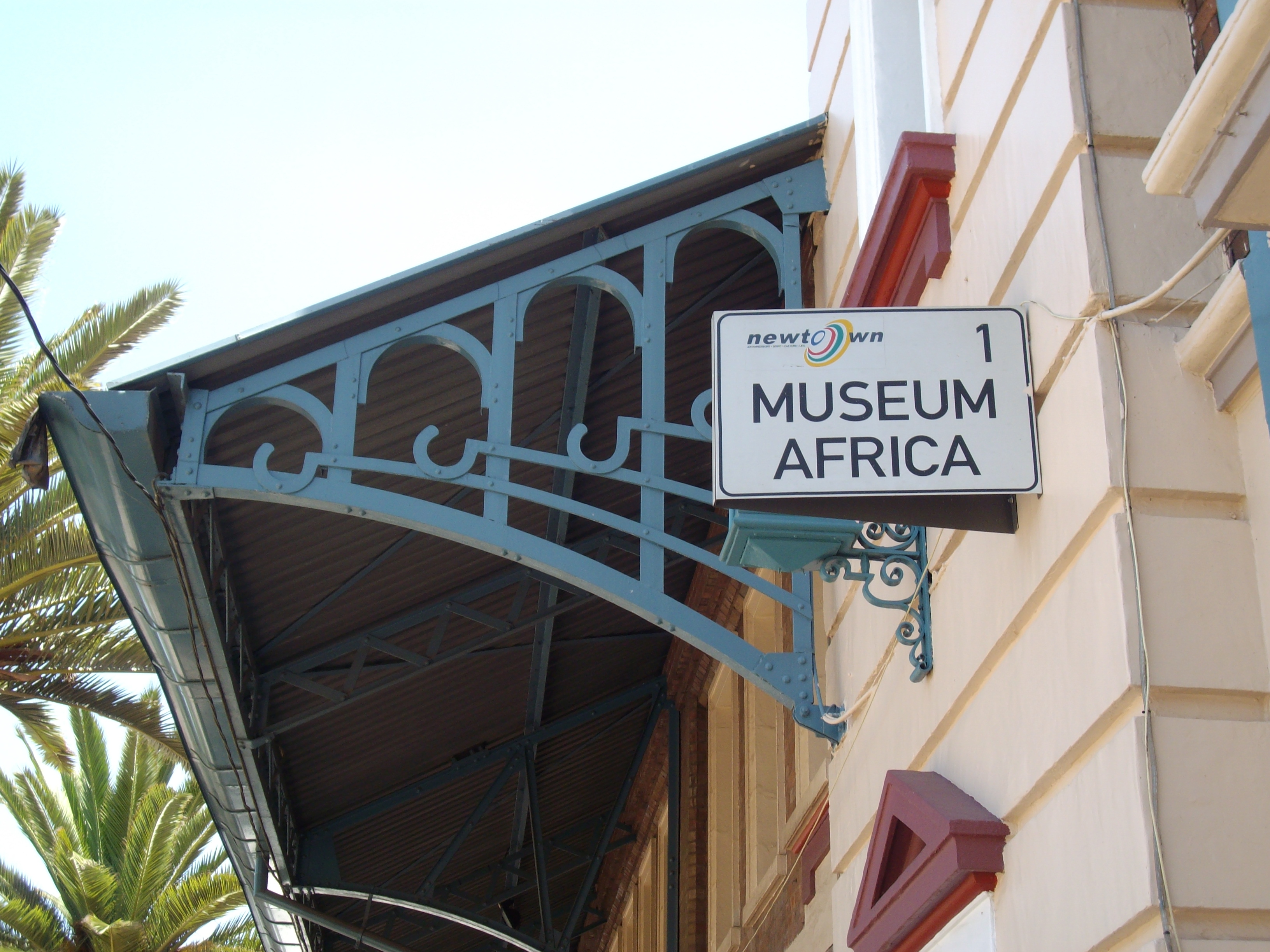
MuseuMAfricA
Walk into MuseuMAfricA and the first thing you notice is the building itself. The former Johannesburg fruit and vegetable market, built in 1913, has the soaring ceilings and generous proportions of a structure designed to hold the daily commerce of a growing city. Since 1994, it has held something less perishable: the cultural memory of a continent. Located in the Newtown district, opposite Mary Fitzgerald Square and sharing its block with the Market Theatre, the museum sits at the center of a cultural precinct that has become Johannesburg's answer to its own restless appetite for reinvention.
From One Man's Library
The museum began in 1933, when the Johannesburg Public Library purchased a substantial collection of Africana -- books, documents, and material culture -- from John Gaspard Gubbins, a collector whose holdings were significant enough to anchor an institution. Through the mid-1930s, the museum's scope expanded beyond its bibliographic roots to encompass all aspects of African cultural history. It published catalogues with titles like "Military medals of South African interest" and "Artists' impressions of Johannesburg, 1886-1956," and from 1943 to 1993 produced the quarterly journal Africana Notes and News. What began as a wealthy collector's passion became, over six decades, an archive of South African life that no single collector could have imagined.
Branches and Offspring
The museum's ambitions extended well beyond its own walls. It established the James Hall Museum of Transport in 1964 and the Bensusan Photographic Museum and Library in 1969, the same year it opened the Museum of South African Rock Art. The Bernberg Museum of Costume followed in 1973, and in 1978 it absorbed the Museum of Man and Science. Most significantly, MuseuMAfricA launched an exhibit called "Never, never again" that directly inspired the creation of the Hector Pieterson Museum in Soweto, dedicated to the 1976 student uprising. Christopher Till, who had served as head of the Africana Museum, went on to create and run the Apartheid Museum at Gold Reef City. The parent institution's influence rippled outward through institutions that millions of visitors now experience without knowing where the impulse originated.
What the Collections Hold
The permanent exhibitions weave personal and political histories into a coherent whole. MyCulture traces the origins and evolution of South Africa's cultural and ethnic groups. Johannesburg Transformations charts the city's tumultuous arc from mining camp to metropolis. Tried for Treason reconstructs the Rivonia Trial of 1963-1964, in which ten defendants -- including Nelson Mandela -- faced charges of sabotage that could have carried the death penalty. The Geology Museum holds over 17,000 rock and mineral samples from across Southern Africa, including specimens from the Tsumeb area of Namibia, the gold-bearing Witwatersrand reefs, and the copper deposits of the Okiep region. In the Bensusan Museum of Photography, rare Victorian and Edwardian cameras sit alongside the images they produced: wet-plate prints, stereoscopic views, and early portraits that document faces the written record never bothered to name.
The Workers' Story
Two blocks from the main building, opposite the Sci-Bono Discovery Centre, sits the Workers' Museum -- a branch dedicated to the migrant laborers who came from across Southern Africa and beyond to work the gold mines that created Johannesburg. The museum tells a story that the city's gleaming high-rises prefer to forget: that the wealth of the Witwatersrand was extracted by men who left their families for months or years at a time, lived in crowded hostels, and received a fraction of the value of what they pulled from the earth. It is the museum's most unflinching exhibition, and arguably its most necessary -- a reminder that Johannesburg's founding industry depended on labor conditions that would be unrecognizable to the tourists who now photograph the city's skyline.
Neglect and Resilience
MuseuMAfricA has not been immune to the challenges facing Johannesburg's inner city. Reports of neglect and inadequate funding have dogged the institution for years. During the COVID-19 lockdowns of 2020, when museums across South Africa were shuttered, thieves broke into the building -- not to steal artifacts, but to strip tap fittings and basins from the bathrooms. The resulting flooding threatened stored exhibits with water damage. It was a grimly fitting metaphor: a museum dedicated to preserving cultural heritage, itself in need of preservation. Yet the collections endure, the exhibitions remain open, and the building -- that grand old market hall from 1913 -- still holds its ground in a neighborhood that has weathered every storm Johannesburg has thrown at it.
From the Air
Located at 26.202S, 28.031E in the Newtown cultural precinct of central Johannesburg. The museum occupies a large early-20th-century market building identifiable from low altitude by its industrial-scale roofline adjacent to Mary Fitzgerald Square. OR Tambo International Airport (FAOR) is approximately 24 km east. Lanseria International Airport (FALA) is about 35 km northwest. The Newtown district sits just west of the Johannesburg CBD core, identifiable by the Nelson Mandela Bridge connecting it to Braamfontein. Viewing altitude: 2,000-4,000 feet AGL.