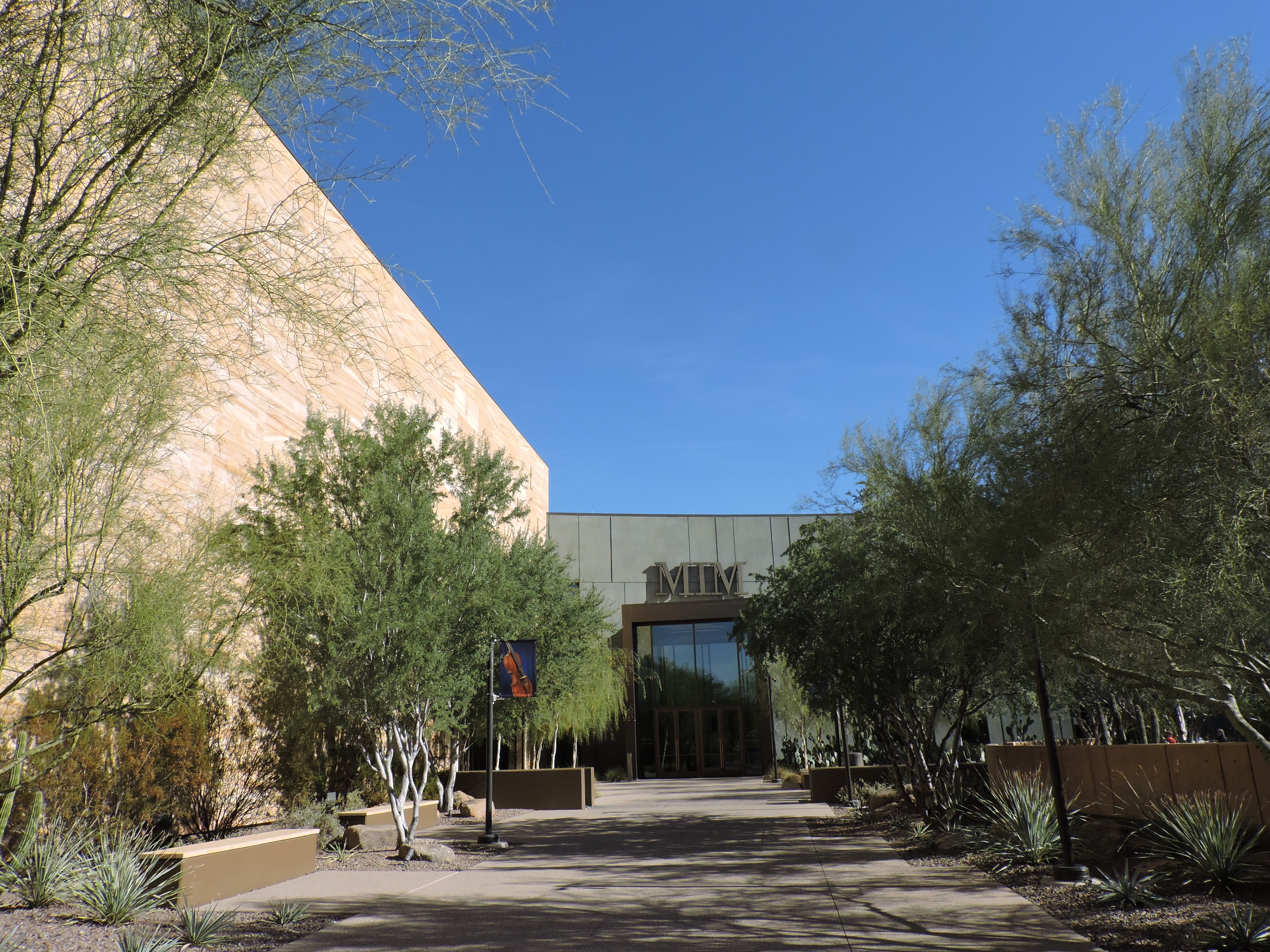
Musical Instrument Museum (Phoenix)
John Lennon's guitar hangs near a Congolese thumb piano. A Stradivarius shares space with an Appalachian dulcimer. Taylor Swift's performance outfit occupies a gallery steps away from traditional Hopi drums. This is the Musical Instrument Museum in north Phoenix, where the organizing principle is not musical genre or historical period but geography: every inhabited continent represented, nearly 200 countries and territories contributing to a collection of over 15,000 instruments. It opened in April 2010 as the largest museum of its type on Earth, the vision of Robert J. Ulrich, former CEO and chairman of Target Corporation. After visiting the Musical Instrument Museum in Brussels with friend Marc Felix, Ulrich returned to Phoenix determined to build something even more ambitious. The result cost over $200 million and covers 200,000 square feet, but the numbers tell only part of the story.
Sound Without Borders
Walk through the five geographical galleries on the upper level, and you begin to understand music as humanity's most universal technology. The Africa and Middle East gallery displays instruments from sub-Saharan villages and North African cities. The Asia and Oceania gallery spans five sub-galleries: East Asia, South Asia, Southeast Asia, Oceania, and Central Asia with the Caucasus. Europe offers everything from antique charter horns to foot-operated drum kits. Latin America divides into South America, Central America and Mexico, and the Caribbean. The United States and Canada gallery traces instruments that shaped North American music: the sousaphone, the ukulele, the electric guitar, the Appalachian dulcimer. Special exhibits honor manufacturers like Fender, Martin, and Steinway. Each display includes a flat-screen video of local musicians performing on the instruments you're viewing. Wireless headphones activate automatically as you approach, filling your ears with the sounds these objects were created to make.
The Artist Gallery
The ground floor Artist Gallery answers a question the geographic exhibits leave open: what happens when extraordinary talent meets extraordinary instruments? Here visitors encounter the personal effects of legends. Elvis Presley's guitars and stage costumes. Pablo Casals' cello. John Lennon's piano. Carlos Santana's instruments. Tito Puente's timbales. Roy Orbison's black-clad performance gear. Johnny Cash memorabilia. Taylor Swift's sequined outfits from various tours. Nigerian juju master King Sunny Ade's instruments. The gallery rotates constantly, bringing new artists into conversation with permanent fixtures. Video concert footage and photographs provide context, but the instruments themselves carry the weight of the performances they enabled.
Touch, Play, Discover
Most museums post signs warning visitors not to touch. The MIM's Experience Gallery invites the opposite: pick up that drum, strum that guitar, pluck that harp. Instruments from many cultures rotate through, giving guests of all ages the chance to make music rather than simply observe it. The Mechanical Music Gallery takes a different approach to interactivity, featuring instruments that play themselves: player pianos that still dance through ragtime, mechanical zithers, and cylinder music boxes that chime with Victorian precision. The Collier STEM Gallery explains the science behind the magic: soundwaves, amplitude, frequency, wavelength, and timbre demonstrated through a deconstructed Fender Stratocaster. A Conservation Lab visible through large windows shows how staff maintain and preserve 15,000 objects, each requiring specialized care.
A Theater for the World
The 299-seat MIM Music Theater hosts concerts that range as widely as the collection itself. Violinist Joshua Bell recorded his album "French Impressions" here in 2011, drawn by the exceptional acoustics. Martha Reeves has sung Motown classics. Lyle Lovett has performed his Texas singer-songwriter repertoire. Wanda Jackson, the Queen of Rockabilly, took the stage. Jordin Sparks, Ronnie Spector, Irish traditional group Altan, jazz pianist Ramsey Lewis, and guitar legend George Benson have all performed. The programming reflects the museum's philosophy: music transcends categories, and a single venue can hold them all. Cafe Allegro serves global cuisine to match the global collection, while the museum store offers instruments visitors can take home and learn to play themselves.
A Collector's Legacy
Robert Ulrich was already a collector of African art and a world museum enthusiast when he visited Brussels with Marc Felix. The Musical Instrument Museum there, housed in an Art Nouveau building, sparked an idea that would consume his post-Target years. He consulted with the Musee de la Musique in Paris, which had modernized in 1997, learning what worked and what could be improved. The Phoenix museum opened in 2010 with displays for larger countries including subsections for ethnic, folk, and tribal music. India, China, Brazil, Mexico, and the United States each have multiple galleries. The PNC Bank Family Center provides space for families with young children to take a break without leaving the museum. Every design decision serves the mission: make the world's music accessible to everyone who walks through the doors.
From the Air
The Musical Instrument Museum sits at 33.6675N, 111.9787W in north Phoenix, approximately 14 nautical miles north of Phoenix Sky Harbor International Airport (KPHX) and 8 nm southwest of Phoenix Deer Valley Airport (KDVT). The contemporary building covers roughly 200,000 square feet and is visible from altitude as a distinctive low-rise structure. At 3,000-4,000 feet AGL, look for the museum just east of the Loop 101 freeway near Tatum Boulevard. The McDowell Mountains rise to the east, providing excellent visual orientation.