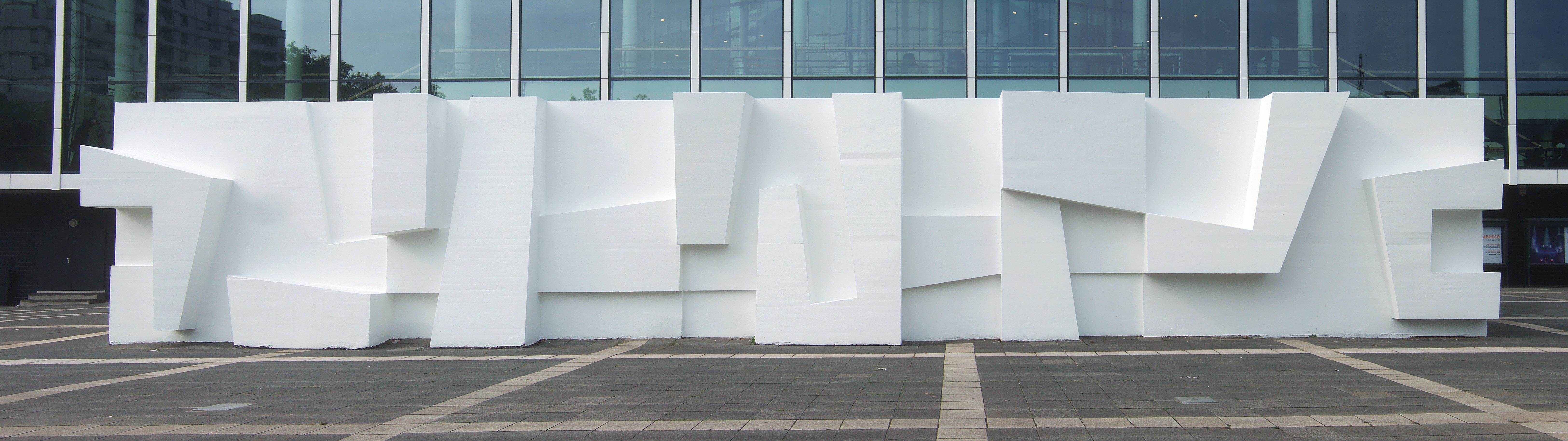
Musiktheater im Revier
Walk past the Musiktheater im Revier in the evening, when the lights are on inside, and the cubic glass facade gives you a view directly into the lobby. What you see is a wall of blue. Seven meters tall, twenty meters long, made of natural sponges glued and lacquered in a shade so saturated it appears to absorb the light around it rather than reflect any. That wall is by Yves Klein. He installed it in 1959, the year the theater opened. It is one of the largest works he ever made, and the blue is not the famous one. International Klein Blue, the patented pigment-in-acetone mixture he had perfected, would have evaporated, lost its bind, and probably caught fire. So for Gelsenkirchen he mixed a new blue. The city named it after the city.
A Coal Town Builds a Modernist Opera
Gelsenkirchen in 1959 was at the peak of its industrial era - tens of thousands employed in collieries and steelworks - and the city used its tax revenues to commission a building entirely out of step with its self-image. The architect Werner Ruhnau, then a young modernist, designed a cubic glass shell wrapped around a circular auditorium, with a four-thousand-five-hundred-square-meter glass facade that turned the whole building into a lantern. From outside you can see straight through to the curved interior. The cubic outside, the cylindrical inside - the contrast was the point. It opened on 15 December 1959 as a three-genre house in the typical German Drei-Sparten-Theater mold: opera, ballet, and spoken theater. The spoken plays were dropped in the 1966-67 budget cuts. The opera and ballet stayed. The auditorium has 1,008 seats in the Large House and 336 in the Small House, plus a Jean Tinguely mobile in the smaller foyer that is half kinetic sculpture and half mechanical metaphor.
Ruhnau Invites Klein
Ruhnau was deeply embedded in the European avant-garde of the late 1950s. He brought in Yves Klein, the French monochromist who was just then making his name with pigment so blue that it appeared to dematerialize. Klein arrived with collaborators - the sculptors Norbert Kricke and Robert Adams contributed work to the foyers as well - and produced two monumental sponge reliefs for the Large House lobby. The main wall is seven by twenty meters in solid blue. A smaller second relief, blue and white, sits opposite. Each sponge was dipped in pigment and fixed to the panel, creating a texture that catches every shift of foyer lighting differently. The pigment problem was real: International Klein Blue used a synthetic resin binder that was perfect on a small panel and unstable across a wall this large. Klein collaborated on a substitute formula, and the result is what Gelsenkirchen has called its city color ever since. The graphic designer Uwe Gelesch later codified Gelsenkirchen Blue as the city's official hue.
The Largest of Three Orchestras
The Neue Philharmonie Westfalen, the house orchestra of the MiR, is the largest of the three state orchestras of North Rhine-Westphalia. It is funded jointly by Gelsenkirchen, Recklinghausen, and the district of Unna, which is a reminder that the post-industrial Ruhr operates as a network of cities rather than a single metropolis. Johannes Kalitzke was chief conductor from 1984 to 1990. Rasmus Baumann has been the orchestra's general music director since 2014. The ballet is led by Bridget Breiner. The repertoire mixes the standard German house material - the Mozart and Verdi and Wagner that every Stadttheater is expected to do - with a real commitment to contemporary work. Bernd Alois Zimmermann premiered here in 1968. Alexander Mullenbach's chamber opera Die Todesbrucke had its first performance in October 2003. The German-language production of Gershwin's Porgy and Bess premiered at the MiR in 1970, decades before that became a standard part of the European opera circuit.
An Opera About Schalke
On 9 May 2004, the MiR did the most Gelsenkirchen thing it had ever done: it premiered a musical about the local football club. Schalke 04 was celebrating its hundredth anniversary, the same anniversary that had triggered the construction of the Veltins-Arena a few kilometers north. The composer Enjott Schneider wrote a stage work titled Nullvier - Keiner kommt an Gott vorbei, which translates as Zerofour: Nobody Outdribbles God. The title is a Schalke fan slogan. The musical wrapped a century of working-class football history into the same building that, forty-five years earlier, had imported the European modernist avant-garde into a Ruhr mining town. Same lobby. Same Gelsenkirchen Blue wall. A different congregation.
Protected, Visible, Loud
The Musiktheater im Revier was listed as a protected cultural monument in 1997, recognition that this is one of the most important pieces of post-war architecture in Germany. The Klein walls are visible to anyone walking past the glass facade at night, free, with no ticket required. The 1961 Bernhard Wicki film The Miracle of Father Malachia was shot inside the building. The two houses run about 320 performances a year between them. Gelsenkirchen's coal mines are gone now, the steelworks are gone, the Schalke team plays second-division football. The opera house stays. It is the rarest kind of cultural investment - one made at the peak of industrial prosperity, that has outlived the industry, and that has aged into the city's most genuine landmark.
From the Air
The Musiktheater im Revier stands in central Gelsenkirchen at 51.5142 degrees North, 7.0911 degrees East, on Kennedyplatz a few blocks south of the main railway station. From the air the building is a low cubic mass with a striking flat roof, surrounded by a small park and the Gelsenkirchen city center to its north. Veltins-Arena is about 4.5 km north. The nearest commercial airport is Dortmund (EDLW / DTM), about 30 km east; Dusseldorf (EDDL / DUS) is roughly 50 km southwest. Gelsenkirchen Hauptbahnhof sits 500 m north of the theater and offers regional and ICE rail connections through the Ruhr.