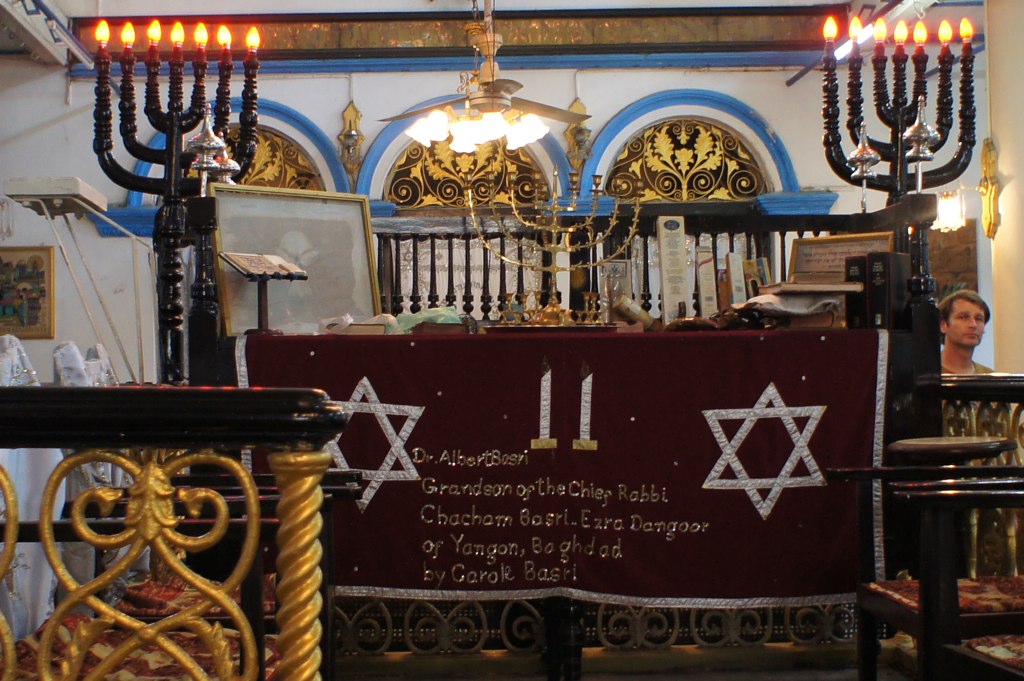
Musmeah Yeshua Synagogue
Fewer than twenty Jews remain in all of Myanmar. Their synagogue -- the Musmeah Yeshua, wedged between Indian paint shops and Muslim traders on a narrow street in downtown Yangon -- is the last physical evidence of a community that once thrived under British colonial rule. Completed in stone in 1896 to replace a wooden predecessor from 1854, the building now serves a congregation so small that its survival depends less on worship than on the determination of a single family.
Merchants from Baghdad and Bombay
The Jews who built the Musmeah Yeshua came from three distinct traditions. Baghdadi Jews arrived from Iraq, bringing Sephardic liturgy and mercantile ambitions. Bene Israel Jews came from India's Konkan coast, and Cochini Jews from the southern tip of the subcontinent. What drew them all was British Burma -- a colonial economy hungry for traders, clerks, and middlemen. The British Colonial Government granted the land for the first synagogue in the 1850s, and the wooden building that rose there served the community's needs for four decades. By the 1890s, the congregation had outgrown it. The current stone building, completed in 1896, replaced the original with more permanent ambitions. A second synagogue, Beth El, opened in 1932 as the population continued to grow.
Peak and Dispersal
By 1940, Rangoon's Jewish community had reached its peak of 2,500 people. They worked as merchants, traders, and colonial administrators -- woven into the fabric of a cosmopolitan port city that also sheltered Hindus, Muslims, Chinese, and the Burmese majority. The Japanese invasion shattered that world. When Japan occupied Burma during World War II, the Jewish community's close ties to the British made them suspect. Most fled to India, joining a massive exodus of refugees who trekked over mountain passes to escape the advancing army. Some returned after the war, but the community never recovered its prewar numbers. Independence in 1948 brought new uncertainties, and the socialist nationalization policies of 1962 drove more families away. Each decade thinned the congregation further.
The Samuels Family Legacy
For decades, the synagogue's survival rested on Moses Samuels, who served as its trustee and tireless guardian. When Samuels died on May 29, 2015, the responsibility passed to his son Samuel -- known as Sammy -- who had studied at Yeshiva University in New York for three years. While in the United States, Sammy promoted tourism to Yangon, and upon returning he founded a travel agency and two hotels in the city. His efforts helped place the Musmeah Yeshua among Yangon's top ten tourist attractions on TripAdvisor. The synagogue sits on the Yangon City Development Council's list of 188 heritage buildings, a designation that offers some protection but no funding. Cyclone Nargis tore off the roof in May 2008 and caused extensive water damage, a reminder of how fragile the building's existence remains.
Prayers in an Empty City
Walking through the synagogue today is an exercise in reading absence. The interior retains its original character -- the bimah, the ark, the decorative details of a late-nineteenth-century Sephardic house of worship. But the pews accommodate a congregation that can no longer fill them. The building stands in what has become a predominantly Muslim neighborhood, a geographic irony that speaks to Yangon's layered history of migration and displacement. A commemorative blue heritage plaque unveiled in 2016 by the Yangon Heritage Trust and Yangon Regional Government marks the synagogue's significance, connecting it to the broader story of diverse faiths in the city's history. For the handful of Jews who remain, the Musmeah Yeshua is not a museum or a tourist attraction but a living synagogue -- one that happens to serve the smallest Jewish community in Southeast Asia.
From the Air
Located at 16.774°N, 96.154°E in downtown Yangon, near the intersection of 26th Street. The synagogue is a small stone building not easily distinguishable from altitude but sits within the dense colonial grid south of the Shwedagon Pagoda. Nearest airport is Yangon International (VYYY), approximately 15 km north. At 2,000-3,000 ft AGL, the surrounding downtown grid of Yangon's colonial quarter is visible, with the golden Sule Pagoda serving as a nearby orientation landmark to the west.