Mustique
The island is named after mosquitoes. The French called it Moustique, and when Colin Tennant bought the 1,400-acre scrubland from the Hazell family in 1958 for 45,000 pounds, the mosquitoes were about the only residents who seemed committed to staying. Seven sugar plantations had been abandoned a century earlier, swallowed by scrub. The Cotton House stood in ruins. Tennant had planned to farm sea island cotton, beef, and mutton, but the cotton failed, and he pivoted to a far more improbable crop: celebrity.
Pirates, Sugar, and Abandonment
Long before rock stars and royals, the Grenadines belonged to people who arrived from South America around 2500 BC, followed by the Arawaks and later the Kalinago. Spanish navigators named the chain Los Pajaros -- "the birds" -- because the rocky islands scattered across the sea resembled a flock in flight. In the seventeenth century, pirates renamed them the Grenadines and used the sheltered bays to hide ships and loot. European planters arrived in the 1740s, establishing sugar plantations worked by enslaved Africans whose labor made the West Indies economically significant at a time when Europe had few other sources of sugar. The Grenadines passed from France to Britain in 1763, and farmers Alexander Campbell and John Aitcheson bought Mustique that year. But when European sugar beet undercut tropical sugar in the nineteenth century, the plantations collapsed. Mustique's seven estates were abandoned, leaving only remnants: a sugar mill at Endeavour and the shell of the Cotton House.
The Baron's Gamble
Colin Tennant, who would become the 3rd Baron Glenconner in 1983, transformed an abandoned island into the most exclusive address in the Caribbean through a single inspired gesture. In 1960, he gave Princess Margaret a four-hectare plot of land as a wedding present. She built a villa called Les Jolies Eaux, and suddenly Mustique had the only endorsement that mattered. When Tennant formed the Mustique Company in 1968, his manager Hugo Money-Coutts secured import and tax-free status for the island in exchange for an annual fee. Villa construction began, and the guest list grew to include Oliver Messel, Mick Jagger, and David Bowie, who built an Indonesian-inspired multi-pavilion estate he found so peaceful he said he could not get any work done there. Bowie sold the property in 1994 for five million dollars. Noel Gallagher wrote and demoed much of the Oasis album Be Here Now while on holiday here in 1996.
Two Mustiques
The island's year-round population of about 500 lives mostly in Lovell Village, a settlement built in 1964 when the original inhabitants were each given a plot of land and a new home. They work the 120 private villas, the hotel, the cafe, the medical clinic, and the security apparatus -- a team led by a former Scotland Yard chief who requires every visitor to register. The population swells to 1,200 in peak season, when the ferry M/V Endeavour from Saint Vincent and the small planes landing at Mustique Airport bring a different kind of islander. The Mustique Charitable Foundation funds scholarships and literacy programs for local residents, and arranges for visiting surgeons. The Mustique Charitable Trust supports school meal programs and diabetes screening on Saint Vincent. These are real investments, but they also highlight the divide: one Mustique is a billionaire's playground, the other is a Caribbean village whose residents service it.
A Living Reef
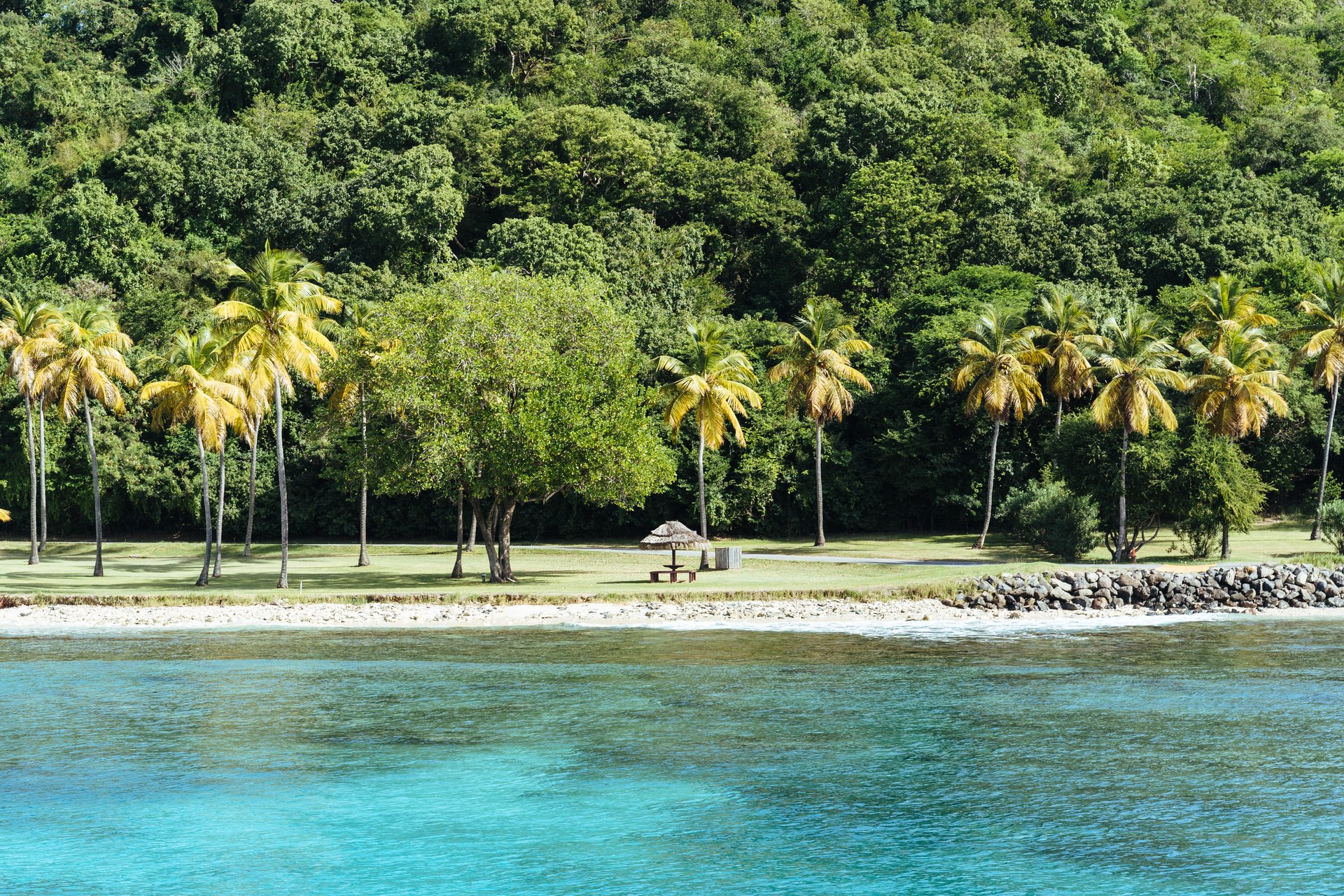
Away from the villas, Mustique sustains a quietly remarkable ecosystem. BirdLife International designated the island an Important Bird Area for its populations of lesser Antillean swifts, green-throated caribs, Antillean crested hummingbirds, and Grenada flycatchers. Hawksbill and leatherback sea turtles nest on the beaches. The snake Barbour's tropical racer and two lizard species -- the green ameiva and bronze anole -- inhabit the scrubland that once consumed the plantations. Coral reefs ring the island, and on the Atlantic side, the waves at Macaroni Beach break hard enough for surfing. On the west side, Gelliceaux Bay offers calm, sheltered swimming. The island that was once too mosquito-ridden for anyone but pirates now attracts creatures far more discriminating.
From the Air
Mustique is located at 12.87N, 61.18W in the Grenadines chain, visible as a distinct green island approximately 18 nautical miles south of Saint Vincent. Mustique Airport (TVSM) has a single runway suitable for small aircraft. The island is 1,400 acres and roughly 3 miles long. Approach from the west for the best view of Britannia Bay and the villa-studded hillsides. Bequia lies about 7 nautical miles to the north, and the uninhabited Petite Mustique is 2 km to the south. Coral reefs surround the island, visible as lighter patches in the water from altitude. E.T. Joshua Airport (TVSA) on Saint Vincent is the nearest commercial airport, about 18 nautical miles north.