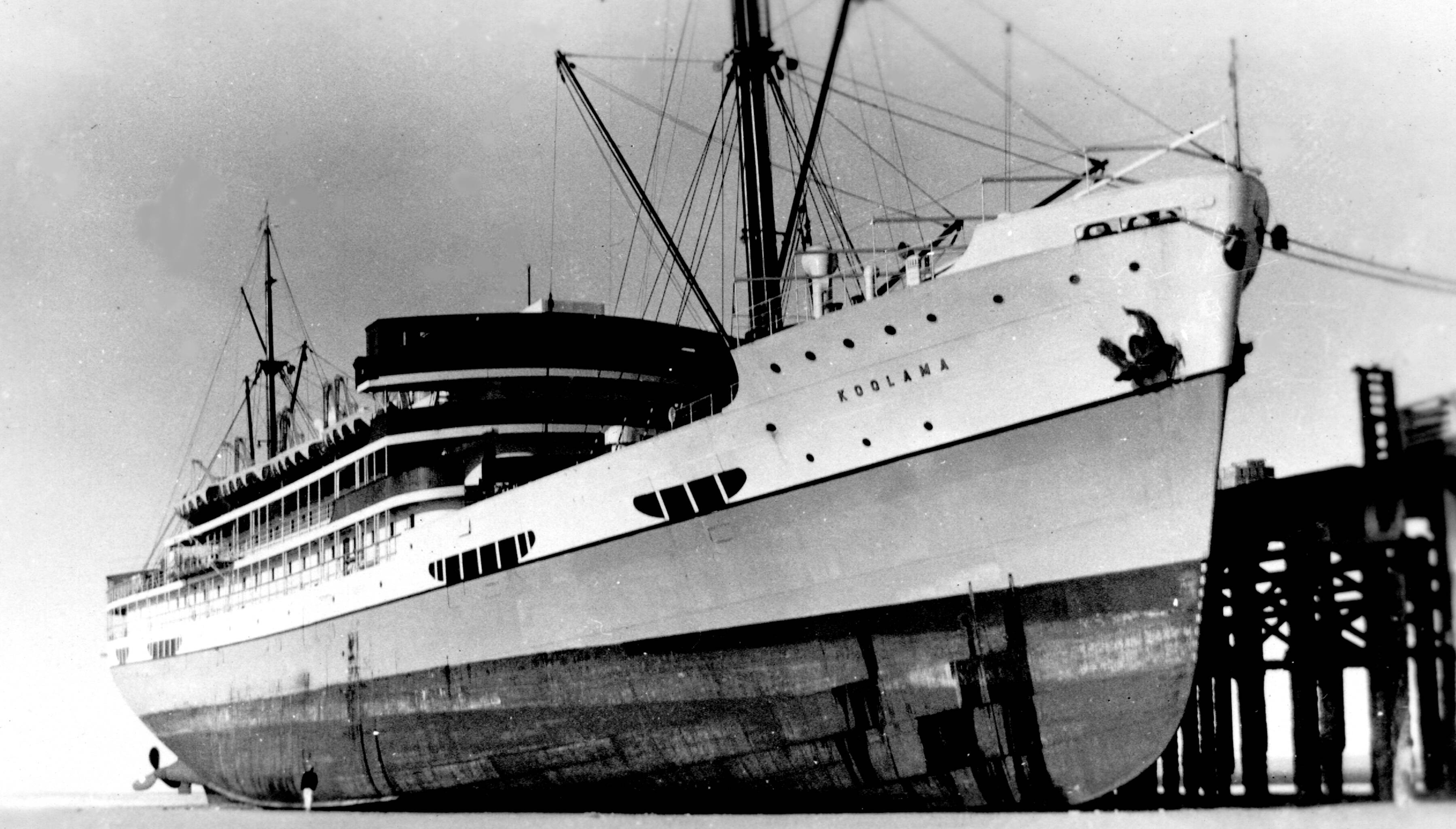
MV Koolama
A single bomb fell through wooden decking, struck a civilian passenger named Raymond Theodore Plummer, peeled away his scalp as far as his nose along with a piece of his skull, continued into the engine room, and detonated. Plummer's brain was partly exposed. He remained alive, albeit unconscious. Two other passengers were also injured. Captain Jack Eggleston, wounded himself, was already making his decision: he would beach the ship. It was 20 February 1942 — the day after Japan had bombed Darwin for the first time — and the war had arrived off the Kimberley coast.
Built for a Different World
Koolama was built in 1937 by Harland and Wolff in Glasgow, Scotland, at a cost of £250,000, for the Western Australian State Shipping Service. She displaced 4,068 tons, stretched 348 feet, and could carry 200 passengers, 90 crew, 500 live cattle, and a freezer hold of cargo. Her working life was the coastal route between Fremantle and Darwin, calling at ports along the way — a working ship for a working coast. In January 1942, with the Pacific war underway, she carried members of the ill-fated 8th Division to Ambon and West Timor, returning with Dutch refugees. The ship that came back was the same ship that had left Fremantle. The world she returned to was different.
The Attack
On 10 February 1942, Koolama sailed from Fremantle for Darwin carrying Army personnel, some convicts on work release, and regular civilian passengers. The ship was armed, though not well — a 50mm deck gun intended for submarines that couldn't be aimed upward, and Vickers machine guns on each side of the bridge. At 11:30am on 20 February, a Japanese Kawanishi H6K flying boat attacked near Cape Londonderry. Three or four bombs fell wide. Eggleston radioed the attack and kept course. Ninety minutes later, three more Kawanishis returned, led by Lieutenant Commander Tsunaki Yonehara, and attacked for thirty minutes. Three bombs hit the ship. One of them found Bluey Plummer. The ship was taking water at the stern with its steering and communications destroyed. Eggleston ordered evacuation by lifeboat and beached Koolama in what is now called Koolama Bay.
The Bay That Took Her Name
Survivors from the beached ship made their way overland toward the Drysdale River Mission at Kalumburu. The mission — itself soon to become a wartime RAAF base — received them and provided what assistance it could. One man died on the walk. He was the only fatality from the attack. Koolama herself remained beached in Rulhieres Bay, which would take her name. In 1947, salvagers attempted to refloat the hull and failed. In 1948 they managed it, but only to move the wreck clear of Wyndham harbour. The hull was towed out to sea and scuttled. A Marine Board of Inquiry had already, in 1942, exonerated all crew members of wrongdoing. Captain Eggleston, who underwent more than forty operations for his injuries, lived until the early 1980s.
The Koolama Incident
There is a second story attached to the Koolama — murkier and more contested. In the chaos of the evacuation and the overland march to the mission, allegations arose of a mutiny among some of the ship's company. The resulting inquiry cleared everyone, but the question simmered for decades. In 2003, documentary filmmaker Ingo Helbig made Malice or Mutiny: The Koolama Incident, examining whether what happened on that beach constituted insubordination, survival instinct, or something else entirely. The film did not resolve the question definitively. The Koolama sits at the intersection of several histories — the Japanese campaign against Australian coastal shipping, the role of the Kimberley missions in the war, and the particular pressure that mortal danger places on shipboard authority. The bay that bears her name keeps no opinion on any of it.
From the Air
Located at 15.45°S, 128.10°E off the Kimberley coast near Cape Londonderry, where the initial attack occurred. Koolama Bay (formerly Rulhieres Bay), where the ship was beached, is visible from low altitude on clear days. Flying at 3,000–5,000 feet reveals the complex inlet and bay system characteristic of this stretch of the WA coast. Nearest airport: Wyndham (YWYM), approximately 130 km to the southeast. The Kalumburu Mission (YKBU) lies approximately 100 km to the northwest.