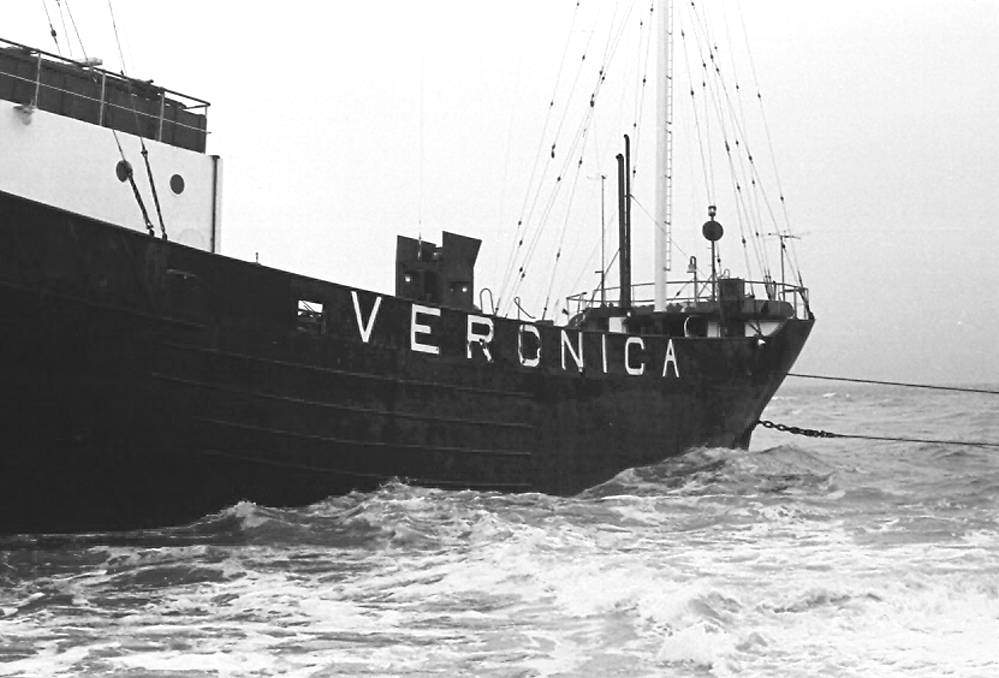
MV Norderney
At 20:54 on the evening of 2 April 1973, the anchors of a 50-metre former trawler called the MV Norderney lost their grip on the seabed. The ship had no engine. There was nothing to do but drift. By 23:30 the storm had pushed her high up the beach at Scheveningen, where the lifeboat Bernard van Leer had already collected her crew. Before they left, one of the men climbed below and pulled the crystals out of the radio transmitter. The Dutch authorities had long looked for an excuse to board the Norderney, and an anchored radio ship grounded inside Dutch territorial waters would have been the perfect one. Without those crystals, by the strict letter of broadcasting law, the Norderney was no longer a radio ship - just a shipwreck. Radio Veronica had been off the air for hours by the time the police arrived.
A Trawler from Hamburg
The ship had not begun as a pirate. She was built in 1949 at Hamburg-Finkenwerder as the MV HH 294 Paul J Müller, a working trawler that spent six years fishing the waters around Iceland. In 1956 she was sold to a Lower Saxony fishing company and re-christened NC 420 Norderney. By 1960, only eleven years old, she had outlived her usefulness as a fishing vessel and was sold to a Dutch scrap dealer. In early 1964 the three Verweij brothers - the management of a renegade Dutch radio station called Radio Veronica - bought her instead. Their existing radio ship, a 1911 German lightvessel called Borkum Riff, was worn out and too small. Norderney was the replacement. At a Zaandam shipyard the trawler was rebuilt: two 25-metre wooden antenna masts, a large studio, a separate transmitter room, and eventually a 10-kilowatt Continental Electronics 316 C medium-wave transmitter with a second one installed later as backup.
Outside the Three-Mile Line
Offshore radio was a clever, brittle compromise. By anchoring outside Dutch territorial waters - six nautical miles from the coast - Radio Veronica was technically broadcasting from nowhere, and Dutch broadcasting law could not touch her. From November 1964 onward, the Norderney rolled gently at anchor in the North Sea and pumped pop music into a country whose state broadcasters preferred classical performances and serious programming. The ship's name was painted in huge letters along her hull, copying the convention of the lightvessel she had replaced, even though she was not a lightship. To listeners on shore she was a fixed star: 538 metres on the medium wave, mornings, afternoons, nights. The DJs lived aboard for weeks at a stretch, supplied by tender, broadcasting through gales.
Stranded, Refloated, Defiant
After the April 1973 storm, the wrecked Norderney sat high on the Scheveningen beach for five days while crews tried to wheel her bow back towards the sea. Veronica's management, in a remarkable show of cross-rival cooperation, accepted an offer from competitor Radio Caroline to use her ship Mi-Amigo as a temporary transmitter - on condition that Veronica's engineers help fix Caroline's equipment first. A demonstration had already been planned in The Hague for 18 April, on the Binnenhof, to pressure parliament against pending legislation that would outlaw offshore broadcasting. In the early hours of that very morning, tugboats finally pulled Norderney back into open water and towed her to her usual anchorage six miles off the coast. By 16:00 - while the demonstrators chanted in The Hague - Radio Veronica was back on the air on her own 538 frequency, plus a 259-metre wavelength carried by Mi-Amigo. It was a small, perfect act of defiance.
Wilhelmus and Silence
The defiance did not save the law. New legislation made transmitting from international waters a Dutch crime, and made advertising via an offshore station illegal too - which choked off the revenue that kept the ships afloat. At 18:00 on 31 August 1974 the Norderney went silent. The last hour was painful and beautiful in equal measure. A clock ticked down on air. A visibly emotional Rob Out, one of the station's directors, said into the microphone that a part of Dutch democracy was dying with the broadcast. The station played a portion of the Wilhelmus, the Dutch national anthem, and a fragment of the main Veronica jingle. Then the crystal came out of the transmitter, and the noise ended. The people behind Veronica regrouped on land as the Veronica Omroep Organisatie, received a broadcasting licence in 1976, and twenty years later left the public system to become a commercial station - exactly the role they had played at sea.
Afterlife of a Pirate
The Norderney did not sink with her cause. She remained at anchor for nearly a year after the last transmission, the subject of constant rumours that Veronica would somehow return from the deck. On 11 August 1975 tugboats finally towed her into IJmuiden harbour, with old Veronica DJs and director Bull Verweij aboard for the homecoming. From there she went to Zaandam and later Dordrecht. There were plans to turn her into a museum. Instead she became a disco. Over the following decades the former pirate served as a nightclub at various moorings around the Netherlands - the antenna masts gone, the transmitter rooms repurposed for dancefloors. In 1990 the VOO hired her back for one celebratory day, anchored off Scheveningen, to host live radio and television marking thirty years of Veronica. The crystal stayed out of the transmitter. The story, like the music, had moved ashore.
From the Air
Coordinates 52.401°N, 4.890°E, at the NDSM shipyard site in Amsterdam-Noord where the Norderney is moored as a floating nightclub and restaurant. From 1,000-2,500 ft AGL the ship is identifiable by her distinctive radio-ship profile - though her tall 25-metre antenna masts were removed in her nightclub years. Schiphol (EHAM) is about 7 nm southwest. Lelystad (EHLE) lies east across the IJmeer. The historical anchorage off Scheveningen, where she broadcast for a decade, was roughly six nautical miles west of the coast at 52.10°N - that empty patch of North Sea where Dutch popular radio was effectively invented.