MVRDV
The acronym should be straightforward: Maas, Van Rijs, De Vries, the three Dutch architects who founded the firm in 1993. But the logo - the angular type, the heavy contrast - came from somewhere stranger. Jacob van Rijs was, at the time, listening to a lot of KMFDM, the German industrial-metal band whose name was a deliberately impenetrable acronym of its own. He wanted his firm's identity to feel like that: bluntly futurist, slightly aggressive, impossible to ignore. Three decades later, MVRDV is the firm responsible for some of the most photographed buildings on the planet, and the typography still looks like a tour poster.
The Markthal Arch
Walk through Rotterdam's Blaak district and you cannot miss it: a horseshoe arch the size of a hangar, glassed at each end, combining housing with shopping inside a single curving shell. The Market Hall, completed in 2014 after five years of construction, packed apartments into the arch above and food stalls and restaurants across the floor below. Critic Rob Bevan of Architectural Review dismissed it as part of Rotterdam's "stodgy diet of instant icons" and indicative of "noodle-headed re-shaping and architectural gymnastics," though he conceded that the building had "brought vigour to a corner of the city demanding it." The Dutch verdict was simpler: queues out the door from opening day. A decade on, the Markthal is one of Rotterdam's most photographed buildings and the centerpiece of the firm's reputation for unapologetically big shapes.
Three Students With Government Grants
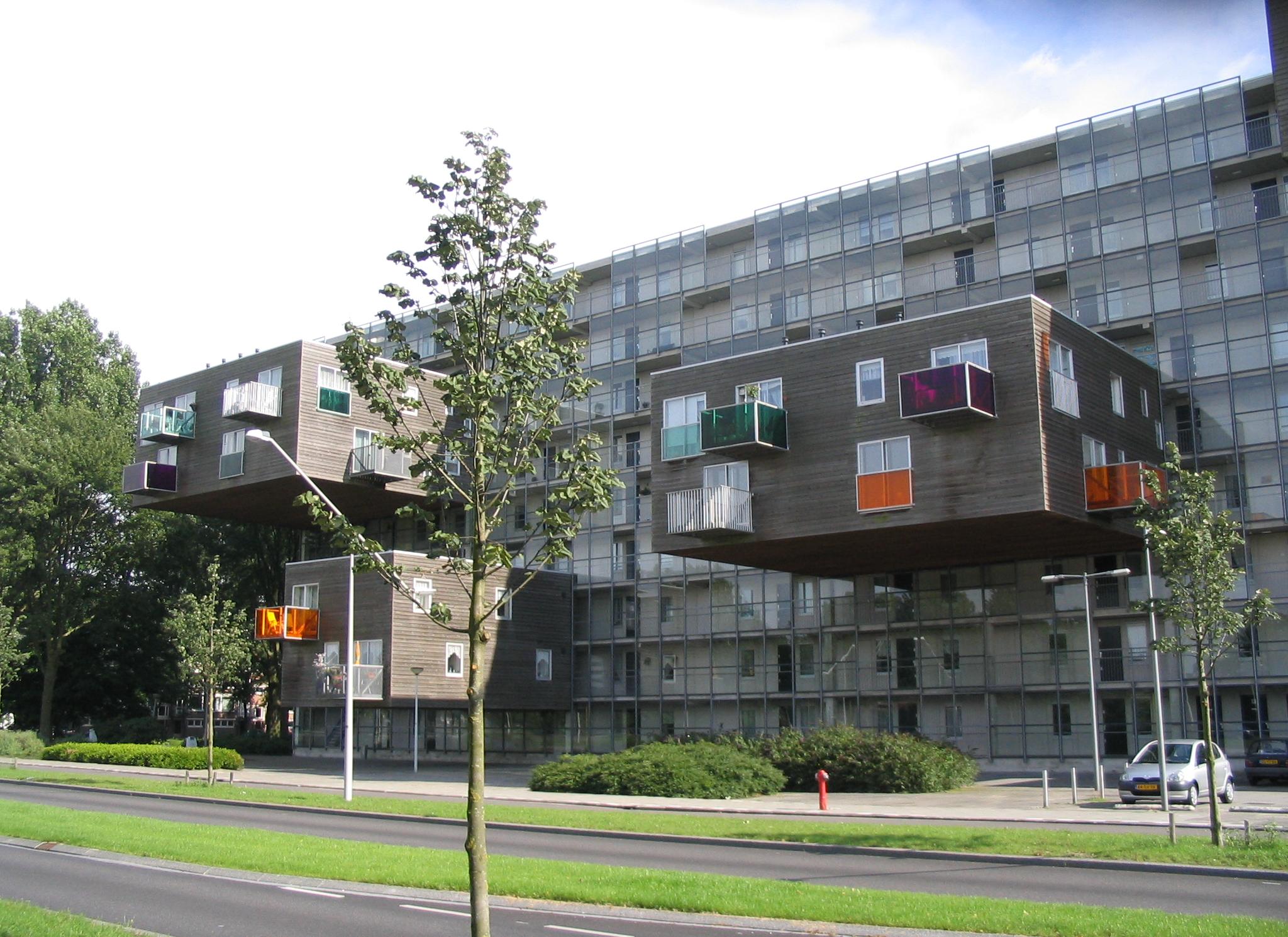
Winy Maas and Jacob van Rijs both worked at OMA, Rem Koolhaas's Rotterdam office, before going independent. Nathalie de Vries started at Mecanoo, the Delft firm down the road. All three studied together at Delft University of Technology and won the Europan 2 competition in 1991 with a project called Berlinvoids. When they founded MVRDV two years later, all three received Dutch government grants to support young architects starting practices - a piece of cultural policy that, however quietly, has shaped the country's architectural exports for decades. Their first commission was the VPRO public broadcasting building in Hilversum, a structure that looked like a stack of geological strata that had been folded and pinched. Maas later described his firm's early work as "intellectual responses" to questions Koolhaas had been asking. Koolhaas's preoccupation with density - the subject of his book Delirious New York - became MVRDV's preoccupation too, distilled into their book FARMAX, an excursion on what happens when buildings stack as high as engineering allows.
The Eye in Tianjin
In Tianjin, on China's northeastern coast, MVRDV completed in 2017 a building that took only three years from first sketch to opening - the firm's fastest realized project. The Tianjin Binhai Library, nicknamed The Eye, fills five stories with floor-to-ceiling terraced bookshelves that flow like topographic contours across the interior. At the center, a 110-seat auditorium sits inside a luminous white sphere that appears, through the building's glass facade, like a giant pupil. The Newsweek headline at the opening called it "every book lover's dream." The actual books, however, are mostly props: many of the upper shelves are decals printed to look like spines, because building codes and fire access prevented stacking real books that high. The library that broke the internet is, at the highest levels, a beautiful lie. The lower floors hold a real, working collection of 1.2 million volumes.
When the Mound Failed
Not every project lands. In 2021, Westminster City Council in London commissioned MVRDV to design a temporary 25-meter mound that would rise around the Marble Arch, encouraging tourists to climb it for views over Hyde Park. The result was a critical disaster. Visitors found the grass already dying, the views underwhelming, the experience grim enough that the council refunded ticket prices and dismantled the structure within months. MVRDV publicly accepted blame for the architectural result but pointed to the council for watering down the design, excluding the firm from construction oversight, and ignoring its advice. Critics still called the Mound London's worst attraction, a pile of rubble. The firm filed the lesson alongside its triumphs and kept moving. In Rotterdam, the Depot opened just months later. In Tirana, MVRDV converted a dictator's pyramid into a youth center. Some buildings work. Some, very publicly, do not.
From the Air
MVRDV's office at Achterklooster sits at 51.9236 N, 4.4925 E in central Rotterdam, near the Markthal in the Blaak district. The firm's most recognizable Rotterdam works - the Markthal, the Depot Boijmans Van Beuningen, Didden Village rooftop housing - all lie within a 2 km radius. Nearest airport is Rotterdam The Hague (EHRD), 6 km northwest. The Markthal's horseshoe arch is one of the easier modern Rotterdam landmarks to identify from cruising altitude, particularly when sunlight catches its silvered exterior.