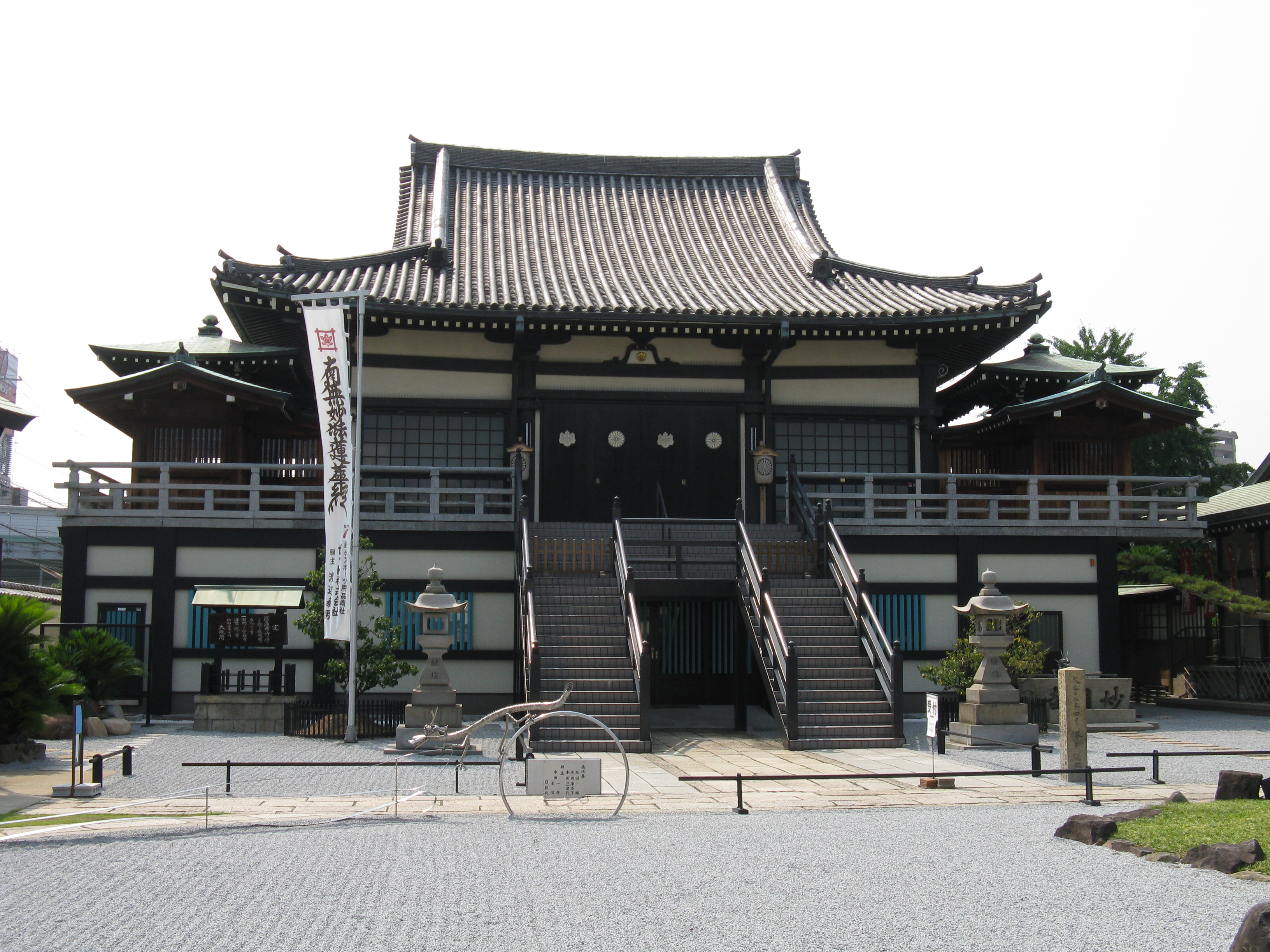
Myokoku-ji
Every night, a voice drifted through Azuchi Castle: 'Take me back to Myokokuji.' The source was not a ghost but a tree -- a cycad, over a thousand years old, that the warlord Oda Nobunaga had uprooted from a Buddhist temple in Sakai and transplanted to his fortress. When his men tried to cut it down to silence the disturbance, the tree bled. It writhed like a wounded snake. Nobunaga -- who feared nothing human -- sent the tree back. That cycad still stands in the grounds of Myokoku-ji, a Nichiren temple in Sakai, Osaka Prefecture, where it was designated a national natural monument in 1923. But the tree is only half the story. The other half involves French sailors, samurai swords, and a diplomatic crisis that played out on the temple's front steps.
Built, Burned, Built Again
Myokoku-ji has been destroyed and rebuilt three times, each occasion linked to a defining moment in Japanese history. Founded by the priest Nichiko Shonin in 1592, the temple measured 109 by 182 meters and served as one of the head temples of the Nichiren sect. Its first destruction came in 1615 during the Summer War of Osaka, when Toyotomi clan forces burned it to the ground on the rumor that their enemy, Tokugawa Ieyasu, was hiding inside. The buildings were reconstructed in 1628. The second destruction arrived from the sky in July 1945, when American bombing leveled the temple along with much of Sakai. The present buildings were erected in the autumn of 1973, marking the third incarnation of a temple that seems to invite catastrophe and outlast it every time.
The Cycad That Frightened a Warlord
The Great Cycad of Myokoku-ji is over 1,100 years old. In 1580, Oda Nobunaga -- the ruthless daimyo who came closer than anyone to unifying Japan during the Sengoku era -- had the tree dug up and brought to Azuchi Castle in what is now Shiga Prefecture. According to temple tradition, the transplanted cycad began calling out at night, demanding to be returned. An eerie atmosphere settled over the castle. When Nobunaga ordered his men to cut the tree down, it bled from the blows, slumped as if fainting, and took on the appearance of a great writhing snake. Even Nobunaga lost his nerve and sent it back to Myokoku-ji. The priest Nichiko Shonin recited a thousand Hokkekyo sutras over the dying tree. In a dream, a figure with a man's face and a serpent's body appeared and made three promises: to ease the pain of childbirth, to relieve hardship, and to bring happiness to the poor. Shonin named this guardian deity Ugatoku-ryujin and built a hall on the spot. On December 13, 1923, the cycad was designated a national natural monument.
Blood on the Temple Steps
On March 8, 1868 -- just weeks into the Meiji Restoration -- roughly a hundred French sailors from a warship anchored offshore came ashore at Sakai Port. They wandered into temples and shrines, alarming local women and children who had never seen foreigners. Samurai of the Tosa clan, assigned as the port's guardians, confronted the sailors but could not communicate across the language barrier. When the French took a Tosa clan flag, the samurai opened fire, killing thirteen sailors. The French returned fire and retreated to their boats. The incident exploded into an international crisis. France demanded compensation, and the Japanese government, desperate to maintain its new standing among Western nations, ordered twenty of the involved samurai to commit seppuku.
Eleven Before Sundown
On February 23, 1868, in front of Myokoku-ji with witnesses from both France and Japan present, the condemned samurai began the ritual. One by one, they cut open their stomachs. By the time eleven had died, the sun had set. The French witnesses, shaken by what they were seeing, abruptly left the temple grounds. The remaining nine samurai were ordered to stop and were later exiled to Tosa, modern-day Kochi Prefecture. Because Myokoku-ji held the special status of a temple designated by Imperial Order, the bodies of the eleven could not be buried on its grounds. Their remains were moved to the nearby Hojuin Temple, where they rest today. A memorial monument now stands at Myokoku-ji to honor the Tosa samurai -- men caught between the old feudal code and the new international order that Japan was racing to join.
From the Air
Located at 34.581N, 135.481E in the city of Sakai, Osaka Prefecture, on the southern edge of the greater Osaka metropolitan area. The temple sits in a dense urban neighborhood and is not individually distinguishable from altitude, but Sakai's position south of central Osaka along Osaka Bay provides good orientation. Nearest airports: Kansai International Airport (RJBB) approximately 20nm south, Osaka Itami (RJOO) approximately 15nm north. The Mozu Kofun cluster with its distinctive keyhole-shaped tombs lies roughly 1km to the south and serves as an excellent visual landmark for locating this area.