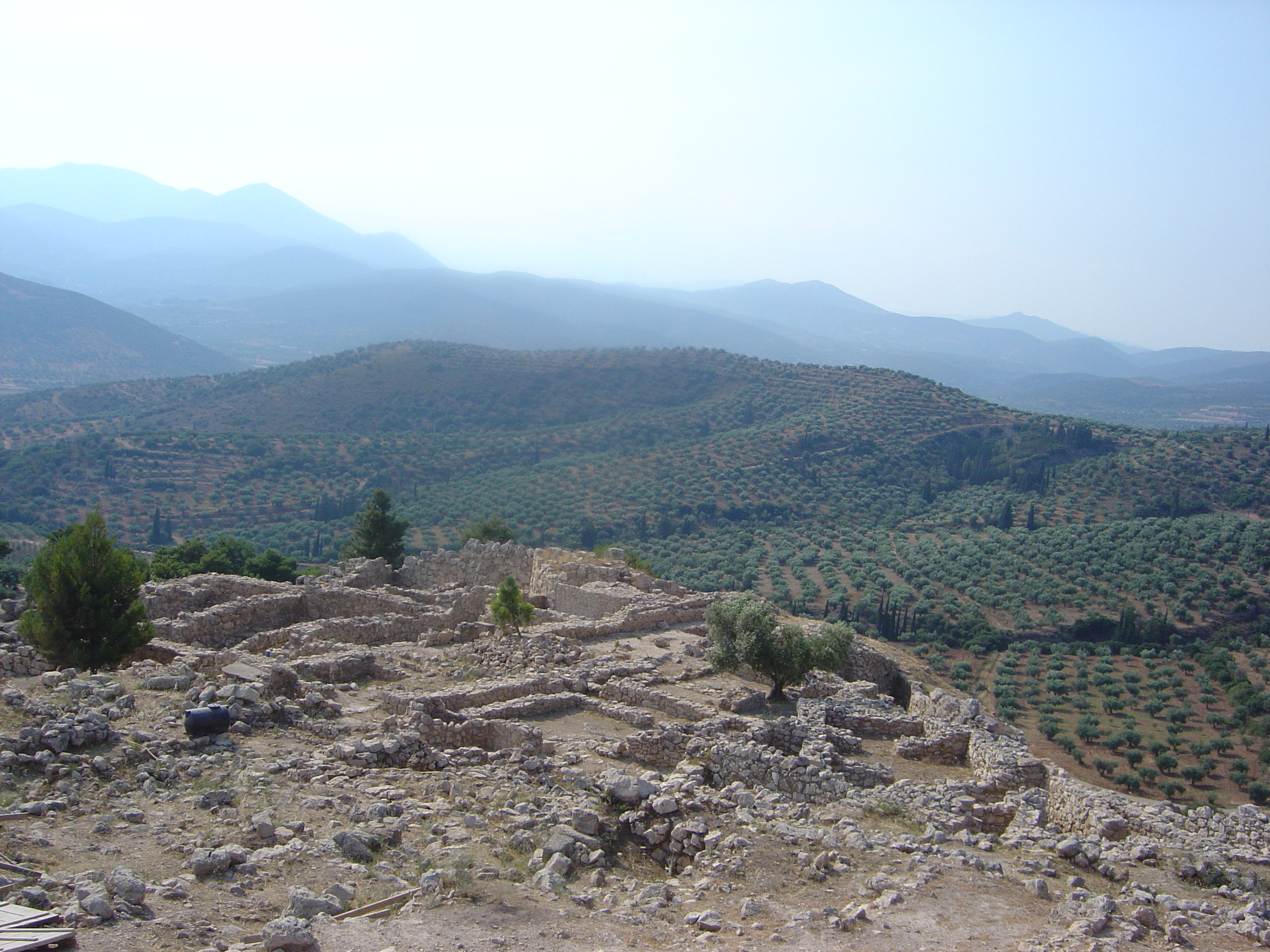
Mycenae
The walls came first. Long before any of the names: long before Agamemnon, long before Homer, long before Heinrich Schliemann's pickaxe broke ground in 1874. The walls of Mycenae were built around 1350 BC out of limestone blocks the size of small cars, fitted together without mortar, some of them weighing more than ten tons. By the classical period, eight hundred years later, the citadel was already in ruins, and the Greeks who came to gawk at it could not believe human beings had laid those stones. Only the Cyclopes, the one-eyed giants of myth, could have moved such things. The walls have been called Cyclopean ever since, and the term is still used for any Bronze Age masonry built at this superhuman scale.
Through the Lion Gate
The most famous entrance in Bronze Age Greece is a low rectangular gateway capped by a triangular relief showing two heraldic lions, or perhaps lionesses, flanking a pillar. The lions' heads are gone, probably knocked off in antiquity, but their bodies remain, three meters tall, carved into a single block of grey limestone weighing twenty tons. The Lion Gate dates to about 1250 BC, and it is the oldest monumental sculpture in mainland Europe. To pass beneath it is to walk through stone that was already ancient when Athens was a village. The relief is meant to project power. Whoever ruled Mycenae in the late thirteenth century BC wanted every traveler arriving at the citadel to understand who they were dealing with, and to remember the encounter.
Grave Circle A and the gold
Just inside the Lion Gate, on the right, lies a circle of upright stones marking a royal cemetery. Six shaft graves were sunk here around 1600-1500 BC, three centuries before the gate above them was carved. Inside those shafts, when Heinrich Schliemann opened them in 1876, lay the bodies of Mycenaean nobility laid out with their wealth: bronze weapons inlaid with silver and gold, drinking cups beaten from sheet gold, jewelry, dagger blades worked with hunting scenes in three colors of metal. And on five of the men's faces, gold funerary masks, hammered into rough portraits of features the masks barely fit. One of those masks Schliemann famously identified as the death mask of Agamemnon, the king who led the Greek expedition against Troy in Homer's Iliad. He was wrong. The mask dates to roughly 1550-1500 BC, three or four hundred years before the traditional date of the Trojan War. Schliemann himself, late in life, came to admit the mistake, joking, 'So this is not Agamemnon, these are not his ornaments? All right, let's call him Schulze.' The name 'Mask of Agamemnon' has stuck anyway. The gold remembers a real king. We just do not know which one.
The Treasury of Atreus
Down the slope from the citadel, hidden in the hillside, sits a stone-built tomb so vast that travelers in the eighteenth century mistook it for a treasury. It is in fact a tholos tomb, beehive-shaped, dug into the hill and faced with a corbeled stone dome 13.2 meters high. For more than a thousand years, until the Roman period, the Treasury of Atreus held the largest corbelled dome in the world - a distinction it still holds. Its lintel is a single block of limestone weighing roughly 120 tons, the heaviest stone ever moved by Bronze Age engineers anywhere. The tomb is empty now; whoever was buried inside was looted long before any modern visitor reached the site. But the dome remains, dim and echoing, the ceiling forty feet above your head, the seams between the corbeled stones laid so precisely that an entire civilization's mathematics is implicit in the geometry. There are nine other tholos tombs at Mycenae. This one is the masterpiece.
What collapsed
Around 1200 BC, Mycenae burned. So did Tiryns nearby, so did Pylos in the southwest, so did most of the great Mycenaean centers, in a wave of destruction that historians call the Bronze Age Collapse. Whether the cause was earthquake, internal revolt, foreign invasion, drought, or some combination still argued, the result was clear: the palace economy disappeared, the writing system called Linear B was forgotten, and Greece entered three centuries of poverty during which we have almost no records at all. When literacy returned, in the eighth century BC, it returned with the Phoenician alphabet and with Homer, who sang of Mycenae as a ruin already, a city of legend, the place where Agamemnon had once been king. The walls were still standing. The walls are still standing. UNESCO listed Mycenae and Tiryns together as a World Heritage Site in 1999.
From the Air
37.731 N, 22.756 E. Mycenae sits on a low hill in the northeast Peloponnese, about 90 km southwest of Athens, 11 km north of Argos, and 48 km south of Corinth. The citadel rises 274 m above sea level, with Mount Profitis Ilias and Mount Sara behind it to the east. Best viewed from 2,000-4,000 ft AGL where the Cyclopean walls and the surrounding plain of the Argolid are clearly visible. Nemea (LGNN), Kalamata (LGKL), and Athens (LGAV, 90 km northeast) are usable fields. Light traffic over rural Argolid; afternoon thermals can be brisk over the ridges in summer.